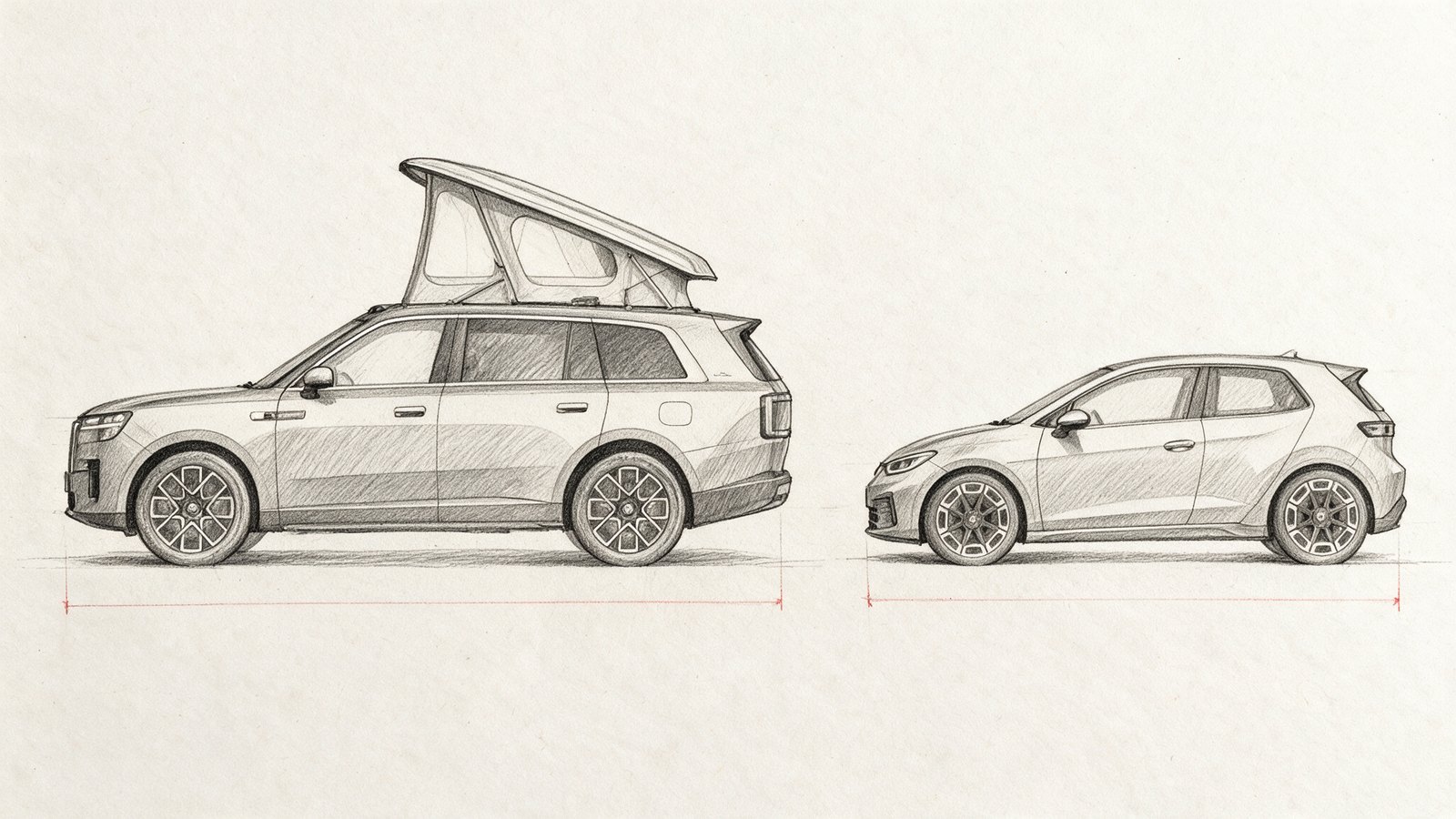
Forty thousand, two worlds.
±€40,000. A few thoughts on how we got here.
On 7 September 2026, Xiaomi launched an SUV in China that turns into a camper at the press of a button. The roof rises electrically, there is a 1.87-metre bed up there, the floor heats on three settings, and somewhere in the upholstery sits a thirty-inch projector. It costs 299,900 yuan, about 38,600 euros.
That same month, in Germany, a Volkswagen ID. Polo with the big battery and the top trim costs 36,995 euros. The sporty version is announced at around 39,000. The car is 4.05 metres long, has a sensible boot and a retro skin in the infotainment that makes the dials look like a Golf I from the eighties.
Same money. Two worlds.
And here is the part that is hardest to swallow: five years ago, Xiaomi did not make cars at all. It made phones.
-
2021 The announcement.
- On 30 March, Xiaomi announces it is entering the car industry. Reference ↗
No plant, no model, no chassis engineers.
-
2024 The first car.
- On 28 March, exactly three years after the announcement, it launches its first model, the SU7. Reference ↗
- On 3 April it hands the first cars over to customers, at the factory in Beijing. Reference ↗
- By the end of the year it delivers over 135,000. Reference ↗
-
2025 The second model.
- On 26 June it launches the YU7 and takes 289,000 orders in the first hour. Reference ↗
-
2026 The third family.
- On 7 September it launches the SkyNomad, with a range extender, a technology it had never built before. Reference ↗
Three model families in two and a half years, starting from nothing. Over the same period Volkswagen, which has been making cars since 1937, pushed the electric Golf successor from 2028 to 2030.
So it is not only a question of money. It is a little more complicated.
Let us take a closer look.
What follows comes in three parts. First, where the price gap comes from: forty years of joint ventures with China, fifteen of industrial policy, the batteries and the chain behind them. Then what Europe got wrong on its own - the decade lost to software, and why Xiaomi came from the other side. And last, who pays: plants left without models, loans stretched ever longer, and what we choose here in Moldova, where nobody is pushing us.
HOW LONG A NEW MODEL TAKES TO DEVELOP
The difference does not come from geniuses, it comes from method: work in parallel instead of in sequence, validate more on the computer than on sheet-metal prototypes, and keep the supplier in the same room as the engineer. The best test of that explanation is that Europeans become fast precisely when they develop in China. Volkswagen brought out a model together with XPeng in twenty-four months, and Renault built the new electric Twingo in twenty-one.
What we are actually comparing
Before anything else, a matter of fairness: this is not apples to apples, and it is more honest to say why from the start. The Chinese car is not purely electric, it has a range extender. It is 5.28 metres long against the German's 4.05. Its price includes 13% VAT, the German's 19%. And on top of that, if it came to Europe it would pay duty at the border.
Except that the drivetrain difference, as a way of saving on production, does not favour the Chinese car. Quite the opposite. The camper carries, in the same car, two electric motors making 310 kW, a 76 kWh battery and a 1.5-litre petrol engine that never turns the wheels, only generates electricity. Three drivetrains that have to agree with one another, plus separate cooling for each, plus a fuel tank, plus an exhaust, plus software deciding millisecond by millisecond where the power comes from.
The Polo has one 155 kW motor, a 52 kWh battery and nothing that burns anything. It is the simple car in this comparison, not the complicated one. To be precise: more parts, more engineering, same money.
And since we are on the subject of apples: let us take a clean one. Xiaomi sells, in the same country, a purely electric car, the YU7. No combustion engine, no tank, exactly the same drivetrain category as the Polo.
- YU7 253,500 yuan, about 32,600 euros. One rear motor, 235 kW, a 96.3 kWh lithium-iron-phosphate battery, 835 km CLTC.
- YU7 Pro 279,900 yuan, about 36,000 euros. Two motors, all-wheel drive, 365 kW, the same battery, 770 km.
- YU7 Max 329,900 yuan, about 42,500 euros. 508 kW, a 101.7 kWh nickel-manganese-cobalt battery, 760 km, 0-100 in 3.23 seconds.
- YU7 GT 389,900 yuan, about 50,200 euros. 738 kW, 2.92 seconds.
The middle version, the Pro, costs the same as an ID. Polo with the big battery and the top trim. At an almost identical price: 96.3 kWh against 52, all-wheel drive against front only, 365 kW against 155, and five metres of length against four.
The simplest thing, though, is to see them. Below, the Chinese camper and the German hot hatch, both filmed by other people, not by me.
One more thing before going further: the Chinese price is not paid in full by the customer. In the second quarter of 2026, Xiaomi's car division lost 2.6 billion yuan, nearly 315 million euros, in three months. For now the low price is underwritten by shareholders, not by efficiency alone.
And the comparison is still missing the part no chart can show yet: how long it lasts. Xiaomi has been building cars since 2024. There is no Xiaomi with three hundred thousand kilometres on it that you can ask how it went, there are no ten-year failure statistics, and there is no service network in Europe. A Volkswagen has all of that, including the unpleasant part: everyone knows exactly what breaks on it and what it costs.
What can be compared are the warranties, because that is where each manufacturer bets its own money. Xiaomi gives 5 years or 100,000 kilometres on the whole car and 8 years or 160,000 on the battery, motors and range extender, and if the battery catches fire from a manufacturing defect it promises a new car. Volkswagen gives 2 years on the car, the European standard, and 8 years or 160,000 kilometres on the battery. On paper, the Chinese car covers more. But a warranty is a promise, and a promise is worth exactly as much as the company making it, ten years from now.
And yet the comparison says something true. Not about the product, but about the cost of making a product. A bigger Chinese machine, with more technology on board, lands at the same price as a much smaller European one. The rest of this essay is about how that happened, and who pays.
The decade Europe cashed in
The story begins in 1984, when Volkswagen signs its first joint venture in China. The rule is simple and holds for thirty years: you get access to the market, you hand over technology, and the factory is owned fifty-fifty with a local partner. Westerners accepted because the market was vast and young.
After China joined the World Trade Organization in 2001, the country motorised. Sales climbed from a few million to over thirty million a year. For Europeans and Americans, China became what nobody had ever been: the money machine. In 2015, from the Chinese joint ventures alone, Volkswagen was taking 5.2 billion euros of profit a year. That money funded investment in Germany, dividends and peace of mind.
Here is the trap, and it is not about laziness. The local partner was learning while the European was cashing in. Nobody asks what happens when the pupil finishes school, as long as the school brings in five billion a year.
How big that school was shows up best in deliveries.
China's policy, not luck
The second half of the explanation is the one most often skipped: in China, nothing that happened was organic. It was industrial policy, held by the state for fifteen years with the same hand.
-
2009 The money.
- The state starts subsidising electric cars and electric buses, first in pilot cities. Reference ↗
-
2015 The plan.
- The ten-year Made in China 2025 plan puts batteries and the electric car on the state's short list. Reference ↗
-
2018 The obligation.
- The credit mandate arrives: whoever sells petrol cars must also build electric ones, or buy credits from someone who does. Reference ↗
-
2019 The competition.
- Tesla opens its Shanghai plant, the only foreign manufacturer without a local partner. Reference ↗
It was administered like medicine.
The result shows best in a single chart. In five years, half the Chinese market moved to the plug.
When the home market filled up with capacity, the surplus went out into the world. In 2020, China was the sixth largest car exporter. In 2023 it passed Japan and became the first. In 2026 it beat its annual record in eight months: over 6.2 million passenger cars, against about 6 million in all of 2025.
The reversal
The most brutal figure is not the export number, it is the home market. In 2020, local brands held less than four tenths of China. Today they hold almost three quarters, and in the electric segment they are past 85%.
This is not one brand's problem. Every foreign carmaker lost in the same decade, for the same reasons: they stayed with the combustion engine in a market that had moved to electric, and they arrived with the right product three years late.
MARKET SHARE IN CHINA, THEN AND NOW
When your share falls in a market where you were selling at a margin, profit does not fall proportionally. It collapses.
In 2025, Volkswagen deliveries in China fell 8%. In the second quarter of 2026, by 36.6%. The Japanese went from a 23.1% share in 2020 to 9.8% in 2025. General Motors, which was making two billion dollars a year in China in 2018, went into loss in 2024 and 2025.
The moat moved, it did not disappear
The underlying explanation is that the electric transition moved the competitive advantage from one ground to another. A hundred years of metallurgy, injection, gearboxes and fine engine tuning became, almost overnight, niche skills. In an electric car, the battery and power electronics make up as much as a third of the cost.
And the battery is exactly where China built deepest. The world price of a pack has fallen 91% in fifteen years, but the Chinese average for 2025, 84 dollars per kilowatt-hour, sits below the world average.
Underneath the price sits something harder to copy: the refineries, the chemistry and the machinery. This is not won with one good model, it is won with twenty years of boring investment.
HOW MUCH OF THE WORLD CHAIN RUNS THROUGH CHINA
The International Energy Agency estimates that a small electric car is built for nearly ten thousand dollars less in China than in Germany. Not because of wages, but because of the whole chain. And the European answer to that figure was geographic, not technological: the ID. Polo is built in Martorell, in Spain, where over three billion euros were invested, not in Germany.
The decade lost to software
This is the part that amuses and annoys me in equal measure, because it is a mistake of pride, not of engineering. Companies that had bought their electronics and software from suppliers for decades suddenly decided to write it all themselves, for the entire group.
Volkswagen built its own division, CARIAD, in 2020. It did so right after paying over 30 billion dollars for Dieselgate: fines, compensation and buybacks, for some 11 million cars with rigged software. In other words, a company that had just come out of a scandal caused by its own software decided the answer was to write even more software, on its own. The result, in operating losses, looks like this.
Over nine billion euros of losses in four and a half years, and Handelsblatt puts the total cost of the division at around fourteen billion. Collateral damage: the electric Porsche Macan and Audi Q6 e-tron delayed by over a year, the group's new platform pushed from 2026 towards the end of the decade, and the electric Golf successor moved from 2028 to 2029 and then to 2030.
The ending is ironic. After spending all that to do it alone, Volkswagen bought its software outside: a joint venture with Rivian, an American manufacturer a tenth its size, worth up to 5.8 billion dollars. In China it works with XPeng. The second-generation in-house project was cancelled.
The obvious question is why they did not go straight to someone who actually makes software, meaning Google. The answer has three parts, and none of them is comfortable. Google services are paid per car, so they are not free. Whoever takes them gives up part of the interface and part of the data, which means part of the customer relationship. On top of that, Google does not exist in China, so any global carmaker needs a second software stack anyway.
What these companies are doing now is a compromise: take the operating system from Google and try to keep the customer. General Motors uses Android Automotive but dropped CarPlay precisely to own the data and the subscriptions. Volvo, Polestar, Porsche, Mazda and Hyundai are on the same road. Mercedes and Toyota build in-house. BMW sits in between, on open Android, without Google services.
The effect on the customer I can see in my own garage, without reading a single report. A BMW from 2011 needed open-heart surgery, with a new unit and coding, to get what any phone had known for years. A Polestar from 2024 gets it over the air, at night, without asking me anything.
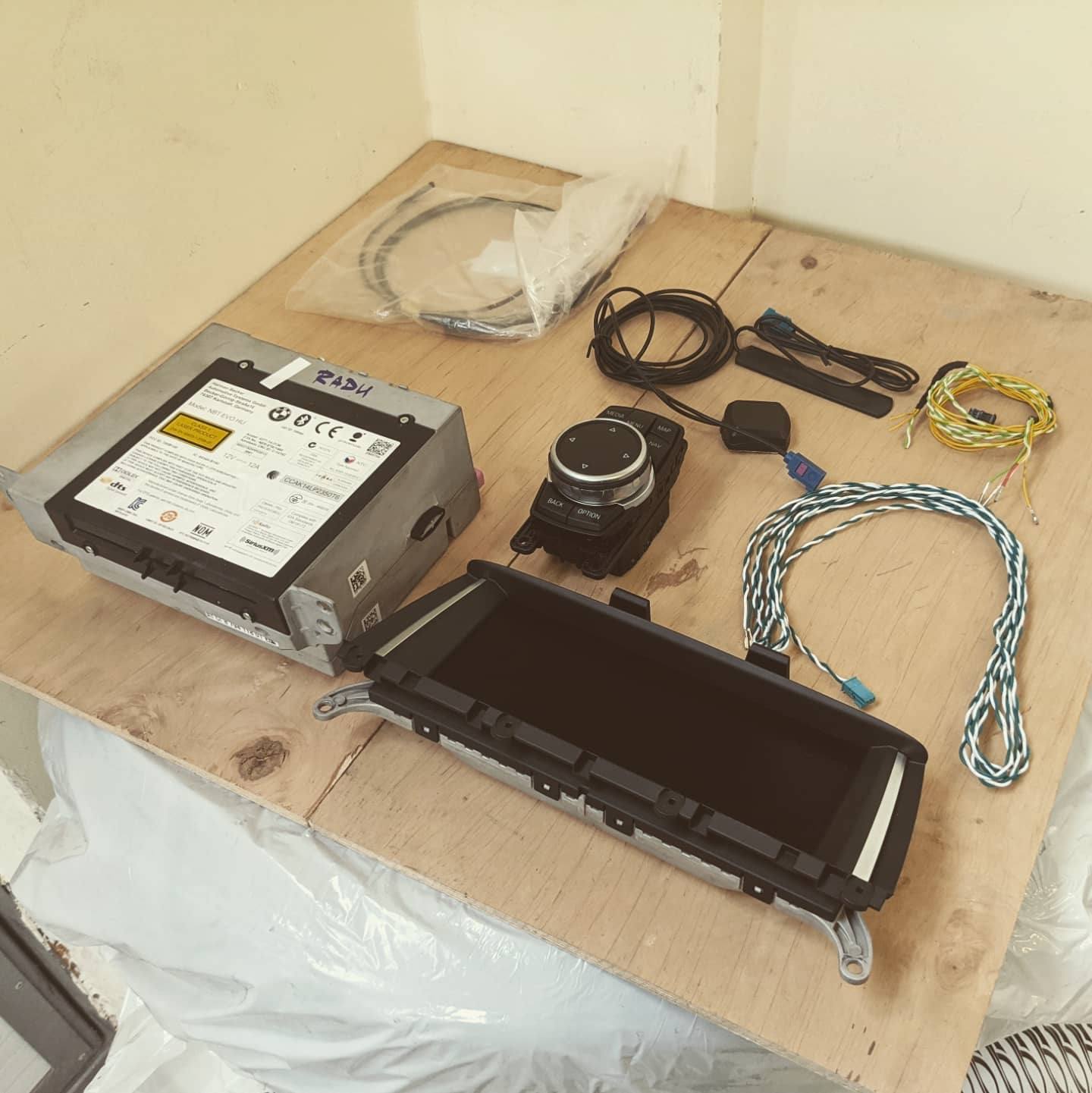
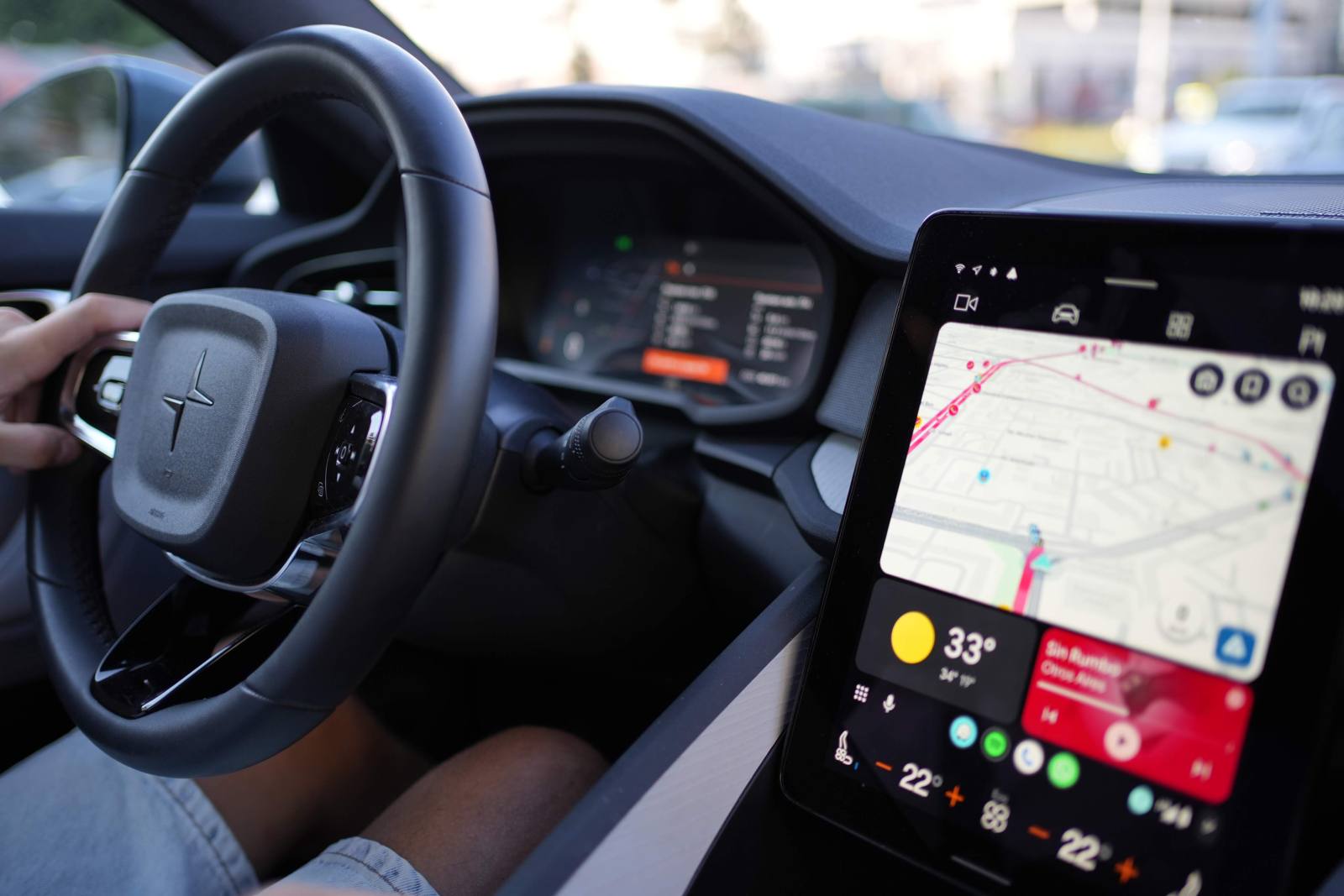
A car that stops getting updates ages twice: once mechanically, once conceptually.
Xiaomi came from the other side
And here is the asymmetry I find most instructive in the whole essay. It is not that one is a software company and the other is not, because both make hardware. The difference is what they set out with. Volkswagen had to build from nothing a division that would write the software for the entire group, inside a house used for decades to buying its electronics from Bosch and Continental. Xiaomi had already spent fourteen years doing exactly what the car demanded: its own software, for its own devices. One had to start, the other simply continued.
Xiaomi was founded in April 2010, by a man who until then had run a software company. Their operating system appeared on 16 August 2010. The first Xiaomi phone appeared on 16 August 2011, exactly a year later. The software came before the hardware, not the other way round, and it stayed that way for fourteen years.
And when the car arrived, it did not arrive into a void. In October 2023, five months before the first delivery, Xiaomi launched HyperOS: a single system holding the phone, the home and the car under one architecture. The strategy is called, with no subtlety whatsoever, "human, car, home". The first conference dedicated to it was on 22 February 2024. The car rolled out of the gate a month later.
The comparison with Volkswagen makes itself: CARIAD started from zero on 1 July 2020 and gathered some 4,500 engineers by the end of the following year. Xiaomi did not need to hire a new division: the people writing the phone's software were already there.
THE XIAOMI ECOSYSTEM, IN MILLIONS
That changes the buyer's question entirely. Someone getting into a Xiaomi is not assessing an unknown car brand. They are assessing the company whose phone is in their pocket, whose vacuum cleaner runs around their house and whose app turns off their lights at night. They judge the car through fourteen years of interfaces they already know. It is the cheapest trust capital in the industry and it cannot be bought with money.
The other side has to be said too, to be fair. Software on a screen is not the same thing as software that stops a car. Braking, steering and driver assistance are built to functional safety standards where it does not matter how pretty the menu looks, and there Xiaomi hired heavily from the traditional industry, exactly the opposite of what Volkswagen did. And the reputation transfer runs both ways: if a Xiaomi device once felt cheap to you, that impression climbs into the car as well.
But on the layer the customer touches every day, the homework had been done long ago.
Three reactions to the same pressure
What I find most instructive is that the three big industries reacted completely differently, and none of them solved the underlying problem.
Europe regulates and negotiates. Duties between 7.8% and 35.3% on Chinese electric cars, but plug-in hybrids still come in at the standard 10%, which is why the wave arriving from China now is hybrids. And in December 2025, the Commission proposed softening the 2035 target, from a full ban to a 90% reduction, with extra credits for small electric cars built in Europe. The proposal only reaches a Parliament vote in November 2026. Put another way, Brussels officially admitted something simple: no law can make a car cheap. Cheap means battery plants, suppliers and volume, and those are built in ten years, not voted through in a meeting.
America blocks. A 100% tariff on Chinese electric cars, 25% on car imports, cut to 15% for Europe, Japan and Korea through deals, and a security rule banning connected cars controlled by Chinese companies. The side effect is delicious: the rule bars Polestar, a Swedish brand, from selling new models from 2027, while Volvo, from the same Chinese group, got an exemption. Then the federal 7,500-dollar credit expired, electric sales fell 46% in a single quarter and their share dropped from 10.5% to 5.8%, and a dozen models were discontinued.
Japan stuck to its bet. Hybrid and hydrogen instead of pure electric. The Japanese share in China fell below half in five years. Honda lost nearly a million cars a year. Nissan sells over 40% fewer cars than in 2018, walked away from the merger with Honda, is cutting around 20,000 jobs and closing seven plants, with capacity coming down from five million to four.
Who actually pays
This is the question the whole essay started from: what did the buyer do wrong that a company made a mistake?
Nothing. And the price they pay is not, directly, the bill for that mistake.
The European buyer pays for a structure: the battery, wages, energy, 19% VAT, the dealer network, homologation and the complexity of a range that is too broad. The mistake is paid differently, more insidiously. The money spent on software stacks rewritten every three years is exactly the money that did not go into the cheap car Europe failed to have in time.
And the final bill is being settled now, somewhere else. On 3 September 2026, Volkswagen's supervisory board approved a plan that adds some 50,000 job cuts on top of those already announced, leaves four German plants without models allocated after 2031, and halves the group's range by 2035.
Nobody pays for the mistake directly. We all pay for it, in models that never get built and plants that never get cars.
On the other side, the Chinese price has a hidden payer of its own. The price war in China has gone so far that, since February 2026, Beijing bans selling below production cost to squeeze out competitors, and exporting to Europe is the valve keeping prices at home alive. It is not sustainable forever, and it will not be.
The monthly payment trap
There is one more part of the story I noticed at the table rather than in reports: almost nobody asks what a car costs any more. Everyone asks what the monthly payment is.
It sounds like a matter of phrasing. It is not. The moment a price turns into a figure per month, any increase can be hidden by stretching the term. The car did not get cheaper, the loan got longer. And the car loses value faster than the debt goes down, so for years you owe more than it is worth.
In the United States, where the figures are public and current, you can see exactly what that looks like at scale.
AUTO DEBT IN THE UNITED STATES, IN 2026
The mechanism is simple and ugly. Someone buys an eighty-thousand car on finance. A few months later they cannot pay. The lender takes the car back and sells it, but the used-market price is below what is still owed. The difference stays as debt on the person, and the loss stays with the lender. When this happens at scale, lenders tighten the tap, credit gets more expensive, sales fall, and used prices fall too, which makes the hole bigger. That is the chain reaction.
Europe has the same problem, but on a different level. Here the risk does not sit with the customer, it sits with the leasing companies, which guaranteed a residual value in advance and now watch electric cars lose half their value in three years. Sixt reported 40 million euros less in one year because of residual values. Hertz took a loss of around 150 million dollars on electric cars sold in a hurry. At the start of 2026, two thirds of rental and leasing companies expected used electric prices to keep falling.
How close is this to a real crisis? Honestly: it is not 2008. Auto credit is far smaller than mortgage credit, a car can be repossessed in days, and most of the portfolio sits with people who pay. But it is big enough to hurt: delinquency on the weakest loans is at its highest in thirty-two years, and those are exactly the people with no other way to get to work.
When you stop looking at the price and look at the payment, you are not buying a car. You are selling a few years of your future.
What comes next
The markers below are already on the calendar: adopted rules, tax deadlines, plants with a start date. Where something is only a proposal, it is noted.
-
2026 The battery comes under the law.
- In China, from 1 July, no new model is approved if its battery catches fire or explodes in testing. Reference ↗
- In Europe, from 29 November, Euro 7 requires every newly approved electric car to keep at least 80% of its capacity after five years or 100,000 kilometres. Reference ↗
The question "how long does it last" finally gets a legal minimum.
-
2026-2027 The Chinese car starts being built in Europe, late.
- BYD starts series production in Szeged, Hungary, towards the end of 2026, a year later than planned. Reference ↗
- Leapmotor begins in the second half of 2026, at the Stellantis plant near Zaragoza. Reference ↗
- Chery starts in the former Nissan plant in Barcelona, after several delays. Reference ↗
- In 2027, Xiaomi enters Germany with eight dealer groups. Reference ↗
- In the summer of 2027, Volkswagen's Osnabrück plant stops building cars and is set to make air-defence systems. Reference ↗
-
2027 America closes the door and tries to make the car cheaper on its own.
- From model year 2027, software linked to China or Russia is banned in connected cars sold in the US, and from 2030 the hardware too. Reference ↗
- Ford wrote off 19.5 billion dollars on electric cars in December 2025. Reference ↗
- In 2027 Ford launches an electric pickup from around 30,000 dollars, on lithium-iron-phosphate batteries. Reference ↗
That is, exactly the chemistry China took to scale.
-
2028 Petrol gets a carbon price.
- On 1 January Europe's carbon market for fuels starts, a year late: petrol and diesel suppliers pay for their emissions, and the cost reaches the pump. Reference ↗
- In China, the halved purchase tax on electric cars ends with 2027, and nothing has been announced for 2028 yet. Reference ↗
- Over three years Honda puts 4.4 trillion yen into petrol and hybrids and only 0.8 trillion into electric cars. Reference ↗
If demand in China weakens, the surplus has one way out: exports. And Japan sticks to its bet.
-
2029 The tariff wall has an expiry date.
- The EU's anti-subsidy duties on Chinese electric cars expire in October 2029, unless extended. Reference ↗
- Since February 2026, Brussels accepts minimum prices instead of the duty, the first for a Cupra built in China. Reference ↗
- The Commission has proposed that subsidies, public procurement and CO2 credits go only to cars with at least 70% of their parts value, battery excluded, made in the Union. Reference ↗
The fight moves from customs to the label of origin.
-
2030 Consolidation becomes state policy.
- China's five-year plan, published on 9 September 2026 by nine institutions, requires 70% of new cars sold at home to be electric or plug-in hybrid, and pushes mergers and the closure of inefficient capacity. Reference ↗
- The Chinese car industry ran on a margin of just 4.1% in 2025. Reference ↗
Too many brands for too little money, exactly like Europe in the eighties.
From our table
We look at all of this from a strangely privileged place. In Moldova we have no industry to defend, no subsidies to hand out and no tariffs to impose. We buy from every world at once, with our own money, with no industrial ideology behind it.
The subject first came up at the table, in dispatch №02, where we settled it in a few minutes: five votes out of eight went to "China wins on price and looks". This essay is what was left after I sat down to check the figures.
And we look at it from a very small place. It is worth seeing once, to scale, because this is where the whole story comes from: the Chinese advantage starts with the home market.
Having no weight has one unexpected advantage: here there are no tariffs, so you get a clean view of what people choose when nobody is pushing them. What they choose has changed brutally in three years.
In 2025, 13,035 new cars were sold in Moldova, 26.7% more than in 2024, a record. More than a quarter were Chinese. BYD climbed to third place with 1,081 cars, over five times more in a single year, passing Dacia, which fell to 933. Three years ago, no Chinese brand made the top fifteen.
With no tariffs, no subsidies and no industry to protect, our market shows what happens when people choose strictly on what they get for the money. It is, in a way, the laboratory experiment of this entire essay.
In the garage at our table sit, side by side, the proofs of this essay: a BMW from 2011 that needed a retrofit to learn what a phone had known for years, and a Polestar, a Swedish brand built in China, running an American operating system, that updates itself at night.
The question is no longer who builds better cars. It is who can still build them affordably.
Cheers. ★
Sources · Verifiable data. Prices and specifications: the Xiaomi SkyNomad range, official ID. Polo specs, the new dashboard, the base price. China's market and exports: CAAM, passing Japan, local brand share. Volkswagen: the joint-venture profit, the software division's losses, the September 2026 plan, the Rivian joint venture. Batteries and materials: BloombergNEF, critical mineral refining, why Chinese cars are cheap, industrial robots. Policy and reactions: the EU target for 2035, duties being prepared for hybrids, US electric models discontinued, the Japanese in China, GM drops CarPlay, US electric sales after the credit, Polestar and the US rule, US car tariffs, status of the 2035 proposal, China's rule against selling below cost. Xiaomi as a software company: founded in 2010, the first phone, a year after the operating system, HyperOS, the "human, car, home" strategy, CARIAD hiring. Xiaomi's timeline and pace: the March 2021 announcement, the SU7 launch, three years after the announcement, the first SU7 deliveries, the 2024 deliveries, YU7 orders, the SkyNomad launch, the development cycle. Xiaomi: second-quarter results, the YU7 range and prices, the SkyNomad warranty and spec sheet. Exports, on comparable definitions: JAMA, the world export table, VDA for Germany, the BEA series for the United States. Dieselgate: the settlement with the US Department of Justice, the total cost. Auto debt and residual values: Edmunds, trade-ins with debt above value, the Federal Reserve on delinquency, pressure on residual values in Europe. Moldova: the Chinese brand share, the 2025 brand ranking, populations, at the UN. The calendar: Euro 7, China's battery standard, BYD in Szeged, Leapmotor in Zaragoza, Chery in Barcelona, the Osnabrück plant, the US connected-vehicle rule, Ford's losses, Ford's 30,000-dollar pickup, the ETS2 delay, China's purchase tax on electric cars, Honda's plan, the EU duties on Chinese electric cars, the first accepted minimum price, the "Made in EU" rule, China's five-year plan, the Chinese industry's margin. The videos: SkyNomad N90 Max, by CARVIEW, ID. Polo GTI, by Autogefühl.