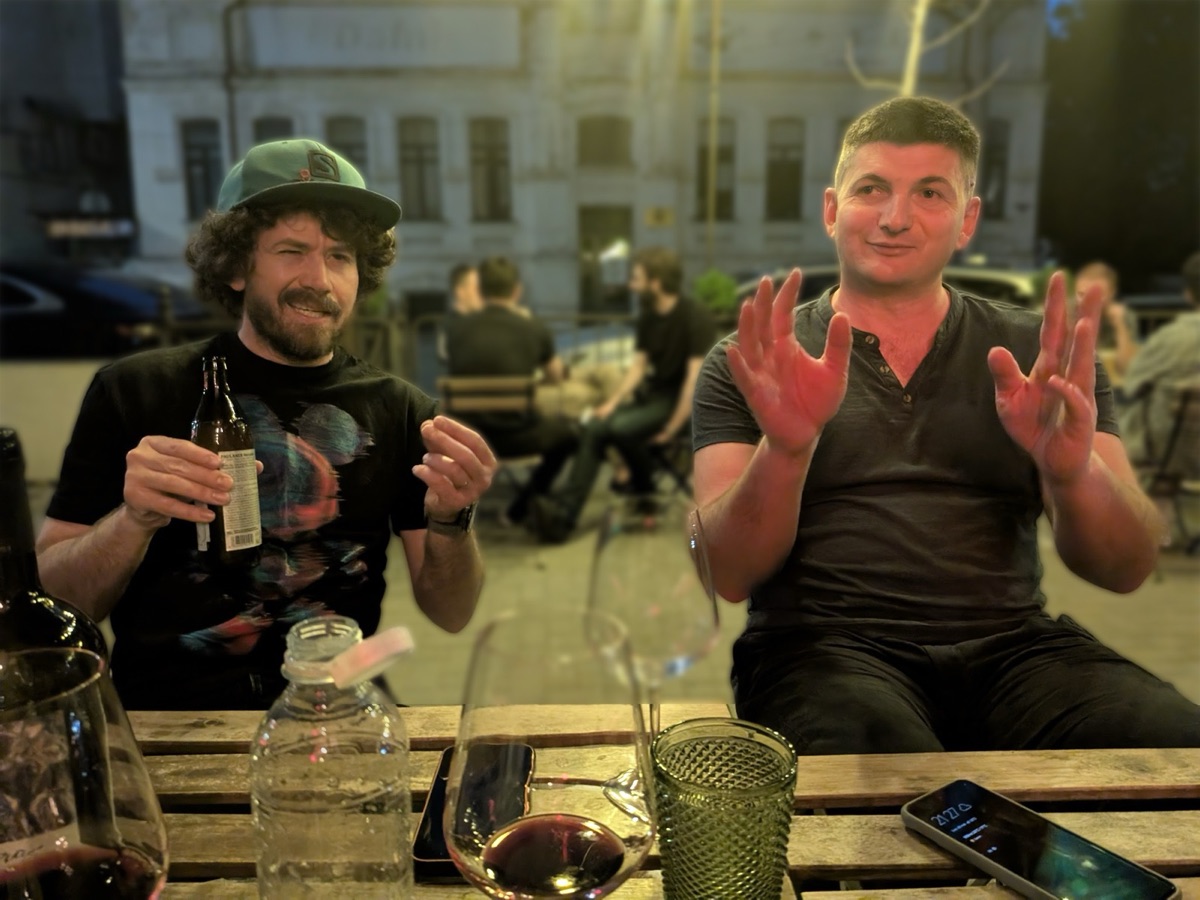
Chinese cars, American startups, and what AI can do. Three threads by the second bottle.
On how a German auto industry, with a hundred years of R&D, risks losing to a Chinese car with two screens and a leather interior. On how almost no digital product we use comes from Europe. And on how AI gives us, for the first time, the speed not to fall behind anymore. Three endless threads, in four hours.
It was Monday. OC joined the table for dinner. The conversation started differently: someone said „three of my neighbors already bought Chinese cars and they're very pleased". And just like that, in four hours, we covered Europe, China, America, and the future of our work.
Here is how opinions split.
§.01 · THREAD ONE
Chinese cars vs German engineering
Bavaria invested a hundred years in alloys, suspensions, impact structures. BYD shows up with two Samsung screens and a leather interior that looks like a premium lounge. The difference isn't at first glance anymore - it has to be looked for. And fewer and fewer people look.
Behind it stands an aggressive but legitimate strategy: the Chinese state injects capital into its own industry, exactly as the US did with Silicon Valley through DARPA. The difference - Europe no longer has an industrial project. The EU acknowledged this in October 2024 when it imposed countervailing duties on Chinese EVs: BYD ~17%, SAIC ~35%.
And there's something else. A Chinese car isn't bought to last a lifetime anymore - it's bought like a phone, for a few years. With a new generation every two-three years, the question is no longer „how much does it cost?", but „will spare parts still exist in ten years?". WM Motor filed for restructuring in October 2023; liquidation was confirmed later. Customers were left with cars without software support, without parts, without dealers. For a BMW E36 from 1995 you can still find original parts today, thirty years later. For a Chinese car from 2024, what you'll still find in 2034 is anyone's guess. And every time you buy one, capital that was European flows into another economy.
China wins on price + look▓▓▓▓▓5
Germany holds on durability▓▓2
Neither is a 20-year investment anymore▓1
„Consumers no longer ask about alloys. They ask how many inches the display has."
- AG, who sees the trend from the first search
„You don't buy a Chinese car. You lease it for a few years. Then you lease another one."
- EC, who counted the BYD models released just last year
„European money, Chinese factory, Chinese tax. This isn't trade anymore - it's capital transfer."
- AS, without raising his voice
„We no longer ask how much it costs. We ask if parts will still exist in ten years."
- RT, to the one with Mazda in mind from last week's dispatch
„A Chinese car is good until the first repair. Then you start frantically looking for a dealer."
- DS, skeptical as usual
The subject grew far beyond one dispatch. RT went and checked the figures, and a separate essay came out of it - about how a Chinese camper ended up costing the same as a small Volkswagen.
What's the last European digital product you installed? Spotify. Maybe. And the list ends there. Skype was Estonian - Microsoft bought it and shut it down in May 2025. SAP exists, but it's industrial software, not on your phone. Two or three successful video games. That's Europe's digital industry over the past thirty years. Europe makes directives, Americans make platforms.
Why? Fragmentation. The US - 330 million people, one language, one tax code. The EU - 450 million, but 24 languages, 27 tax codes, 27 regulators. An American launches in San Francisco and has 50 states ready. A European has to think about 27 versions of VAT before the first sale. Plus salaries: in SF, a senior engineer earns 3-4 times more than in Berlin. Stock options are taxed efficiently in the US, harshly in Europe. European talent isn't conquered - it's exported.
And there's more. The EU AI Act was adopted in 2024 - before Europe had a single major LLM. Mistral appeared in 2023, capitalized far below OpenAI and Anthropic. We regulate an industry we don't yet have. In Chișinău the situation is even clearer: Moldova doesn't sell digital products, it sells the people who make American products. We are Silicon Valley's quality outsourcing. At least until now (see §.03).
Fragmented, over-regulated, under-funded▓▓▓▓4
We have talent, but it leaves▓▓▓3
We can catch up if we take it seriously▓1
„Spotify. And that's it. The rest of the apps on your phone are American."
- RT, after a brief count
„An American wakes up with an idea, opens an account at nine in the morning, and starts selling. A European consults a lawyer."
- AS, with his glass on the table
„We have the best programmers. They've all left for SF."
- AG, on brain drain
„Moldova doesn't sell products. It sells the people who make the products."
- DS, no longer raising his glass
„We regulate AI before we build it. It's like a traffic code without cars."
- EC, short and definitive
§.03 · THREAD THREE
AI as a second wind
What can we do now that we couldn't do two years ago? A biscuit maker, someone in the countryside with a small guesthouse, an architect - each knows best what's missing from their own workflow. Small, repeated problems for which no off-the-shelf software has an answer: an order log built around his recipes, a booking page in his language and rhythm, a cost calculator made exactly the way he runs his projects. Custom micro-apps, made just for him.
Until two years ago, all this cost tens of thousands of euros and months of work with a software firm. For most small entrepreneurs it didn't exist - they didn't even dream of it. Today they build it themselves, in a few afternoons. The quality of the idea matters more than the technical talent that supports it.
The engineer in Chișinău has the same tools today as the engineer in San Francisco. The designer in Cluj delivers at the level of a Berlin agency. For the first time in history, geography is no longer a premium. Whoever knows what they want, ships. The rest are left watching.
And here's the key: AI doesn't replace expertise, it amplifies it. The worst user is the one who uses AI to do something they don't understand - mediocrity at scale results. The best is the master craftsman who knows exactly what he wants: AI gives him speed, judgment tells him when to stop. The artisans win. The dilettantes sink, more elegantly.
Geography has faded - same tools everywhere▓▓▓▓▓5
AI amplifies expertise, doesn't replace it▓▓2
The real risk is mediocrity at scale▓1
„The one who bakes the biscuits knows better what he's missing than any software firm. AI gives him the hands."
- RT, on the small entrepreneur
„The engineer in Chișinău has the same kit today as the one in San Francisco. The difference is only in what you want to do with it."
- AS, on geography fading
„At first I thought AI replaces. Now I see it amplifies whoever knows what they want."
- AG, after a long pause
„AI multiplies those who know - and those who don't, just the same. The dilettantes become louder."
- EC, short, as usual
„The more philosophers and strategists we have, the better. The rest, AI does."
- DS, raising his glass
What we drank
Purcari Maluri de Prut · Purcari Vinohora Roșu · A Czech beer for EC.