 In the garage · since 30.07.26 · 8:30
A dossier kept by RT · the opinions are his, not the table's
In the garage · since 30.07.26 · 8:30
A dossier kept by RT · the opinions are his, not the table's
POLESTAR
2
The mirror, solved. The dashboard, redrawn in Figma. The rest - analog, exactly as it should be. €3 for a getaway to nature.
12 entries · ~42,700 km · SOH 93%
WHY THE 2, AFTER ALL
Of the whole Polestar range, this is the purest one: the lightest, the simplest, the only one that corrected its drivetrain.
Before the test drives, the check-ups and the negotiated tire pressures, there was the question: why, of all things, a Polestar 2? The arguments, served cold.
01 · The brand
Polestar didn't appear out of nowhere: it started as a Swedish racing team - Flash Engineering, from 1996, then Polestar Racing - racing Volvos in the touring car championship and tuning the road cars. In 2015, Volvo bought it outright, the way Mercedes keeps AMG. And since 2017 it has been a standalone brand, electric only, with its headquarters, design and engineering in Gothenburg. The name comes from the North Star.
And for those who wrinkle their nose at "it's Chinese": yes, the Polestar 2 is built in China, in the plant that also builds the Volvo XC40. Exactly like the iPhone - designed by Apple in California, assembled in China. The Polestar 2 is designed and engineered in Sweden and assembled in China.
The first car under the new brand was a statement, not a volume product: Polestar 1 - a hybrid GT with a carbon-fibre body, over 600 hp, built in just 1,500 units. Only then came the 2 - the car that had to matter.
02 · The format and the design
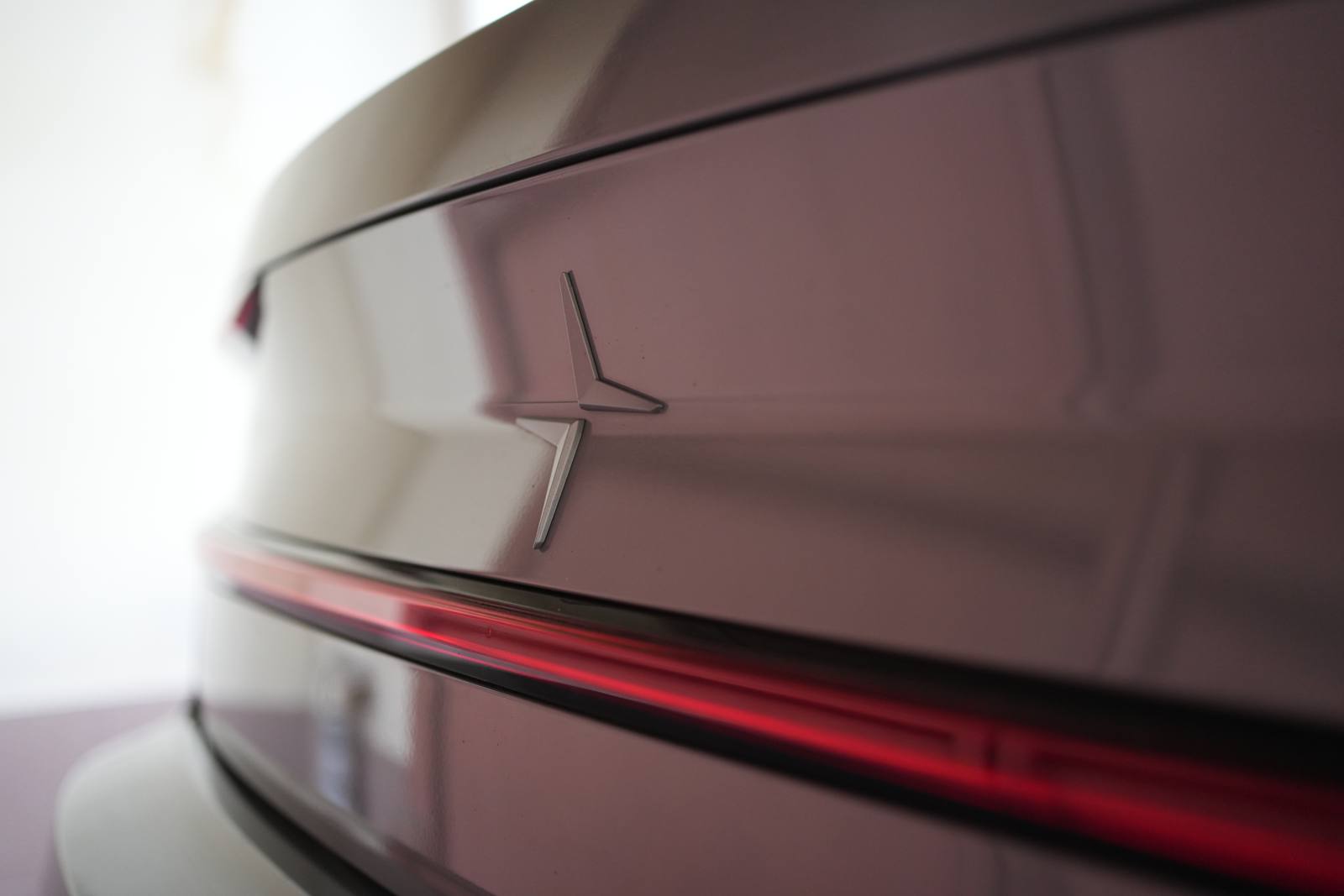
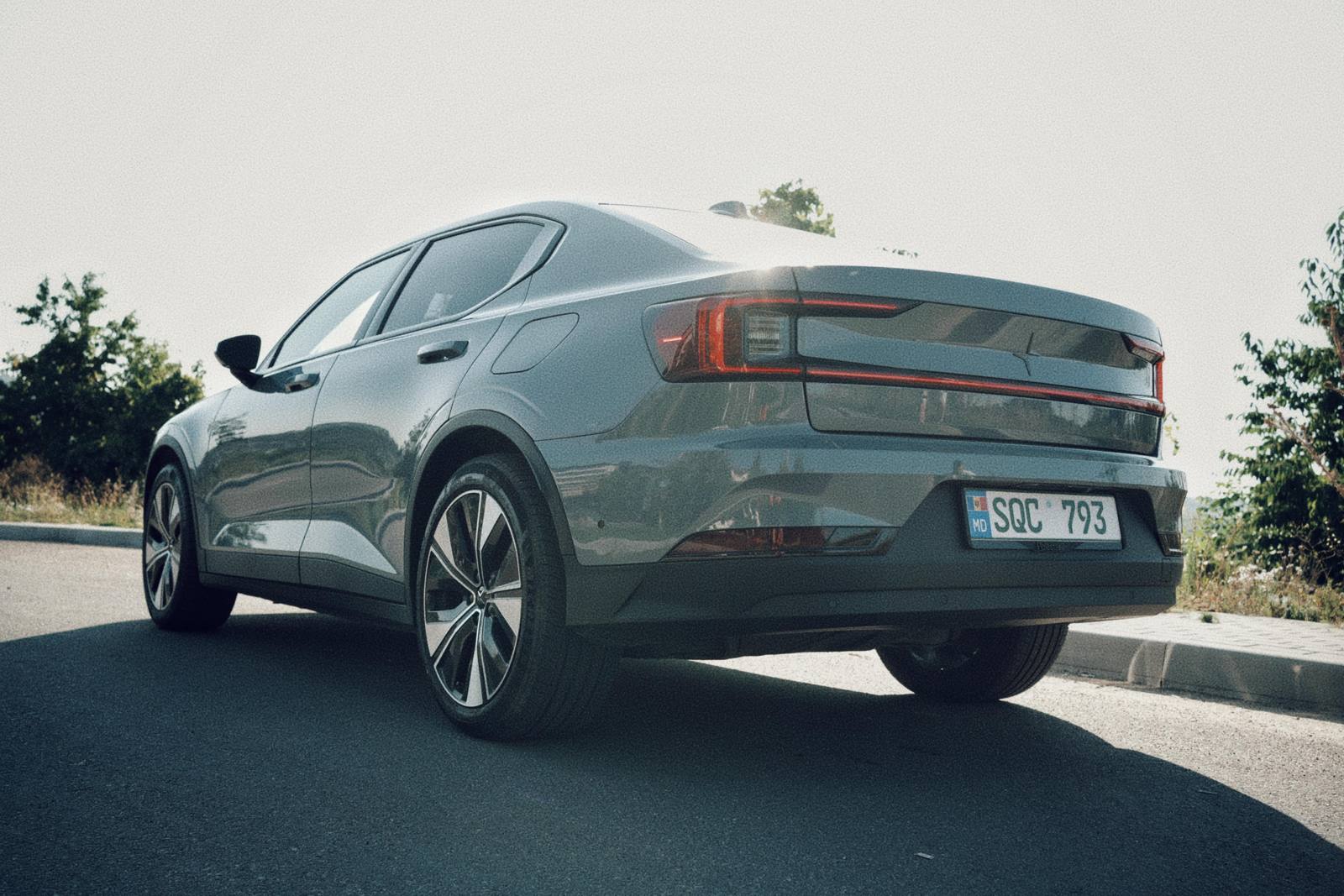
A curiosity that works. Visually it reads as a sedan, but it sits higher than one - and in reality it's a fastback, with a large tailgate that opens together with the rear glass. The design is restrained, almost stern, yet muscular - a Scandinavian monolith. Not a single extra line, and still a road presence many more expensive cars don't have.
Nothing accidental here: the brand's first CEO, Thomas Ingenlath, came straight from the chief designer's chair at Volvo. Polestar is run by designers, not by marketing - you can see it in every line. Even the racing blue, "Swedish racing blue", is an inheritance from the circuit years.
03 · The philosophy
Deeper than the design is the way of thinking. The Swedes have a word for it - "lagom": exactly enough, nothing more. And behind it stands a whole unwritten law of Scandinavia, Jantelagen - the Law of Jante: don't think you're special, don't stand out, even if you could. Sounds odd for a car with 421 hp - but that's precisely what it does: it has them and doesn't show them. It pulls away gently, looks restrained, stays quiet. Mechanical modesty - power that feels no need to prove anything.
04 · The battery
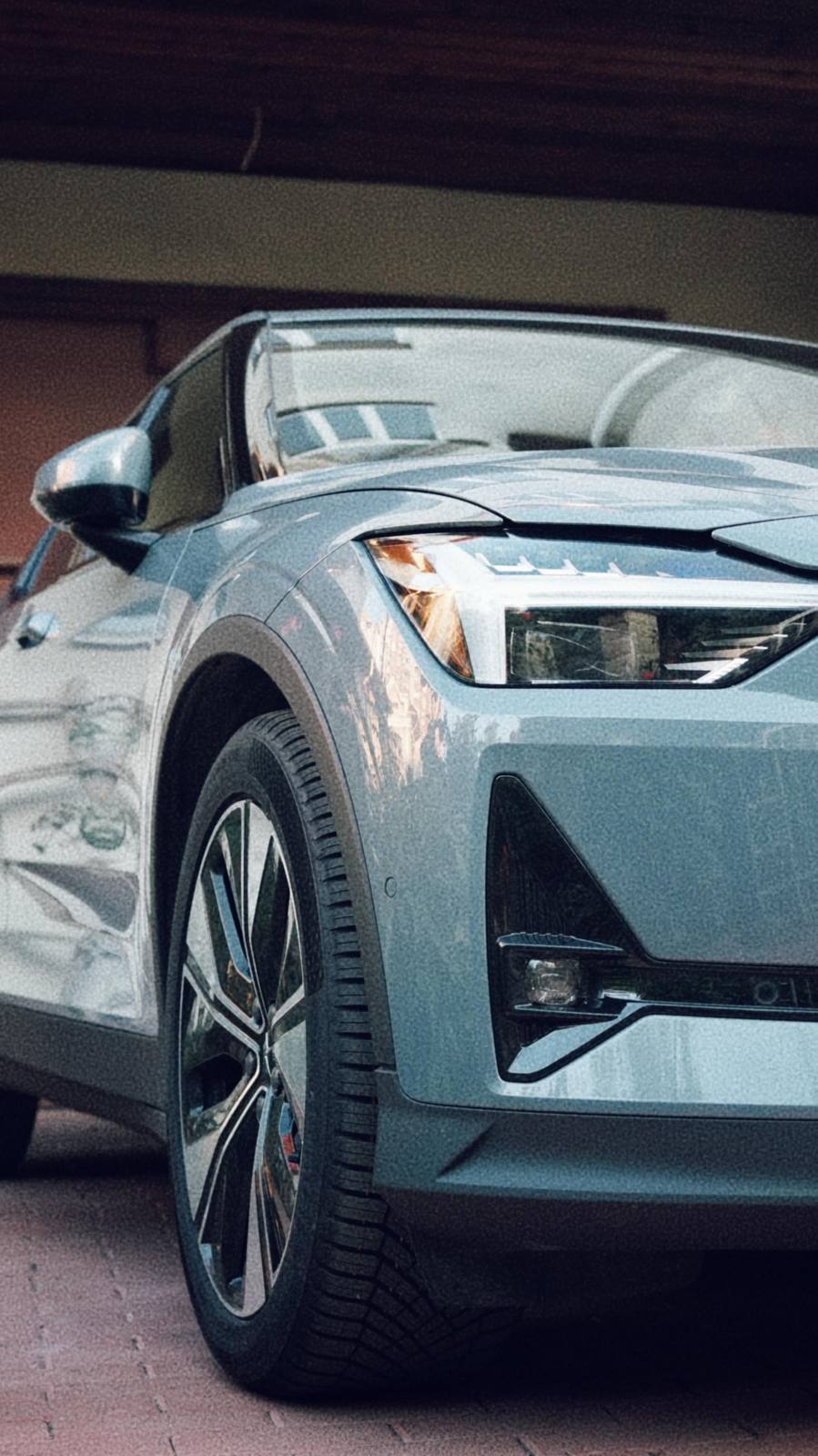
It's architecture, not just a slab under the floor. Pe CMA platform (shared with the XC40), the 27-module pack is shaped like an H plus a T - it fills the centre tunnel too, not just the floor. It is structurally integrated, adds to the chassis rigidity, and the mass sits gathered toward the middle. Measured effect: road noise is 3.7 dB lower than on a conventional chassis - the battery is tuned to cancel certain frequencies, working as a vibration damper. That's why some say it drives nicer than classic EVs, where the battery is a flat slab doing structural duty. They're right.
05 · The drivetrain
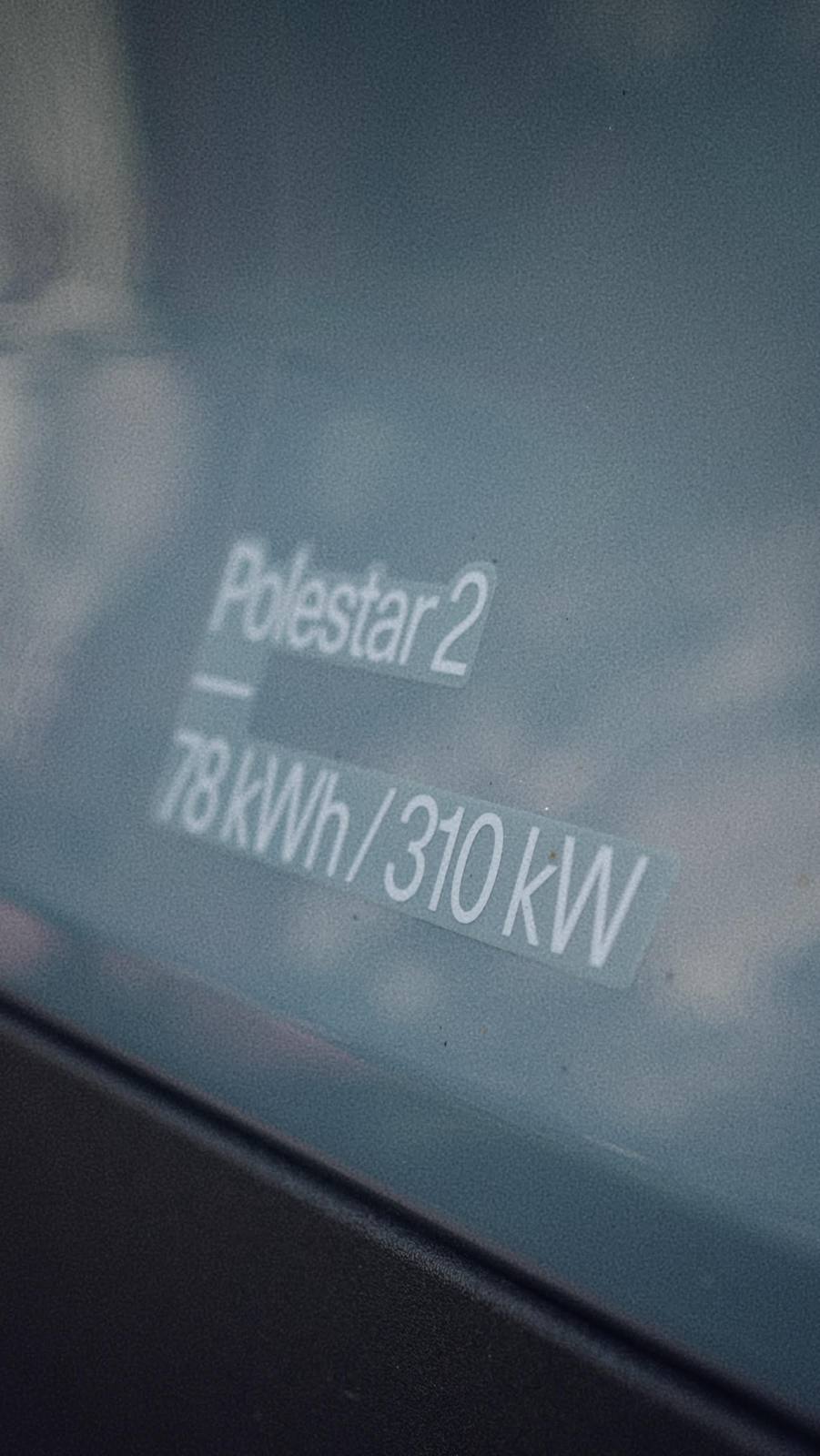
After the facelift, it's the right one. Polestar did something almost unheard of at a mid-cycle refresh: it moved the drive from the front to the rear. The main motor - new, permanent-magnet, with a silicon-carbide inverter - sits on the rear axle; on the Dual Motor, the front one is asynchronous and decouples completely when it is not needed. 310 kW, 740 Nm, 4.5 seconds to 100. In effect they admitted the car deserved this drivetrain from the start.
06 · The suspension
Simple out of conviction, not economy. Passive - MacPherson up front, multi-link at the rear. No air springs, no adaptive dampers that die at 150,000 km - which is, granted, about when conventional ones die too, except replacing those costs several times less. And on the Performance Pack, Polestar went exactly against the fashion: Öhlins with manual adjustment. Mechanical, analogue, repairable - nothing to "recalibrate at the dealer".
07 · The rest of the range
The Polestar 1 is a hybrid - two worlds to maintain. The Polestar 3 weighs nearly 2.6 tonnes, with air suspension and LiDAR. The Polestar 4 removed its rear window. This is the lightest Polestar - around two tonnes - purely electric, steel body, with nothing that breaks in interesting ways. Plus the Volvo safety inheritance: the block that deflects the wheel in a frontal impact so it does not reach the battery.
08 · How current is it, technically
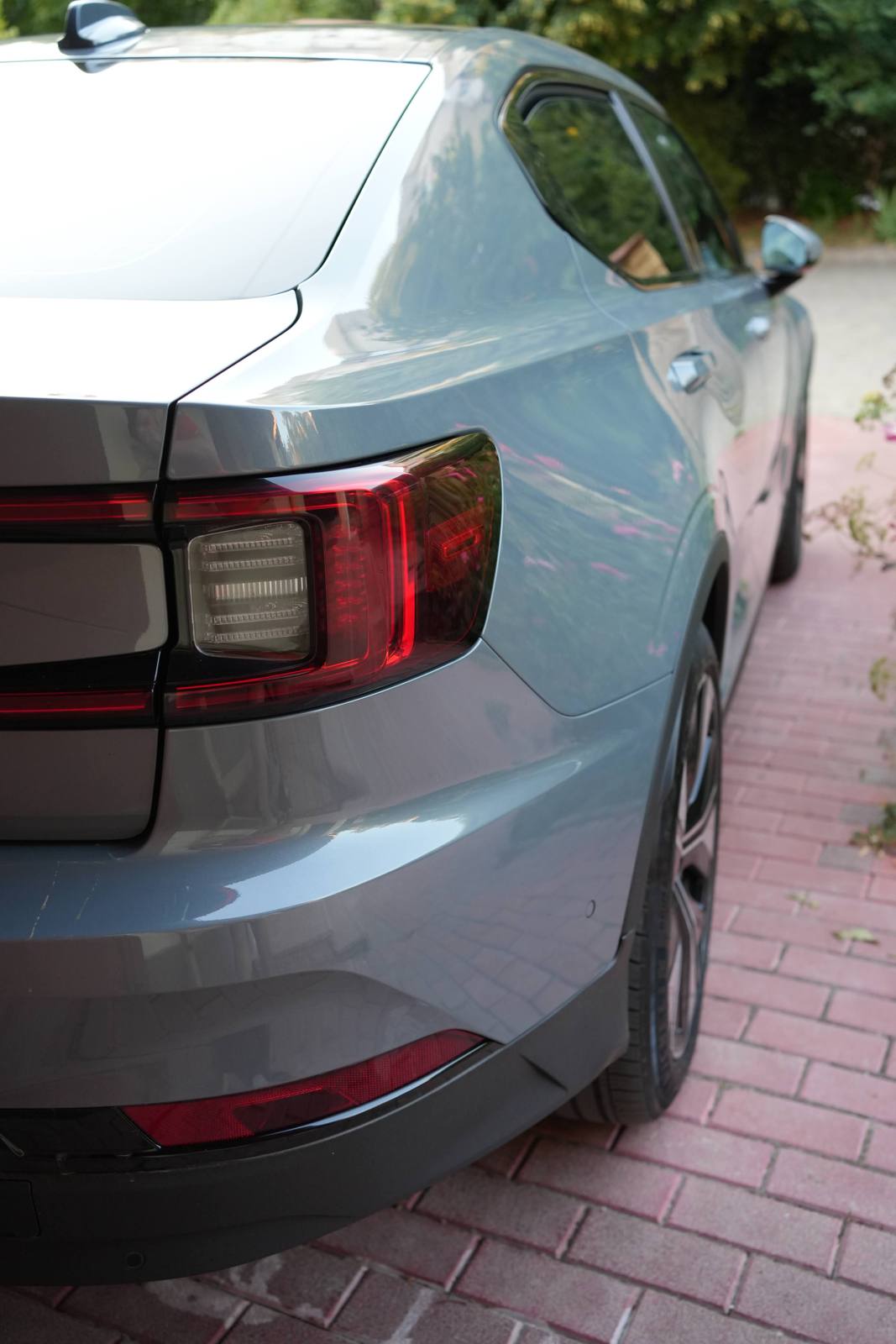
The honest question about a car launched a few years ago is not "is it new?" but "is it current?". And the simplest test is to look at what the Volvo group sells right now and compare the technology.
First, what is on board: the rear motor and the silicon-carbide inverter were not carried over from the old model - they were developed specifically for the facelift, in 2023, with serious efficiency gains across every variant. In other words, the group's current generation of propulsion, not an inherited one.
Then, the decisive argument: Volvo still sells this exact powertrain today, in new cars. The EX40 and EC40 - the former XC40 and C40 Recharge - received the same rear-drive switch, the same new motor and the same enlarged battery in the same year, on the same CMA platform. What sits in a Volvo showroom in 2026, at new-car money, is technically the 2's twin.
The rest of the range confirms it: the entire current Volvo/Polestar line-up - EX30, EX90, Polestar 3, Polestar 4 - runs the same 400V architecture as the 2. The EX30 actually charges slower (153 kW versus 205), and the Polestar 3, at double the price, is capped at 250 kW for the same architectural reason.
The generational break exists, but only at the very top: the Volvo EX60, launched in 2026 on the new SPA3 platform - 800V, a structurally integrated battery, charging at up to 400 kW. And the 2's successor is announced for 2027. The practical difference between generations comes down to one thing: speed at 300-400 kW ultra-fast chargers - which, around here, barely exist for now. At home, on a wallbox, 400V and 800V charge identically.
The garage conclusion: bought in 2026 at under a third of its price, with a powertrain still sold new across the street, the car sits at the best point of the curve - new enough to be current, old enough to be affordable. It will become "the previous generation" only when 800V reaches the compact class.
09 · The money
Second-hand, it's the most accessible Polestar: the brutal depreciation of premium EVs is the first owner's problem and the second owner's gift. Under a third of the price, at 40,000 km, with the battery at 93%.
10 · Why not just the e-Golf
And still - why, if I was happy with the e-Golf? It stayed in the family, nobody replaced it. But the reasons, in order of honesty:
4x4 for the few snowy days a year - and it's nice that it isn't permanent: at speed, the front motor decouples and stops wasting energy. Electrically adjustable seats with memory - useful when my better half needs the car and the seat remembers each of us. And the ground clearance, higher than a Golf's.
The rest - the power, the battery twice the size - are a nice bonus, not a reason.
11 · The spec sheet
| Battery | 78 kWh gross · 75 kWh net (usable) |
| Range | ~590 km WLTP · ~400 km real-world |
| Power · torque | 310 kW (421 hp) · 740 Nm |
| 0-100 km/h | 4,5 s |
| Drivetrain | AWD · front decouples at speed |
| Energy cost / 10,000 km | ~7,120 lei (~€360) - at 20 kWh/100 km and 3.56 lei/kWh, at home |
Note: at ~20,000 km a year, the Polestar's energy costs ~€710. The X3: ~€4,600 in fuel, plus 2-3 oil and filter changes at ~€200 each.
Around here, people still fear electric. One argument that cuts many discussions short: electricity is the only fuel you can produce independently - a few panels on the roof, and the car runs on your own sun. Petrol doesn't grow in the yard.
And another, underrated one: home is your own station. You wake up every morning with a full "tank" - you only see a filling station on long trips.
But pure doesn't mean perfect. The proof - in the entries further on.
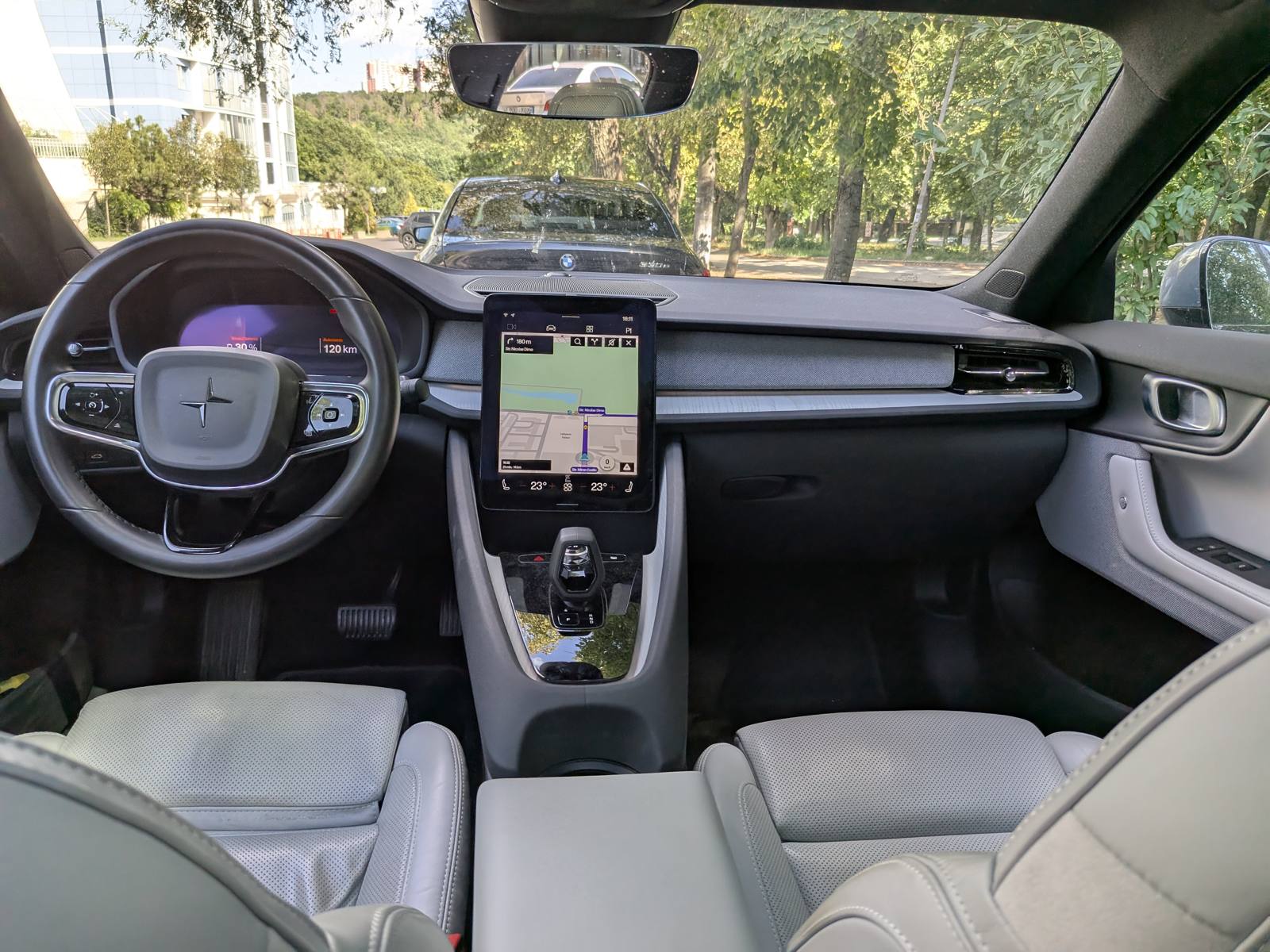
THE TEST DRIVE
The third Polestar 2 I try is the first one that doesn't argue with the road.
Before this one there were two: a Polestar 2 from America belonging to an acquaintance, then another from 2022, also from the States, on 20-inch wheels - exaggeratedly stiff, with downright noisy suspension.
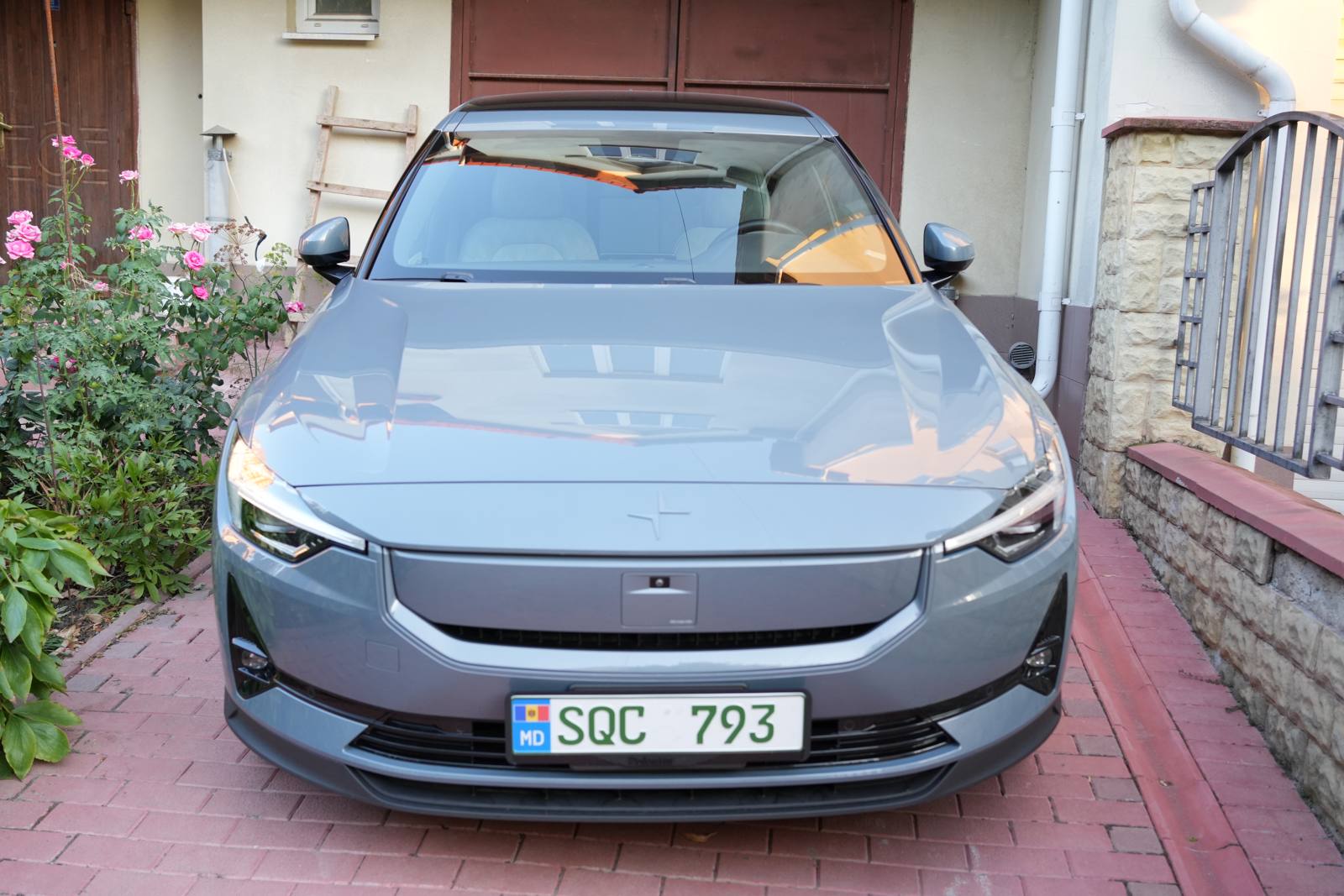
This one - the 2024 facelift, on 19s - has a different character: not extremely comfortable, but acceptable. The difference between 19 and 20 inches is bigger than it looks on paper.
It was the only facelift for sale here: new, more efficient motors, a slightly bigger battery, the front motor decoupling at speed. Leather interior, very well equipped.
Brought over from the States - clearly not in one piece. The driver's side scraped at a car wash (nothing structural) and the passenger-side suspension arms bent on a kerb - replaced. The rest restored, the alignment checked. I said yes.
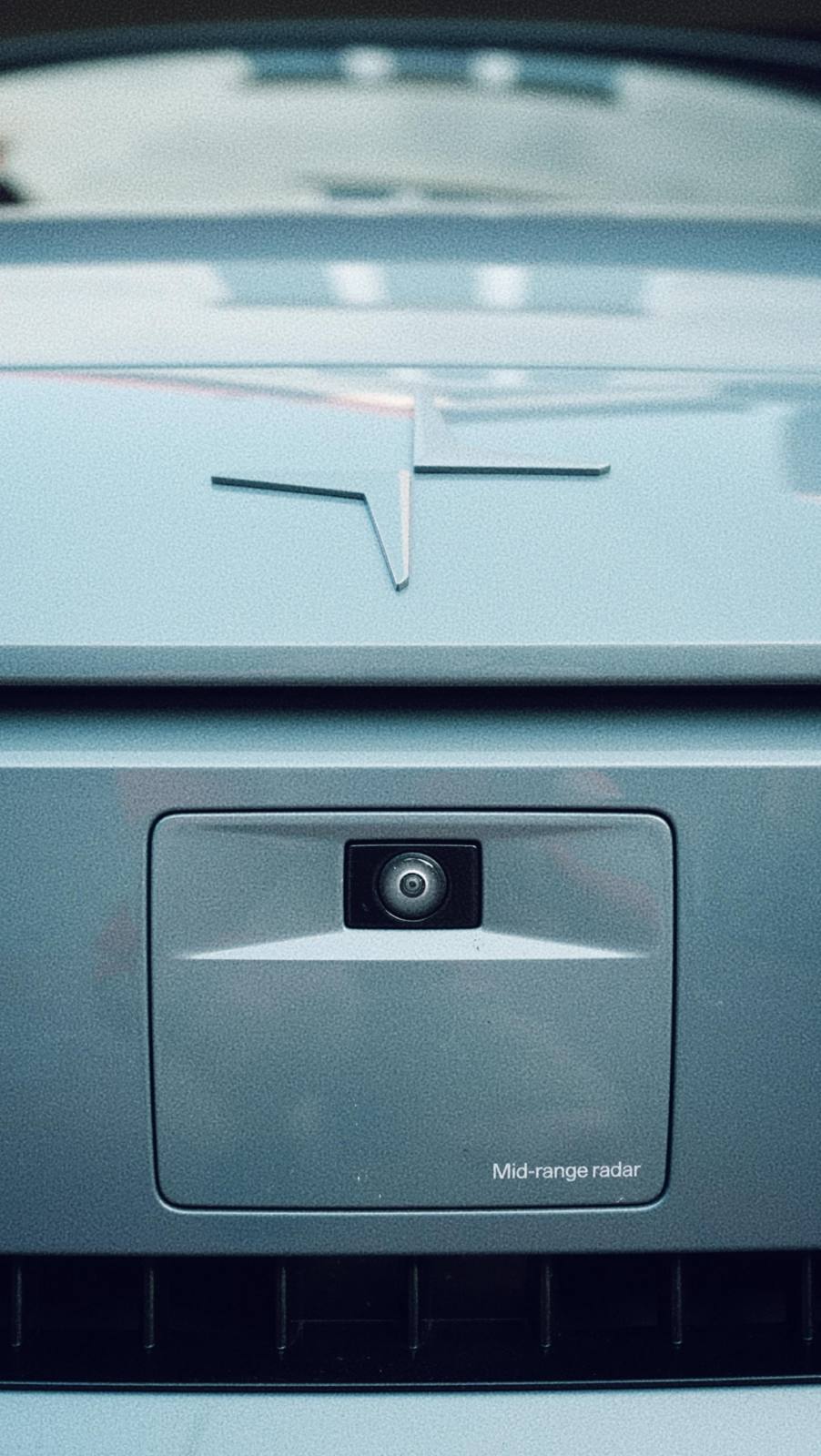
THE CHECK-UP
The service verdict, handwritten on the report: 93%.
A friend who usually helps me check cars took it to a workshop: the alignment, the error codes, the state of the battery.
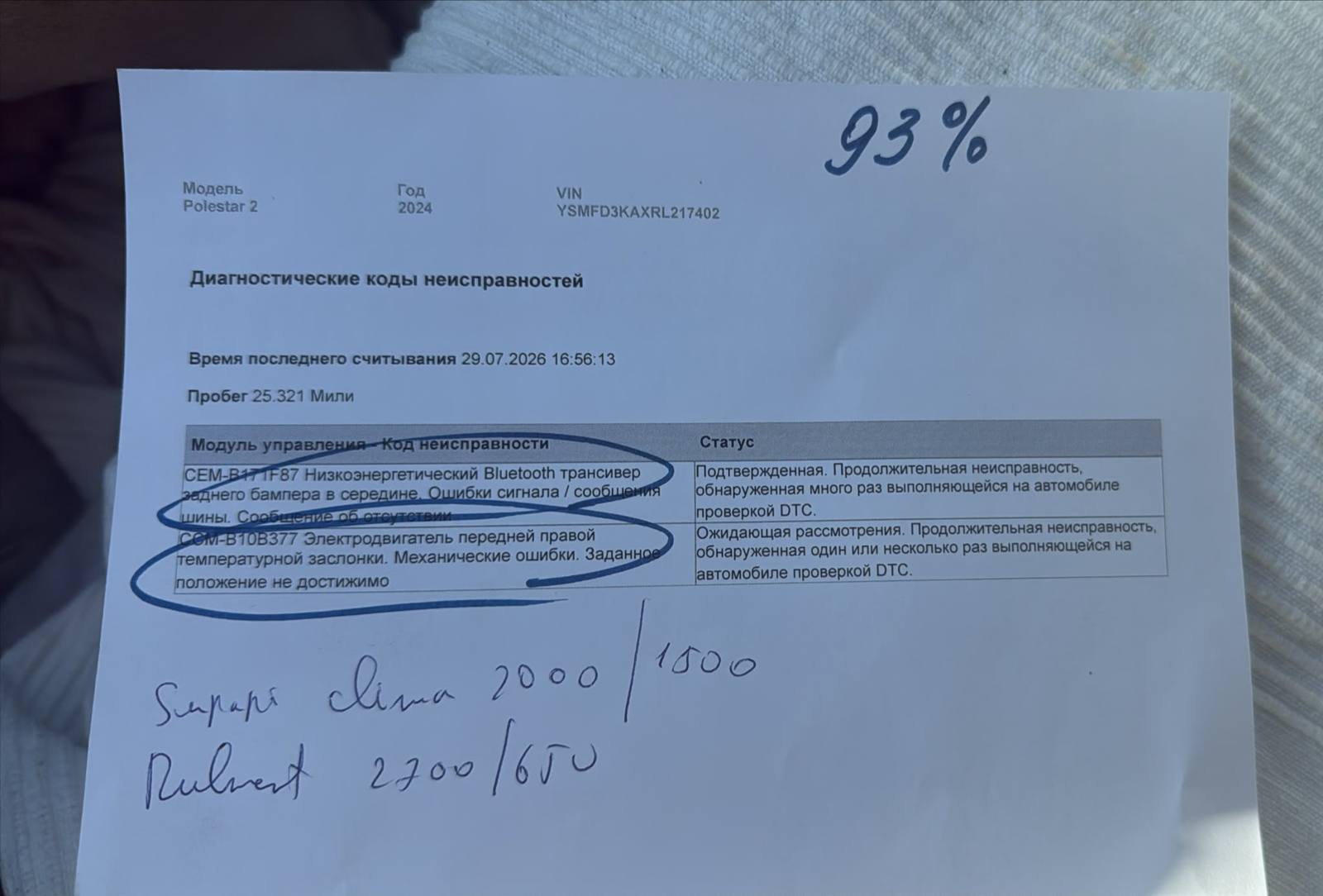
The alignment - fine. The errors - nothing dramatic. The battery - SOH 93% at around 40,000 km on the clock.
For a car at less than a third of its price when new, that's more than acceptable.
THE TYRES
New Continentals, inflated to 2.8 - and the 20-inch stiffness came back.
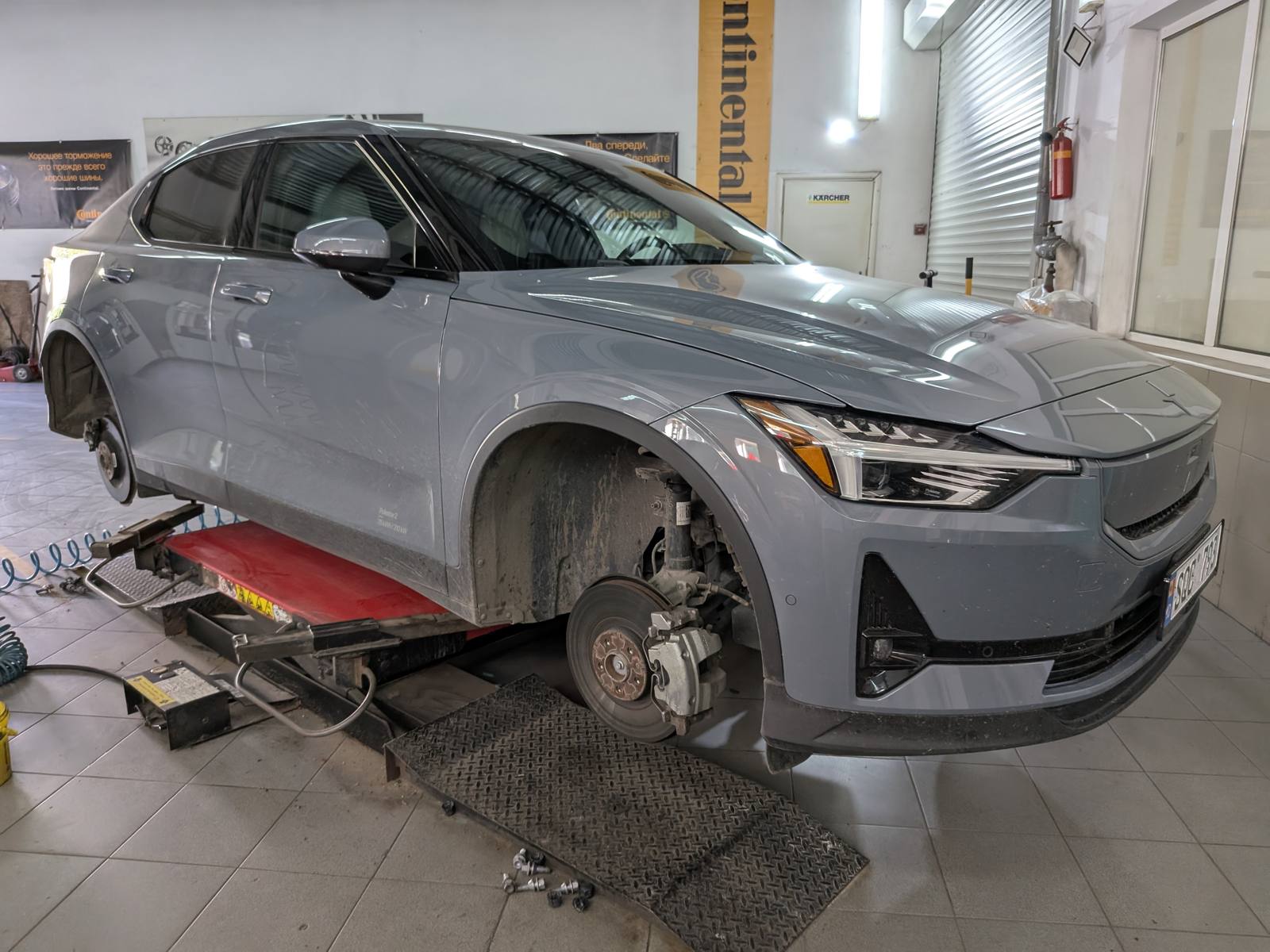
At least one of the tyres on the car was dangerously worn, so a new set of Continentals arrived.
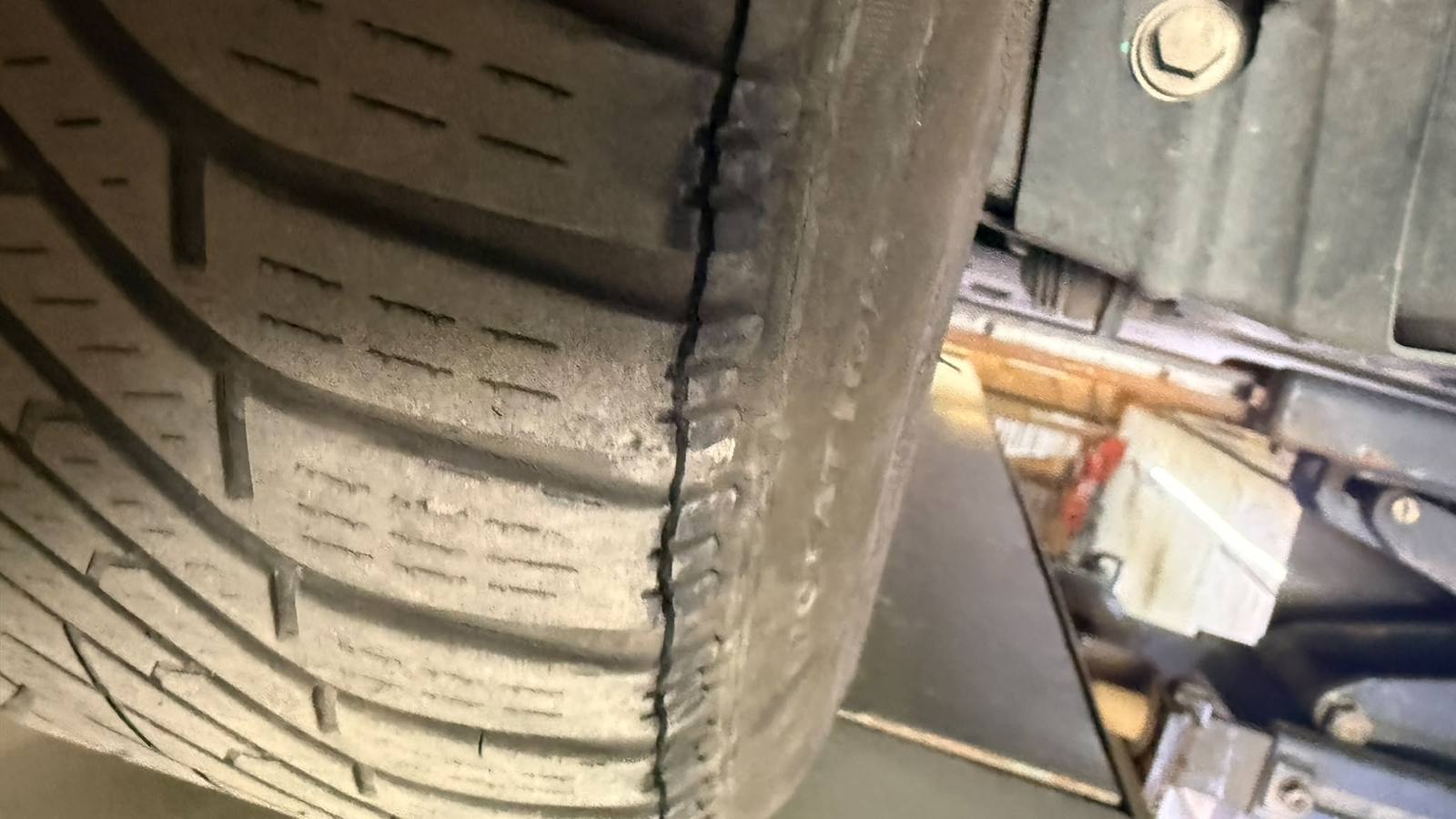
The surprise: the guys at Continental inflated them to about 2.8 bar - and the car turned mega stiff. After a short drive, the fronts had reached 3.0. Exactly that 20-inch stiffness I had been running from.
I let them down to 2.65. Breathable again - not extremely comfortable, but acceptable. On a two-tonne EV, a few tenths of a bar go straight to your spine.
AT THE SOCKET
At the home socket, the car pays a process tax: 350-500 W never reach the battery.
01 · The process tax
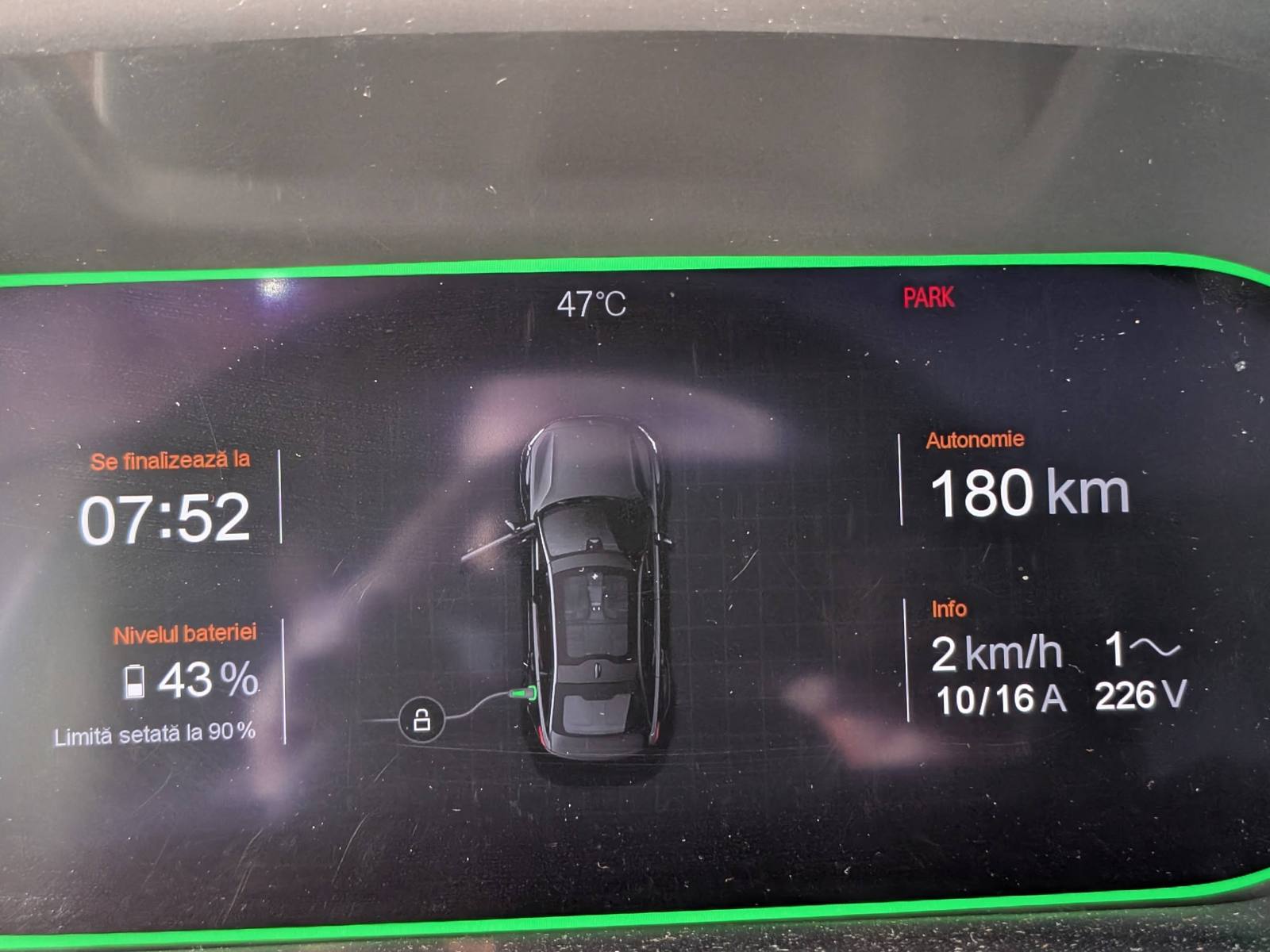
Charging at home, from a plain socket, without a wall charger - here, compared to the e-Golf, things are worse. At 220V directly, a considerable part goes to the process itself: some 350-500 W for the battery's thermal management and the on-board electronics that stay awake the whole time you're plugged in.
The dashboard tells the whole story, especially in a heatwave: 47°C outside, 10 of 16 amps, and a charging speed of 2 km/h. Yes, kilometres per hour: that's how much range you gain while the battery fights the heat.
02 · The math
The math is merciless at 2.3 kW: 400 W of overhead means roughly a 15% loss before any conversion. ADAC's measurements for socket charging show 10-25% total losses, versus 5-10% on a 7-11 kW wallbox. The same process watts - only at a wallbox they are spread over five times the power and half the hours.
03 · The e-Golf benchmark
That's why the e-Golf did better: its battery is passively cooled - no pumps, no thermal circuit running while plugged in. The Polestar has 78 kWh with full liquid management - necessary for this battery and this power, but you pay for it in watts, night after night.
A note, since the e-Golf keeps showing up here as the benchmark: I've had two - a silver 2018 and a blue 2020 - and drove them for over three years, since November 2022. Around town I often preferred it even over a BMW 7 Series G12: you get in and you're gone - light, compact, very manoeuvrable. In winter it greets you with a warm cabin, no engine warm-up and no careful driving until a cold gearbox wakes up. No worries. Perfect for the city.
An unjustly underrated car: everyone thinks electric must mean 70 kWh of battery. Yet for many of us, a daily range under 200 km is enough - if you have somewhere to charge overnight. Meanwhile, the e-Golf won the compact class at TÜV - 2.6% defects at 2-3 years, ahead of everyone, petrol Golfs included. Probably the most reliable Golf ever built.
04 · The consumption
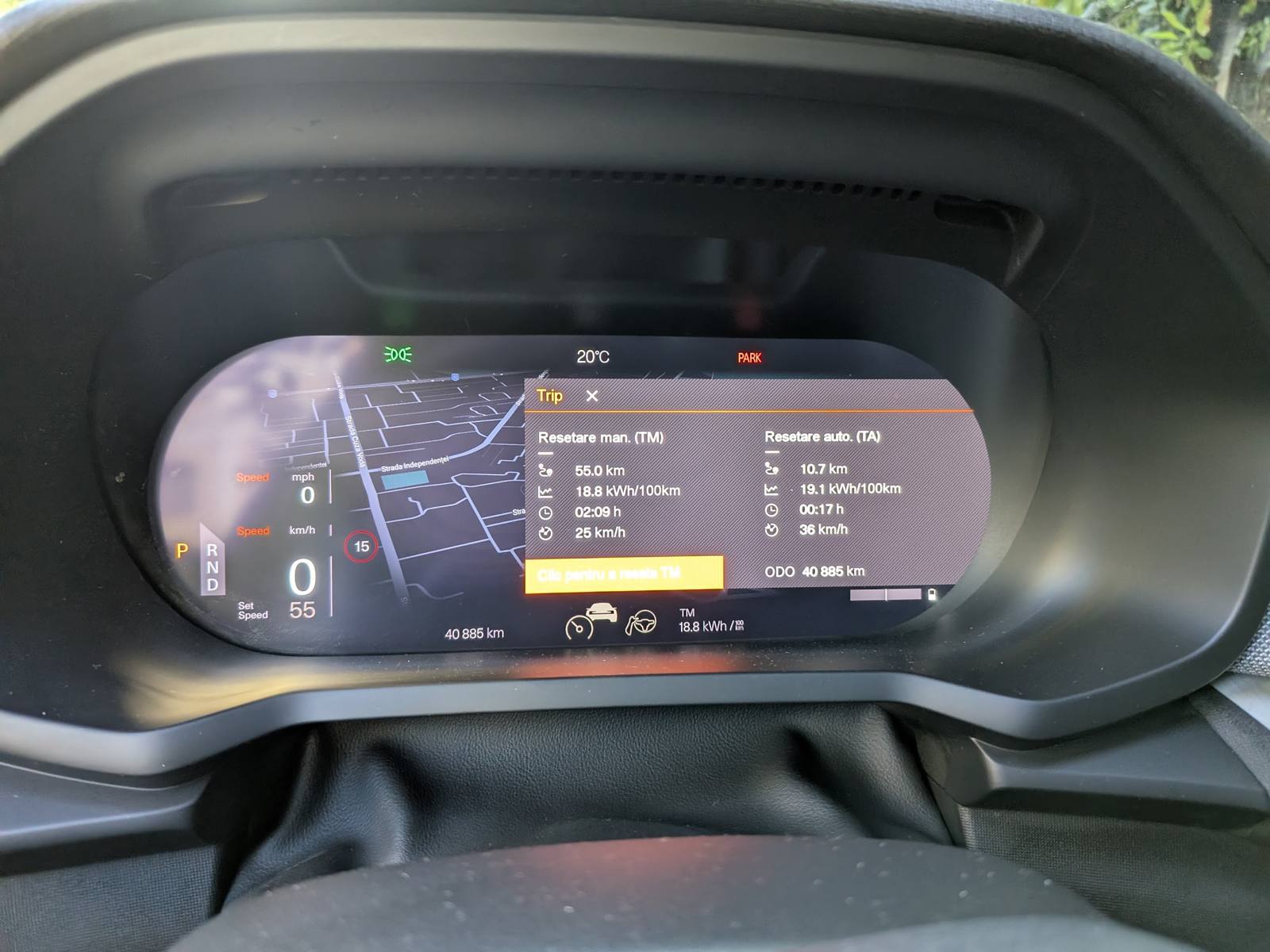
In exchange, the Polestar 2 is surprisingly good: 18.8-19.1 kWh/100 around town, averaging 25 km/h. An e-Golf would do 16-18 kWh in the same conditions - with considerably less weight and a single 100 kW motor. For two tonnes and 421 hp on both axles, the difference is almost an insult to physics.
05 · The garage conclusion
On this car, the 220V socket is an emergency solution, not a routine. The wallbox isn't a luxury - it's math.
So, next up: a 7.4 kW wall charger. I'll be back with impressions after the install - that's exactly what a living dossier is for.
See also: BMW X3 F25 · 09.09.26 · Real consumption - and why the N20 was no alternative
AT THE WHEEL
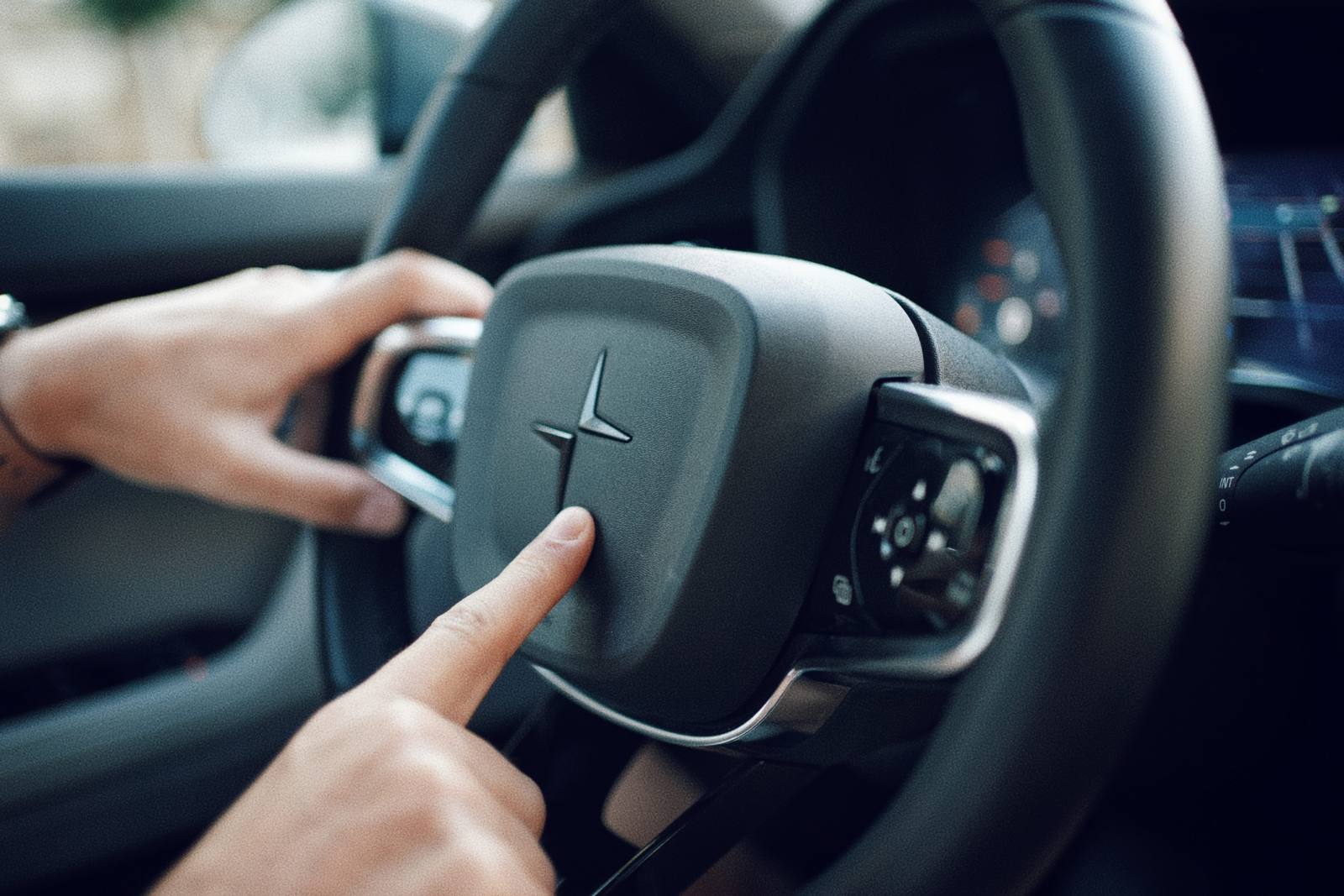
The pedal lies to you beautifully: it sets off like an e-Golf, then remembers its 421 horses.
01 · On the road
The sound insulation is decent.
The steering - almost no feedback. Even next to VAG. Not to mention BMW. But it's fairly precise and quick, and I haven't felt any torque steer.
The car feels heavy, and is - yet body roll is nearly absent. But you have no appetite for pointless acceleration precisely because it feels heavy - and you know that after every sprint you have 2+ tonnes to stop. And that's where all the playfulness ends (which, by the way, an e-Golf has even with its 136 hp) and you settle into serious and calm.
The accelerator is nicely calibrated: at first it doesn't jerk you at all - very friendly and predictable. Press harder - and you understand what 421 hp and over 700 Nm.
02 · The brakes
Strange: brake-by-wire. Under harder braking it bites hard at first, then turns linear - and sometimes you'd swear the discs are warped. They're not.
03 · The modes
No circus of Sport+ and Eco Pro. You configure the one-pedal regeneration (off, low or standard) and the creep - that's it. I drive with regen off and creep on. In stop-and-go traffic though, one-pedal with creep off is excellent: the car stops completely and the brake pedal all but disappears.
Nice detail: during regen the brake lights come on, even if you never touch the pedal.
04 · Multimedia
Mega nice - the first car in the world on Android Automotive, and it shows. It connects to the internet easily, via hotspot or Bluetooth, even though this isn't the European version with a modem on European frequencies. You get Google Maps that knows the battery level, tells you what percentage you'll arrive with, and shows the charging stations along the way.
I've long believed car infotainment should be built by the people who actually know software - Apple, Google. Otherwise millions, if not billions, get thrown at systems the manufacturers bin after a generation or two and replace with a new attempt. Custom skins - yes, anytime. But when you have a solid base for maps, settings and the rest, why not use it and build on top of it?
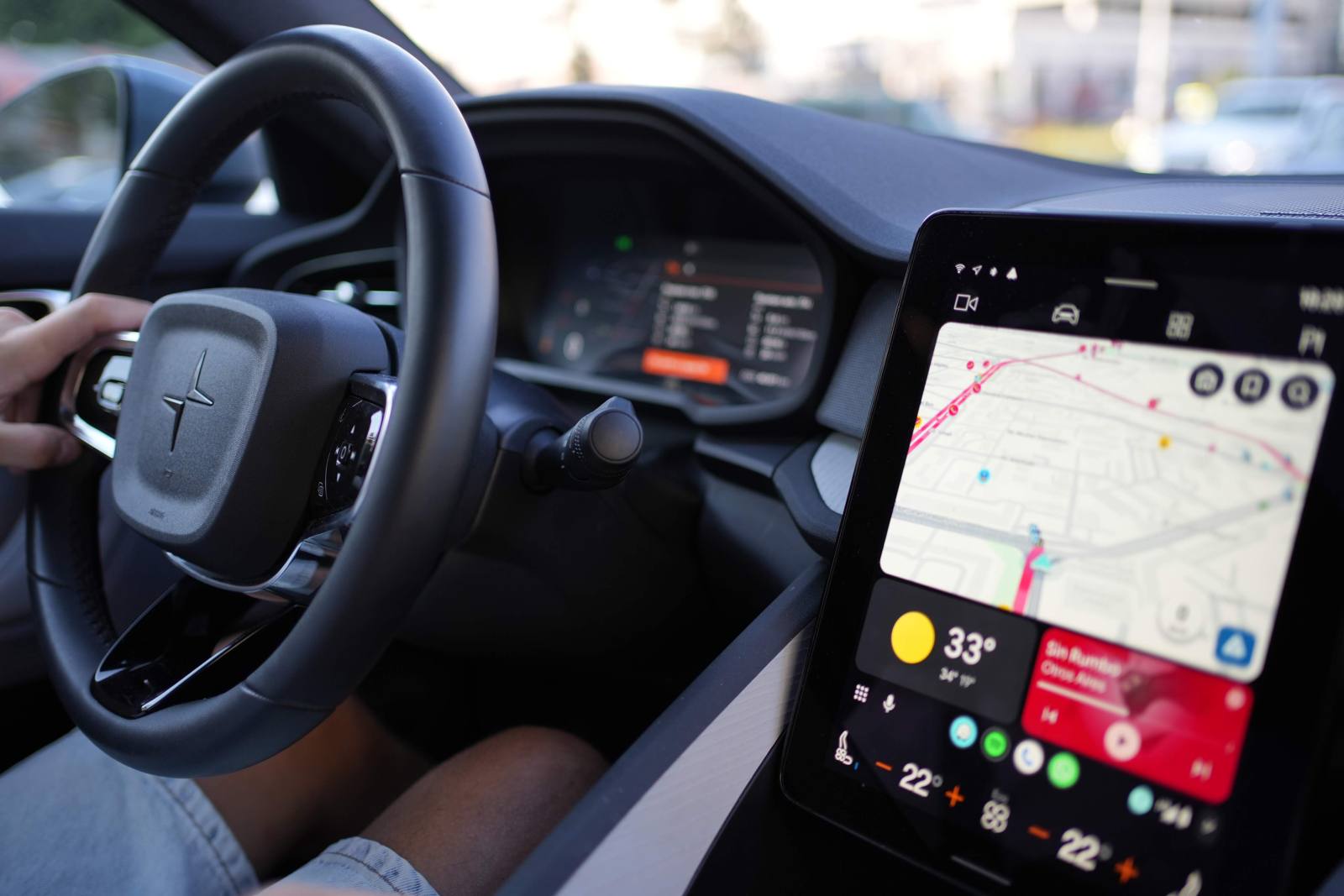
And one thing I only noticed with time, compared with the newer Volvos - which sit on the same Android Automotive: the buttons are big, hard to miss, and the font is the same everywhere - in the settings, in Waze, in Spotify. The apps do not arrive in their phone clothes: on Android Automotive they do not draw their own screens, they hand over the content and the car renders it with its own templates - which is why Waze looks like a Polestar app, with Polestar's letters and buttons, styled the same way. Customisation this deep is rare. It is exactly the "skin over a solid base" from above: Google provides the system, Polestar provides the face, the apps inherit it. Note added on 09.09.26.
See also: BMW X3 F25 · 27.11.21 · Retrofit - NBT EVO with CarPlay in a 2011 car, the road in reverse
05 · The ergonomics
Here begin the oddities. The front doors feel too small: with your elbow on the door ledge you have to sit further forward than feels natural - in the natural position, your elbow is already on the B-pillar.
The armrest is odd too: it only slides forward and back. In the e-Golf, by the way, you could tilt it more upright.
The centre console is wrapped in a textile that stains easily. And it matters what kind of foot you have. A short note: the heel-pivot technique has two anchors - heel under the brake, the safety position taught in driving schools (in a panic you stamp straight down, right onto the brake), or heel under the accelerator, comfortable on long drives but risky for exactly the same reason. If you're in the second camp - your knee ends up against the rigid console. Not pleasant at all.
Over 1.80 m? Take a test drive first, to check your driving position. The steering wheel's reach adjustment is fairly short - another 2-3 centimetres and it would have been perfect.
The seats: good that they're ventilated. For adjustments and comfort - above average, not bad. But a properly set BMW sport seat feels sewn onto you. This one doesn't. And that cuts even more of your appetite for entering a corner fast: even though body roll isn't a problem, the seat has little adjustable side support - you end up sliding left and right across the leather. Unpleasant.
And the glossy plastic by the shifter - a collector of fingerprints and micro-scratches. First chance it gets, it will be wrapped in wood-textured film.
Plus the sonic annoyance: the driver's seat-belt anchor squeaks with the seat lowered the way I like it. I've tried silicone - it still creaks. Otherwise, silence.
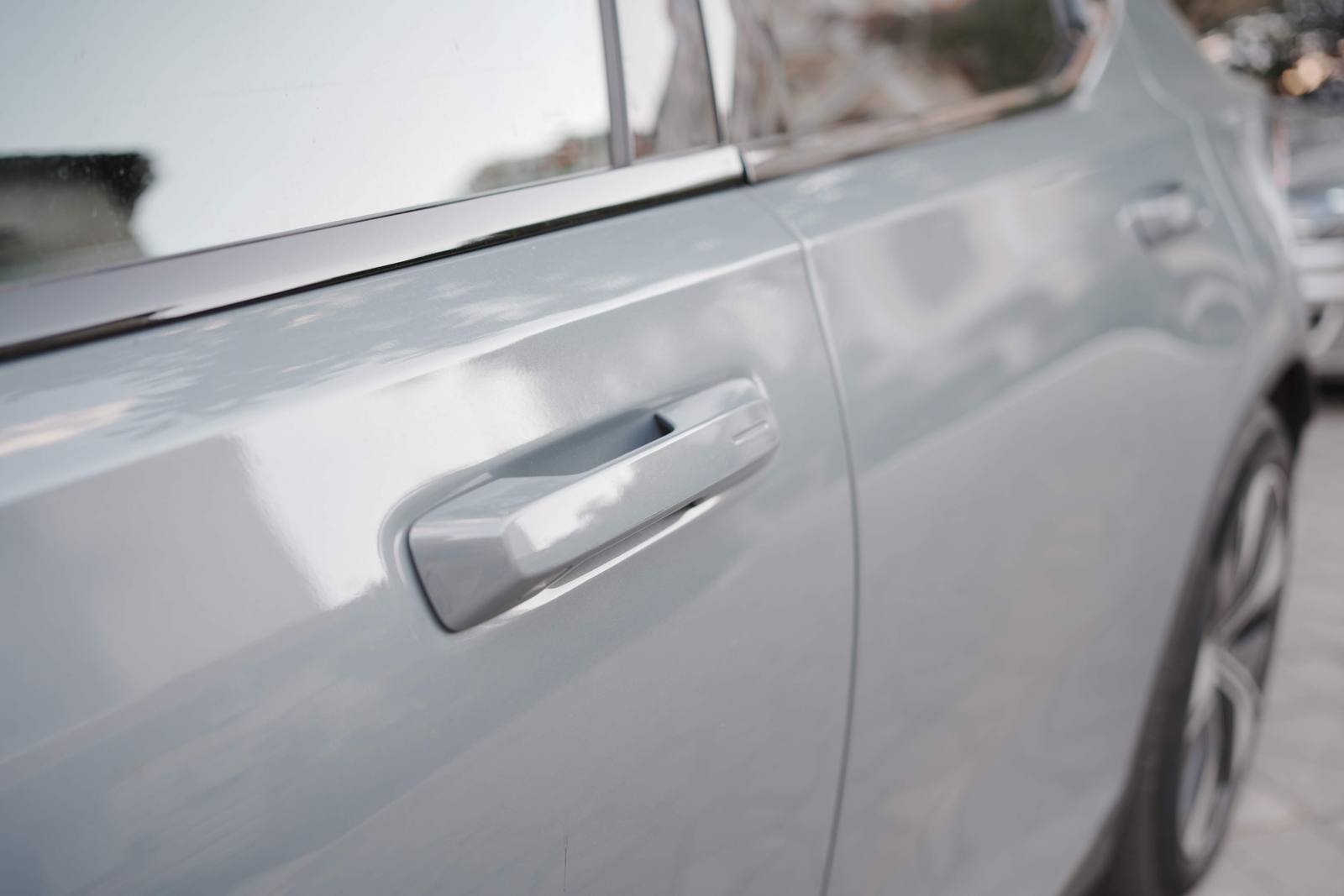
So that it is not only the oddities: the exterior door handles are exactly right - simple, clear, they work. No mechanisms retracting into the door and no hole with a hidden button inside, the way others do it for the sake of looking clever. You pull, it opens. In winter, when flush handles freeze on other cars, the argument writes itself. Note added on 09.09.26.
06 · In the end
And yet, the day-to-day experience is superb in its simplicity: you get in, put it in Drive, go. No start-stop button. At the end - Park, step out, lock. That's all.
It's a fine car overall. What I've listed are my subjective observations - I'm demanding, I've owned many cars and driven even more - and I clearly don't expect S-Class or 7 Series. But it's that feeling when you have a 20-grand 5 Series and buy a 40-grand 7 Series: you're disappointed you paid double and got a few percent more, not +100%. That doesn't mean the 7 Series isn't worth the money, or that it's a bad car. You see the idea?
One more thing: when you step from an e-Golf into something positioned at least a class above, you realise how good the Golf had become by its seventh iteration - ergonomics, touch points, the elementary comfort and driving position. In the Polestar, even after a week I'm still micro-adjusting - backrest, seat, wheel - and I'm still not quite there.
THE FIRST TRIP
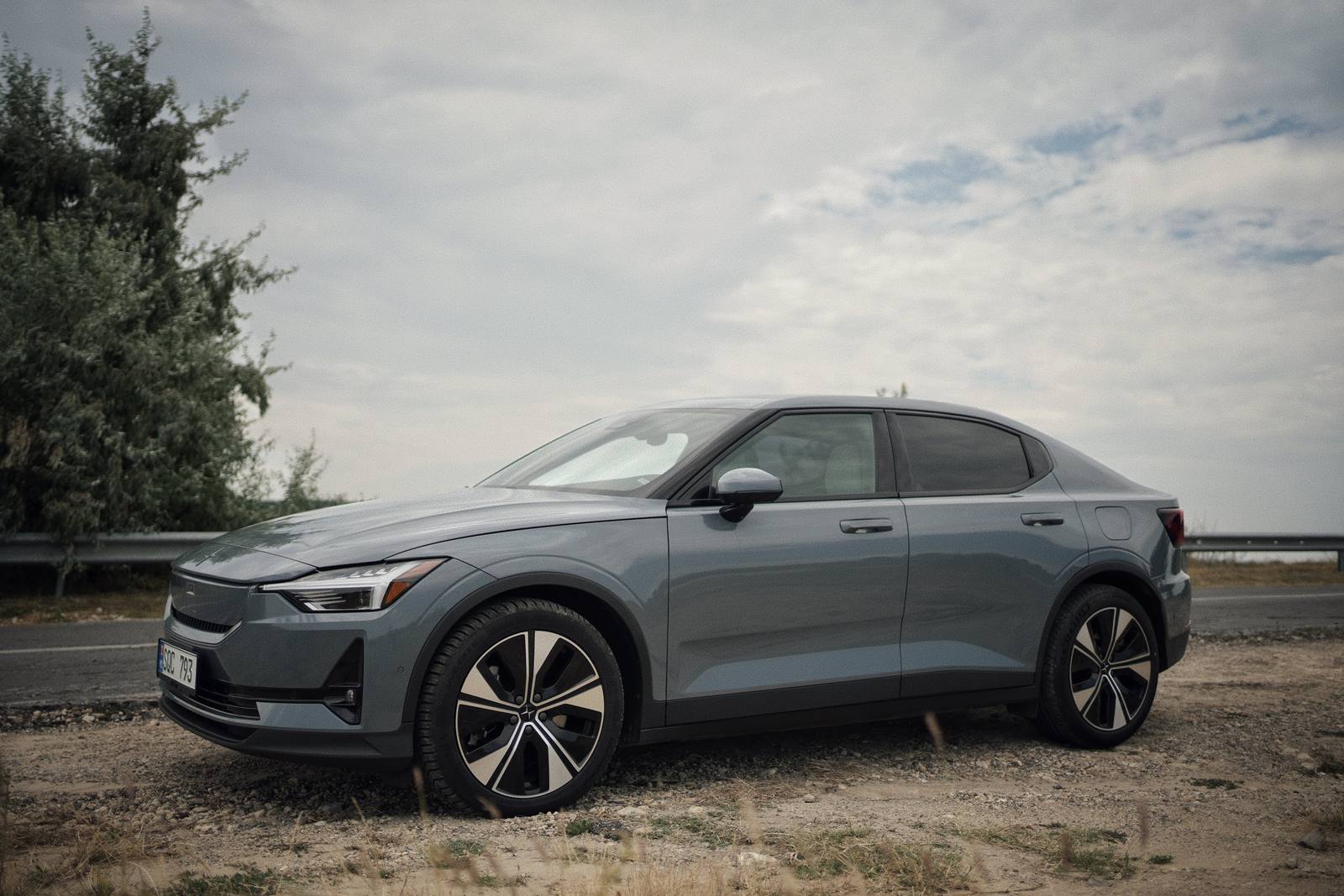
144 kilometres to Orheiul Vechi and back - and lower consumption than around town.
The first real trip out of the city: Chișinău - Orheiul Vechi and back, with everything an August day brings. A jam on the way out, good stretches at 90+ on the open road, parked in the sun for a while, 29 degrees outside.
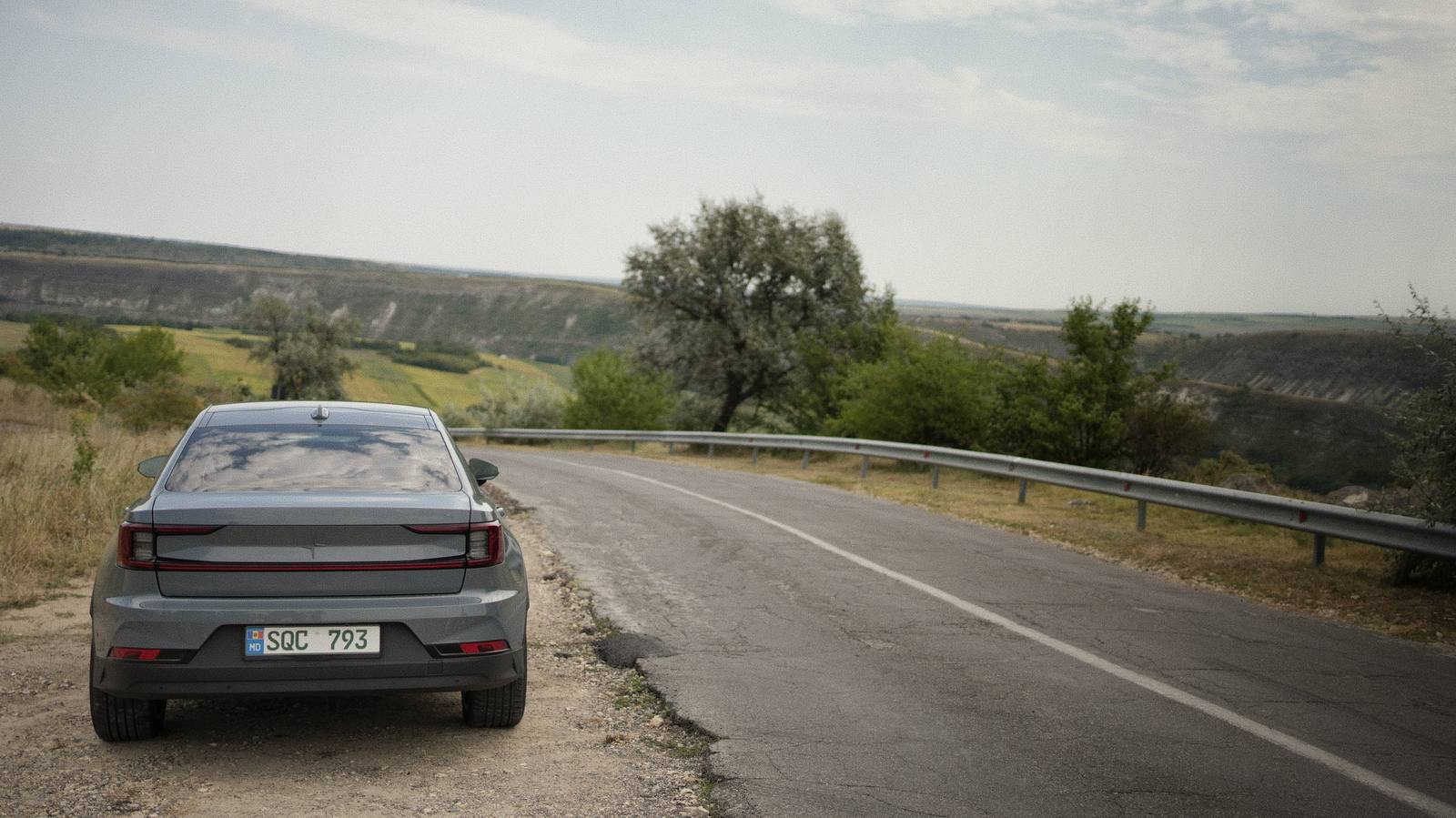
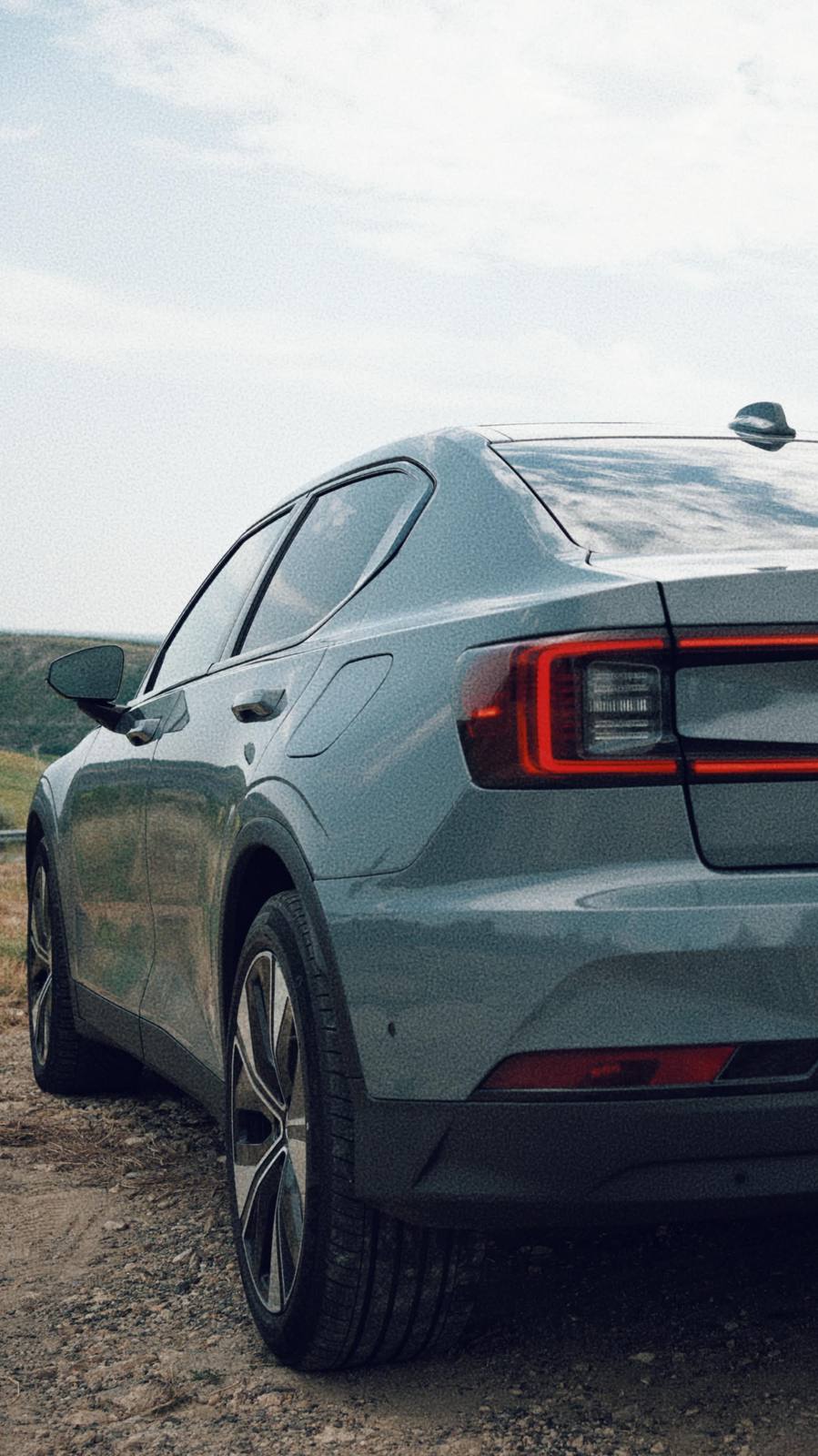
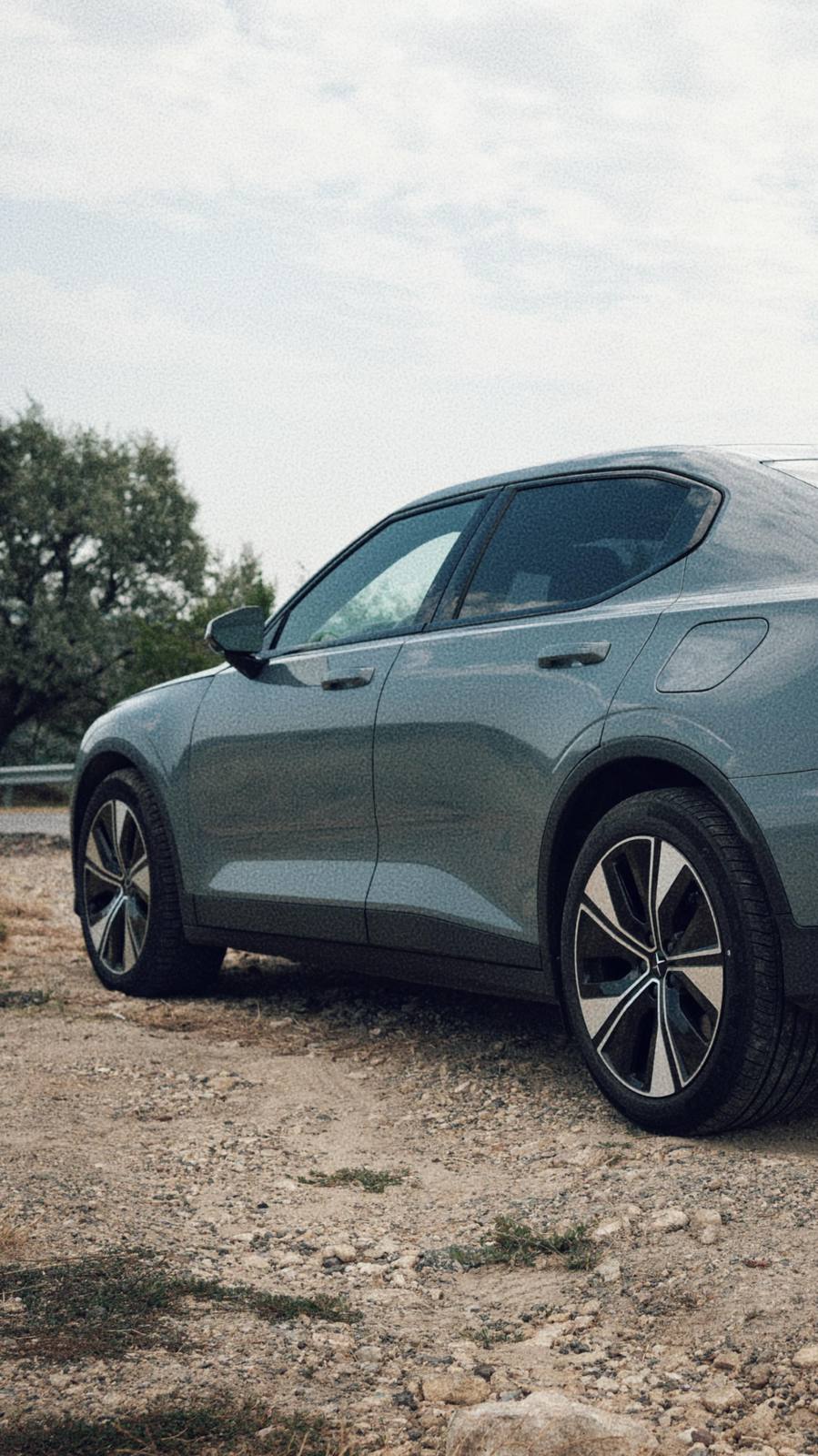
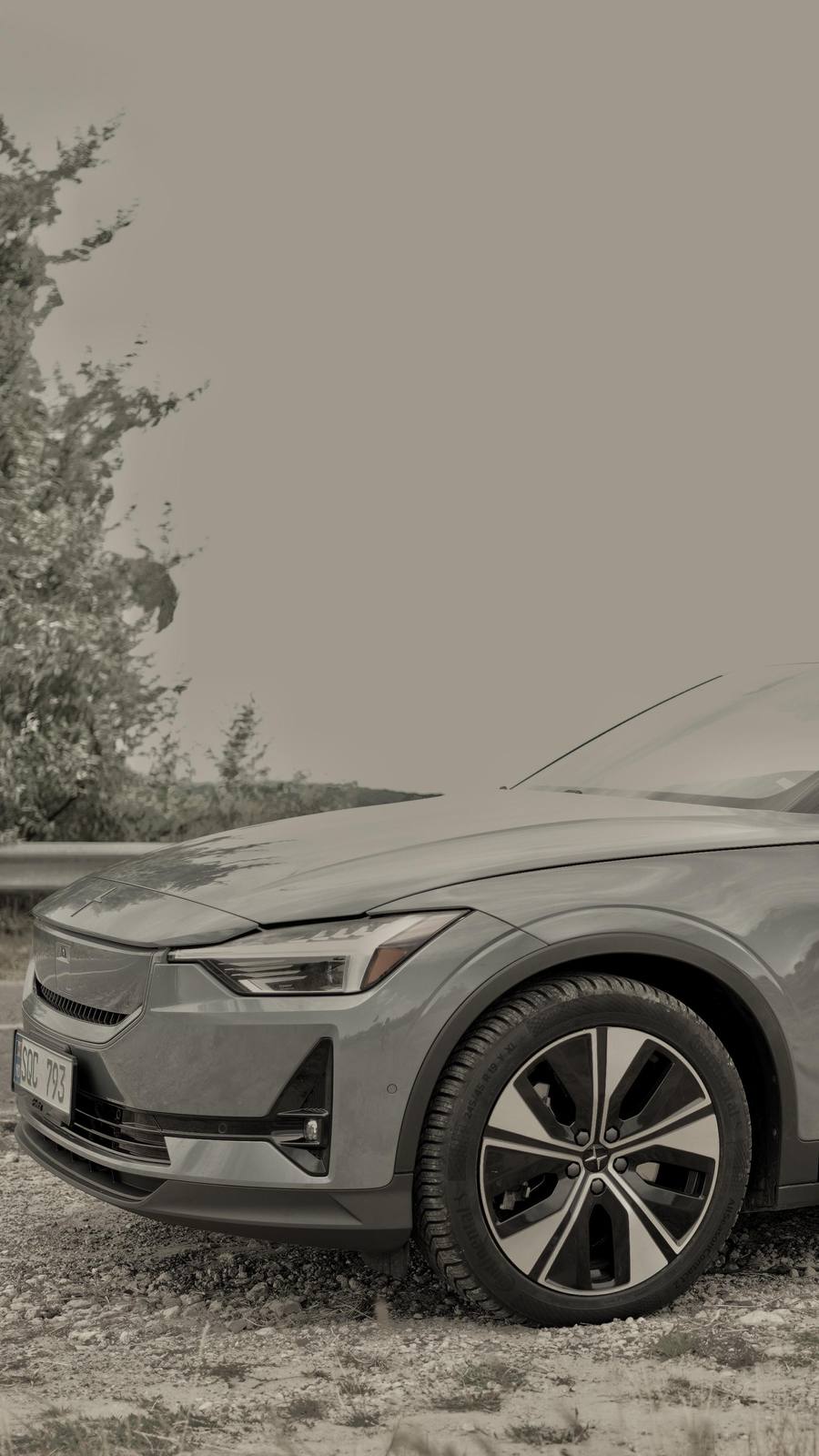
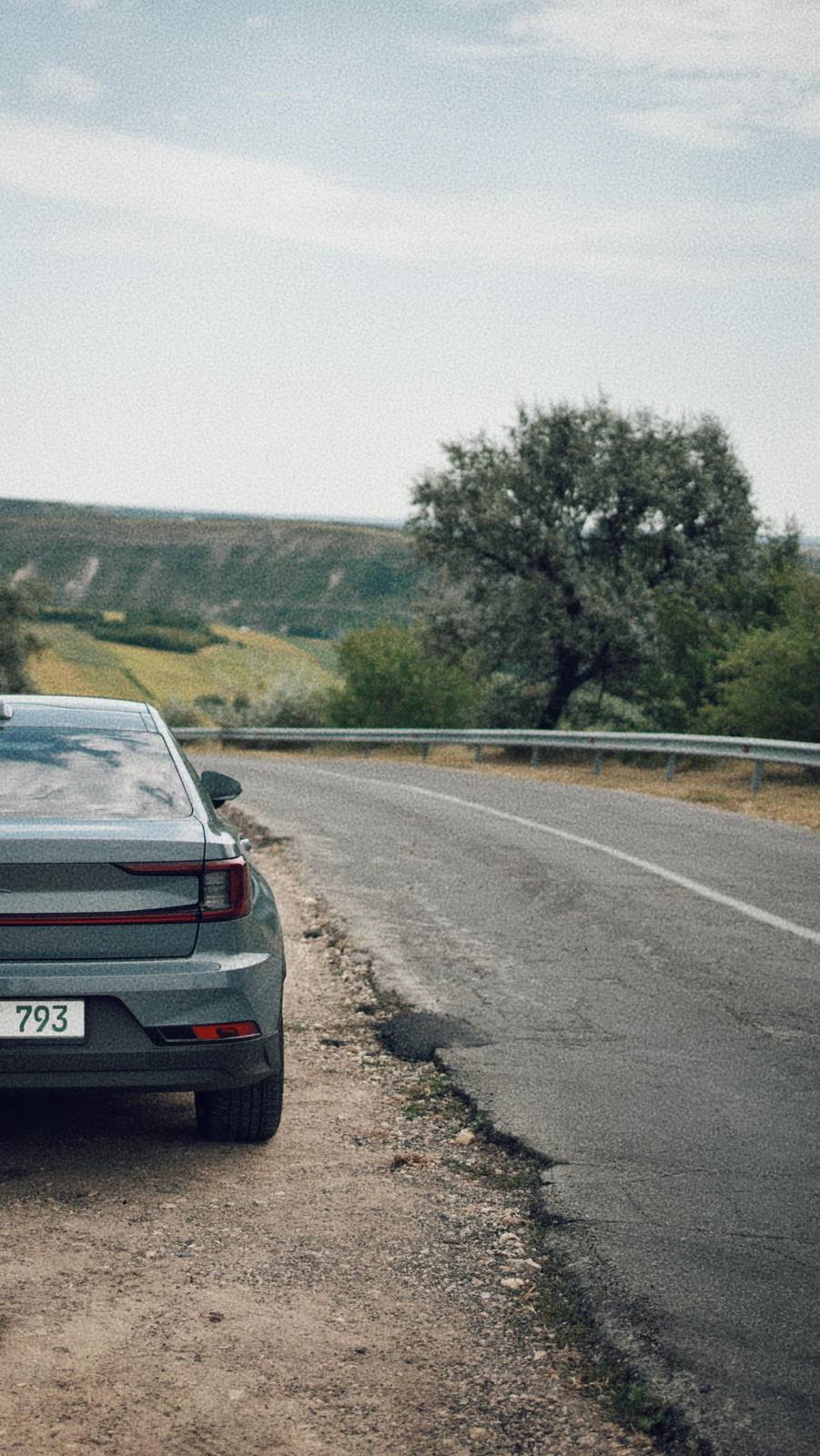
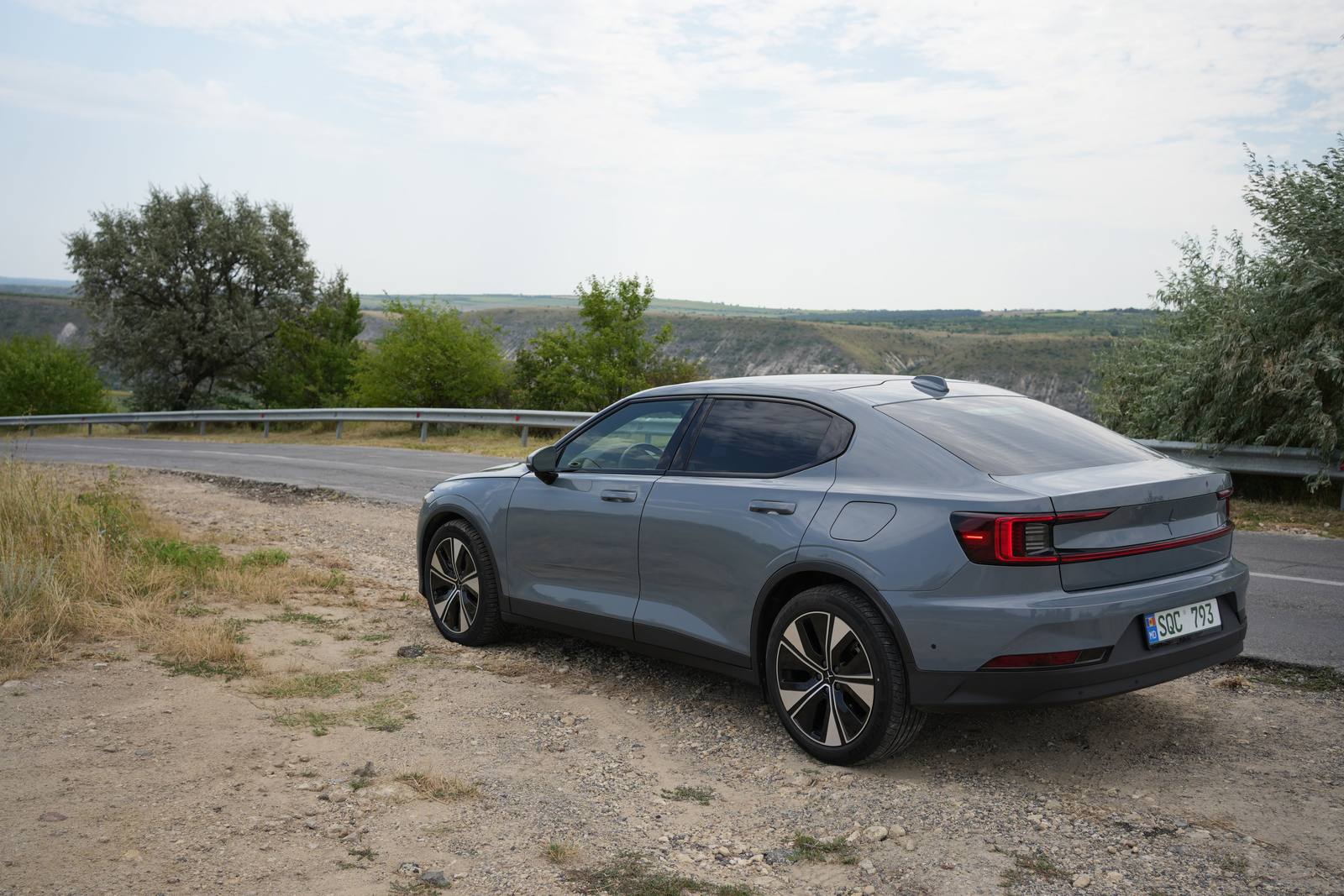
Orheiul Vechi · 08.08.26
01 · The consumption
The surprise of the day: 17.7 kWh/100 km over a 144.2 km route, in nearly four hours, averaging 37 km/h. Less, that is, than it does around town - where the long-term counter sits at 19.1.
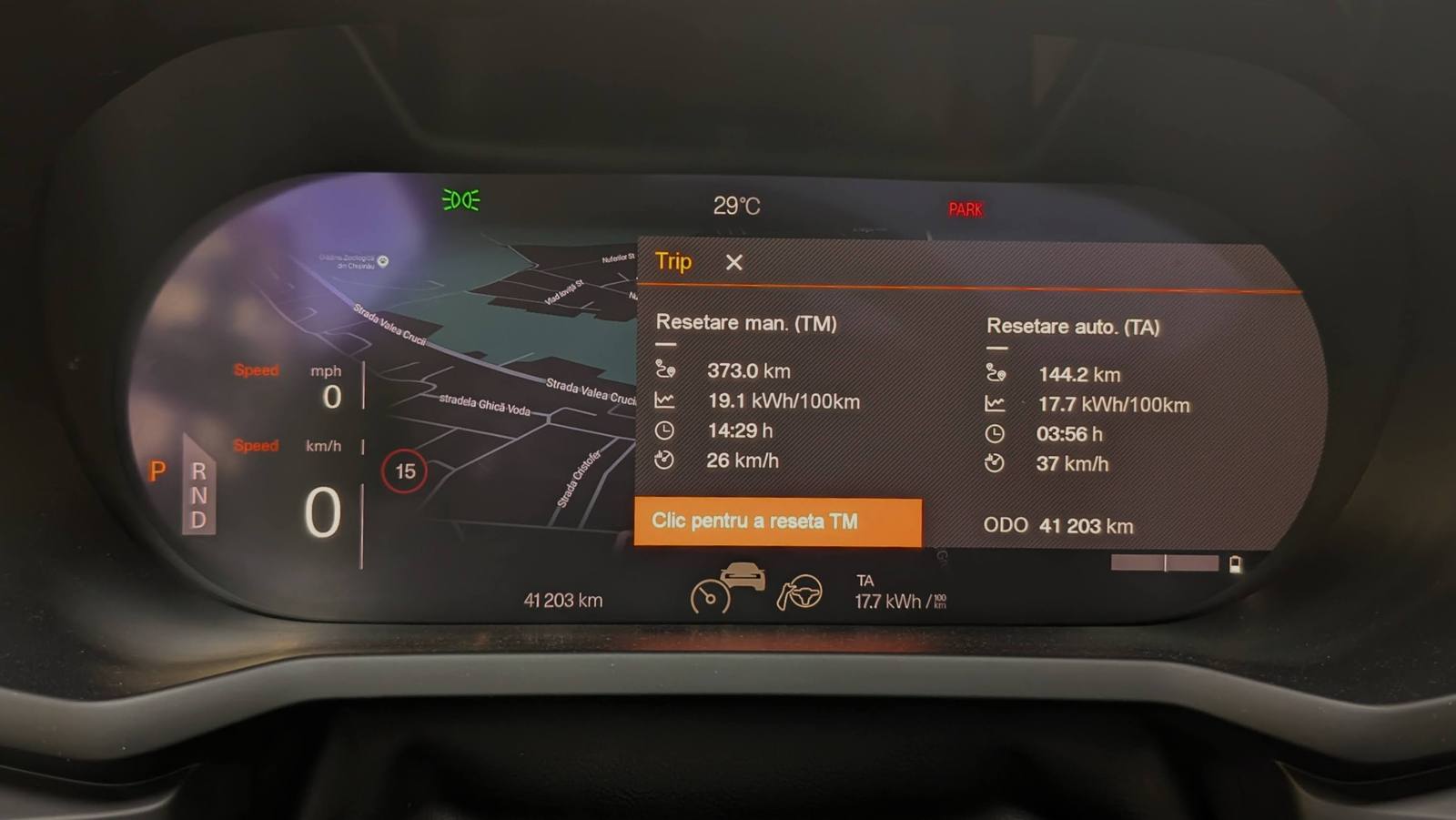
On a petrol car, this day would have looked the other way round: the jam and the crawling make it drink. Here, exactly the parts that raise consumption on petrol - standing still, long descents, frequent braking - are the ones that give energy back. And a cruising speed of 90-100 km/h is still below the threshold where aerodynamic drag really starts to count.
The conclusion, for a two-tonne EV with 421 hp and drive on both axles: the figure is good. Not unreally good - just good.
02 · Road manners
Nothing to fault here. Exemplary. It doesn't jump over bumps, it doesn't wander off the line you gave it, it holds its direction without corrections. Well planted. Easy to drive and, above all, relaxing.
It ties straight back to what I wrote at the wheel: it doesn't invite you to drive aggressively. Only that on a long trip, that calm is no longer a complaint - it becomes exactly what you need. You step out after four hours and you aren't tired.
THE WALLBOX
28 km/h instead of 2. The promise from 03.08, closed by a white box on the wall.
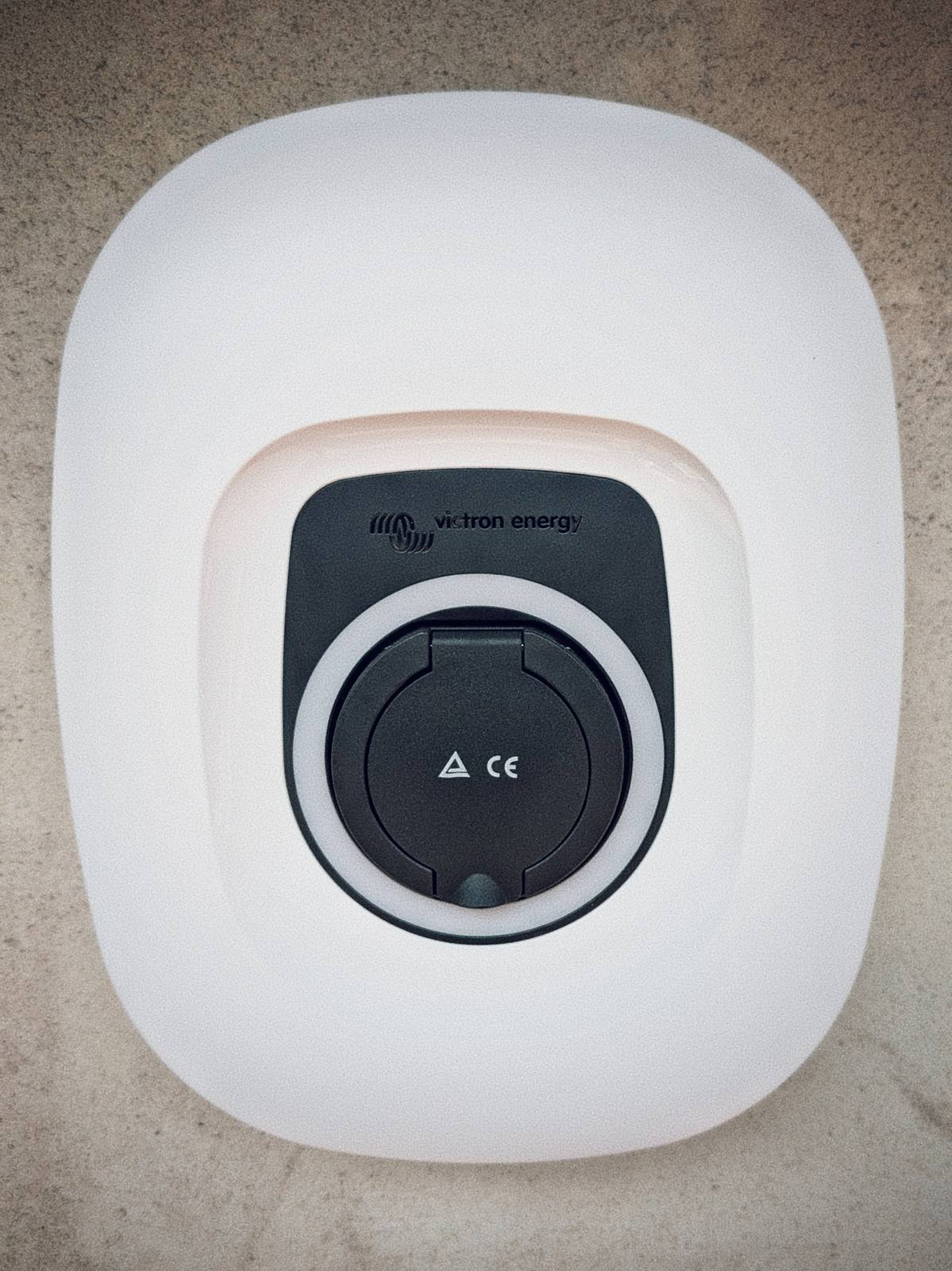
In the socket entry I wrote that the wallbox isn't a luxury, it's math. The day came for the math to be checked: a Victron Energy station, single-phase, 32 A, mounted and commissioned.
01 · The real numbers
The dashboard tells the whole story again - only this time from the other side: 28 km/h charging speed. At the 220V socket, in the heat, it was 2. Fourteen times more, on the same electricity and in the same yard.
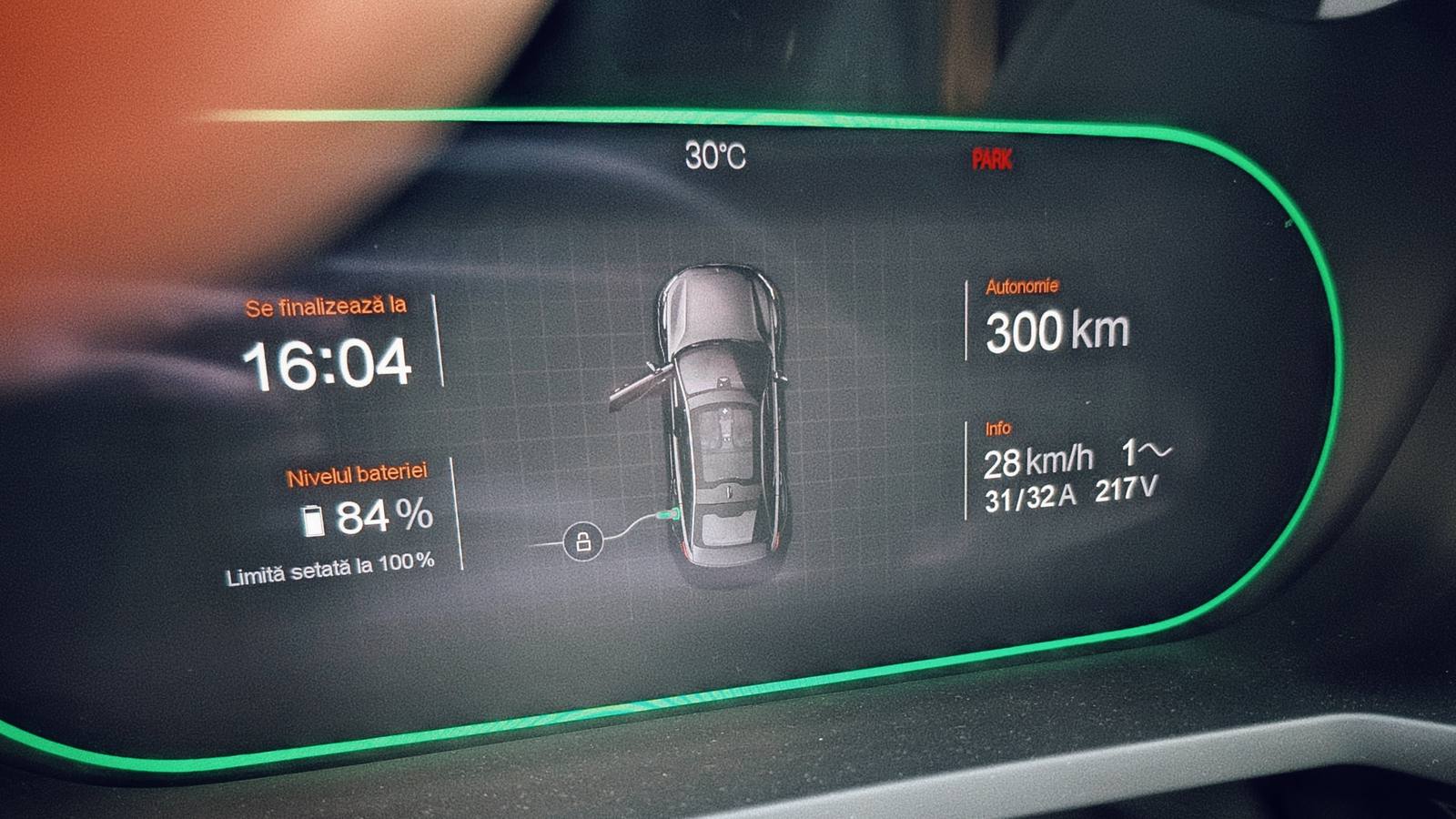
The detail that never makes it into brochures: the station draws 31 of its 32 A, but the grid voltage here is 217 V, not 230. That means ~6.7 kW real instead of 7.4 nominal - some 9% lost not at the car, not at the station, but in the line from the street. You can live with that.
02 · Where the process tax went
The 350-500 W the car burns just to stay awake while plugged in haven't disappeared - they are exactly the same. Only now they are spread over three times the power: from ~17% loss at the socket down to ~6%. Precisely the range ADAC gives for a wallbox.
And the time matters as much as the percentage: the same battery fills in hours, not overnight. At 84%, with the limit set to 100%, the car announced the finishing time itself. That is the difference between "I charge the car" and "the car charges".
03 · Why Victron
The choice isn't accidental. Victron is a Dutch company known not for cars but for off-grid and solar systems - inverters, batteries, controllers. Their charging station talks to the rest of that ecosystem: it can be set to charge from the panels' surplus rather than from the grid.
Which closes the loop back to the argument in the prologue: electricity is the only fuel you can produce yourself. The wallbox is the first half of that sentence. The second - the panels - is for another entry.
IT GROWS ON YOU
Three weeks together - and the car is starting to win. Not through what it does, but through what it refuses to do.
More time has passed, more kilometres have come. And the more I drive it, the more it grows on me - the English expression is exact.
01 · The character
Its character nudges you toward quiet. It never provokes you - and at every incident and provocation in traffic it seems to tell you: you are better than this, keep calm. Few cars have a moral position. This one does.
02 · The pedal, reread
I come back to the accelerator because it deserves it: it is superbly tuned. At the start of its travel it is perfectly linear - no jerk, just smooth build. And if you press 1-2 centimetres quickly and lift just as fast - nothing happens. It filters input noise the way a good preamp filters a bad microphone.
And a correction to what I wrote on 05.08: back then I drove with regen off and creep on. Since then I have switched to one-pedal with standard regen and creep off - and the stops have a finesse almost no car has: you come to a complete halt without that last-moment rocking. The dossier is alive; so are the opinions.
03 · The Volvo brotherhood
What I did not anticipate: Volvo drivers see the Polestar. Especially since it is still rare around here. Every time I needed to change lanes or be let through, the people in XC90s, XC60s, S90s all but invited me to make the move. A kind of family greeting, without the horn.
04 · The mirrors, an open chapter
I have somewhat got used to the US-type driver mirror - the "zoomed-in" one that shows exaggeratedly little. But I have ordered the European-type glass anyway; I think it will change visibility considerably. I will report back once it is fitted.

And in the same chapter: frameless looks superb, but it has its minus - in the rain, drops gather on the glass with no protection from a frame, the way other cars have. And the mirror heating only starts from the rear-defrost button and takes a few minutes. We will see how winter goes.
05 · Connectivity
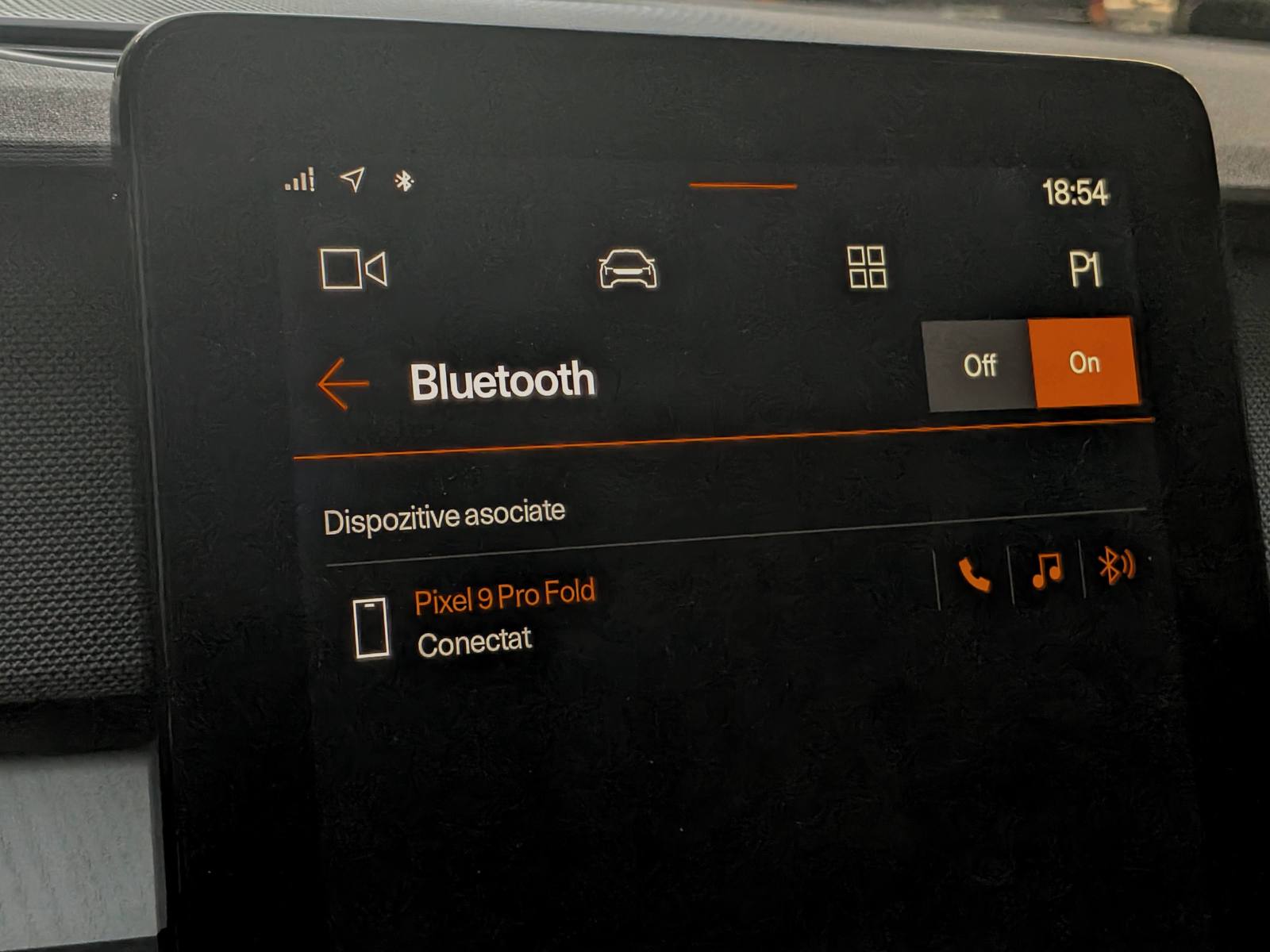
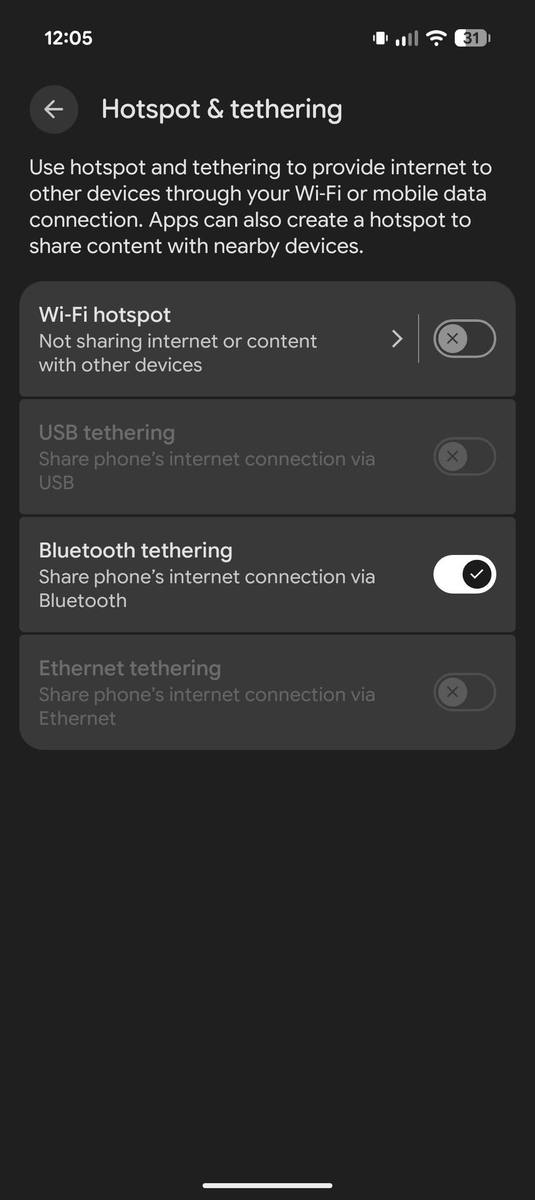
Android Automotive prioritises connections exactly right: Wi-Fi first, then Bluetooth, and only then its own modem. In practice: you enable Bluetooth tethering on the phone once - and that is it. No hotspot to start manually, no cable, no wired Android Auto.
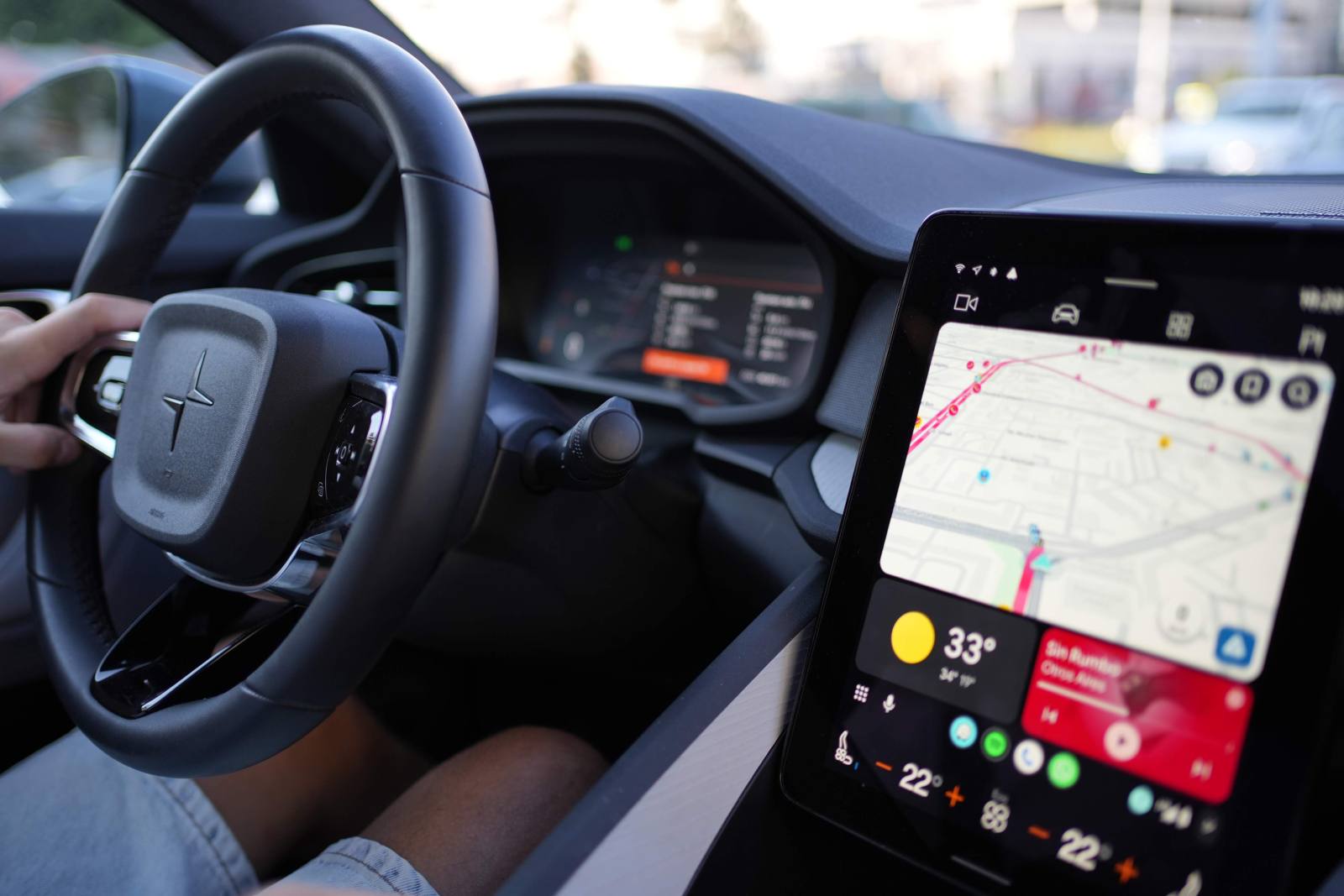
Google Maps in the car is smarter than the one on the phone: it knows the battery level, tells you for any destination what percentage you will arrive with - or whether you will make it there and back - and shows every charging station on the route. Waze has an interface adapted for the Polestar, at a higher resolution than on Android Auto. Spotify links straight to your account. And the vertical screen is the correct format for a car - especially in navigation, where the road flows top to bottom, not side to side.
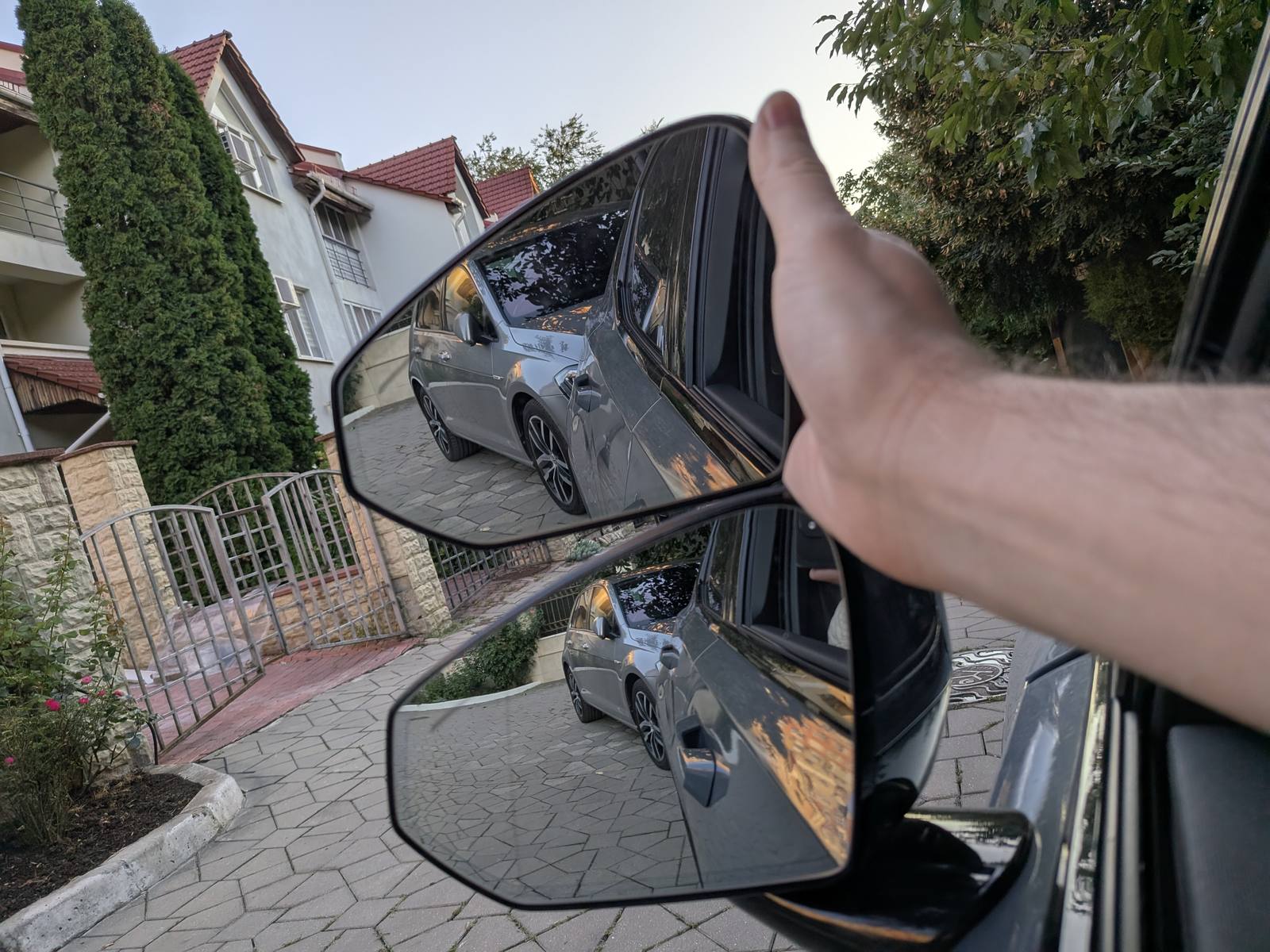
THE MIRROR
The European glass, fitted: you see what you see in any European car - no blind spot on the driver's side. The promise from 19.08, closed.
On 19.08 I wrote that I had ordered the European-type glass and would report back once fitted. It is fitted.
01 · The European glass
The result is exactly the expected one: you see what you see in any European car - no blind spot on the driver's side. The difference shows on the bonnet too, with the two glasses side by side: the American one is flat, 1:1 - the "zoom" I complained about; the European one is aspheric, with a curved outer edge that brings the next lane into the frame. The reason is legal, not technical: in the US the driver's mirror must be flat, at true scale; Europe allows aspheric glass.
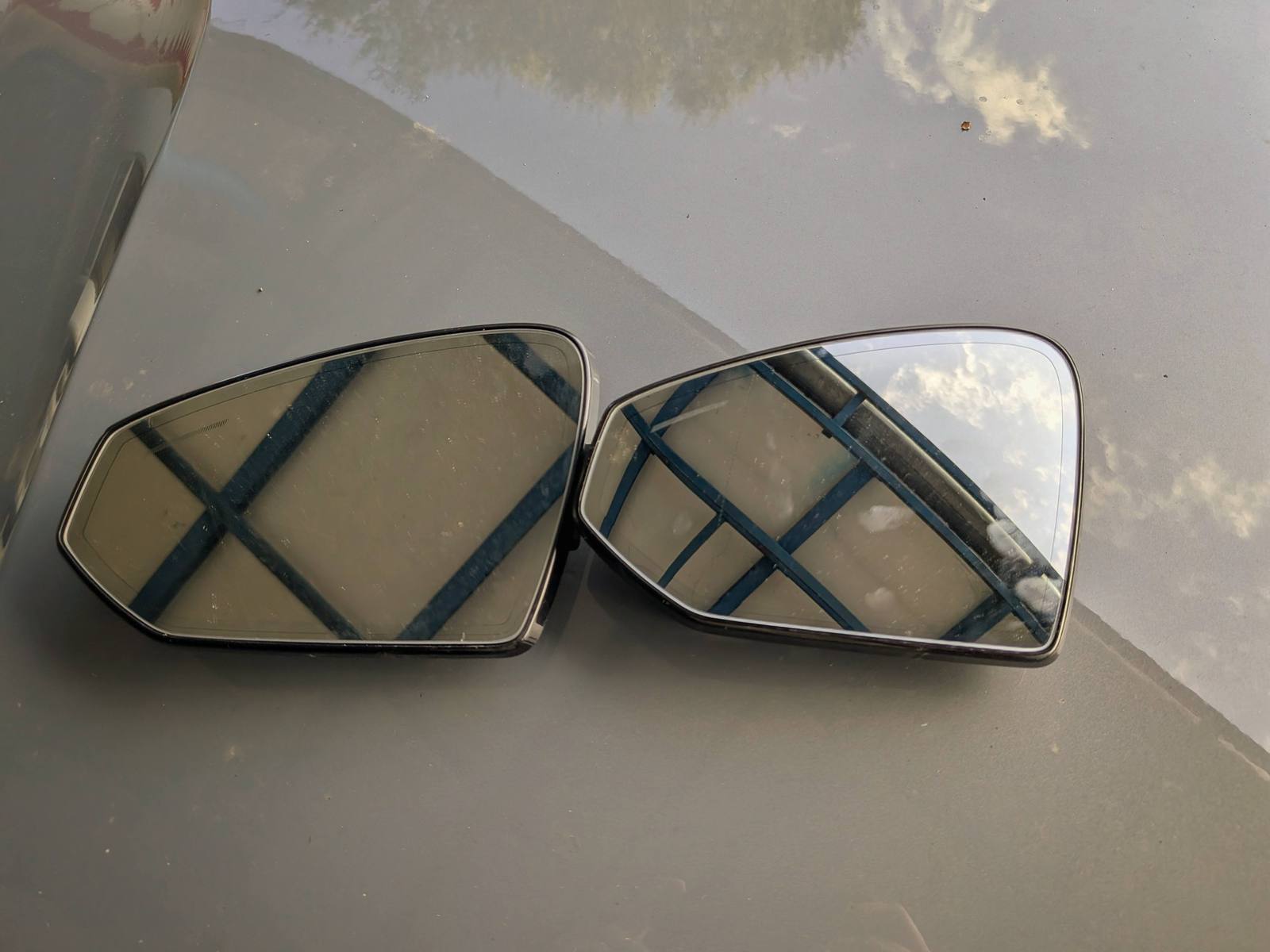
Not my first time. I had a 1:1 American driver's mirror on the Lexus GS too - very awkward. And on the BMW X3 and the 740Li I swapped the driver's glass for the European one, with the same big gain in visibility. On the Polestar 2 it is nothing more than the expected result - and the way I am comfortable. The mirror chapter, at least the visibility part, closes here; rain and winter remain to be seen.
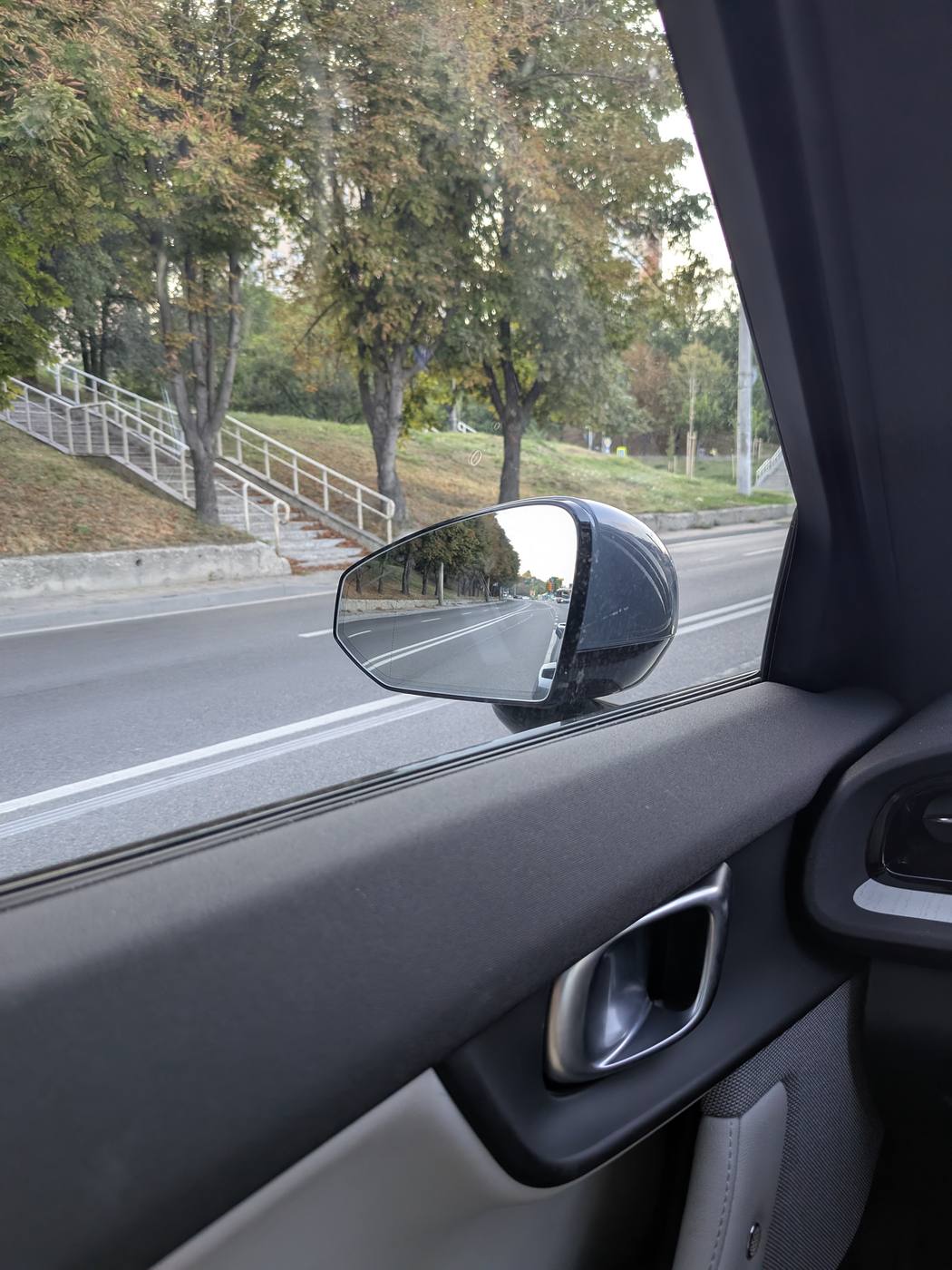
See also: BMW X3 F25 · 03.10.23 · Improvements - the same European glass, two years earlier
02 · By the way · e-Golf, with photos
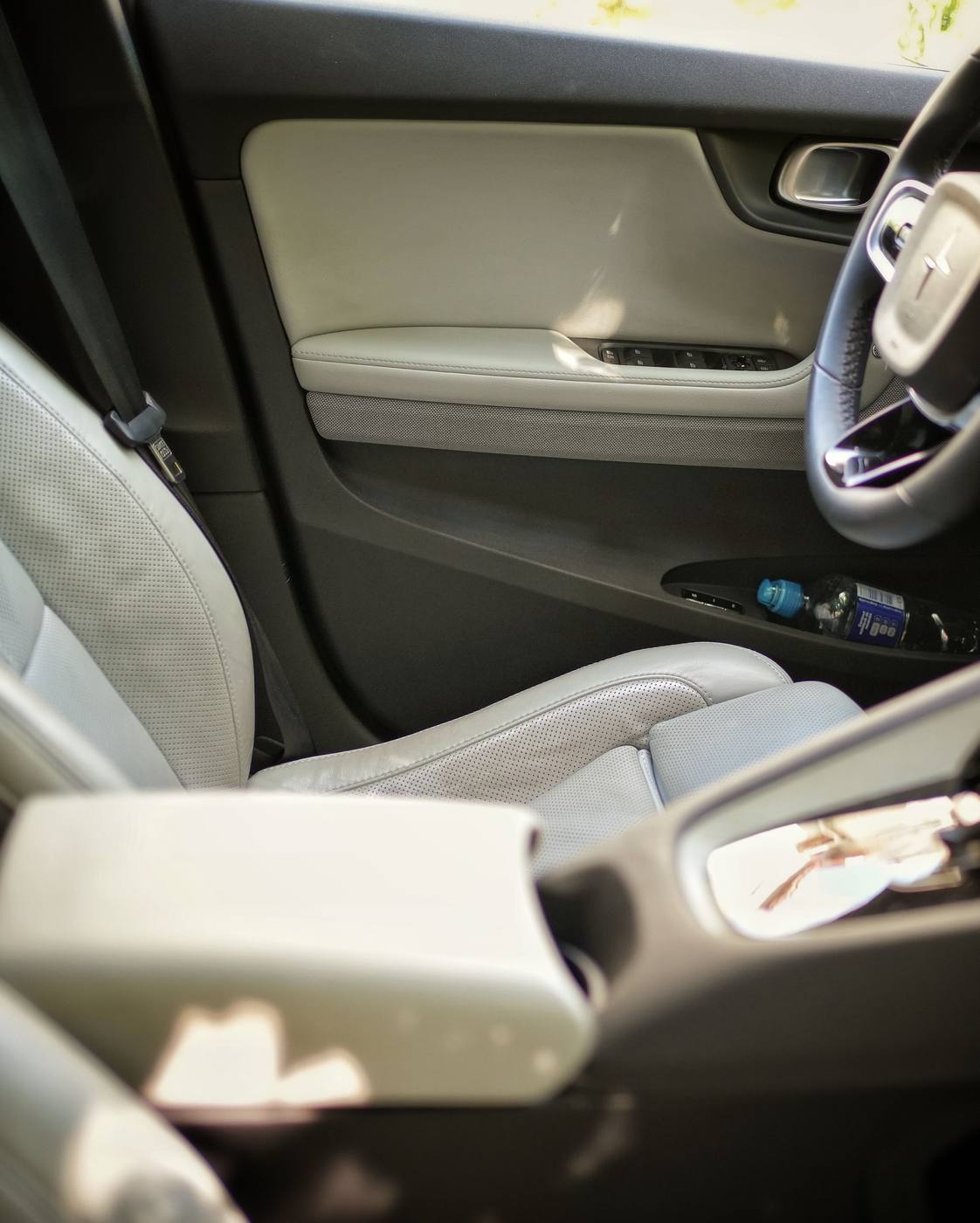
Since I had the camera in both cars anyway, two pieces of evidence for what I wrote under Ergonomics on 05.08. First, the door ledge: on the e-Golf it reaches the seat and the elbow settles naturally; on the Polestar it ends early - in the natural position, your elbow is already on the B-pillar.
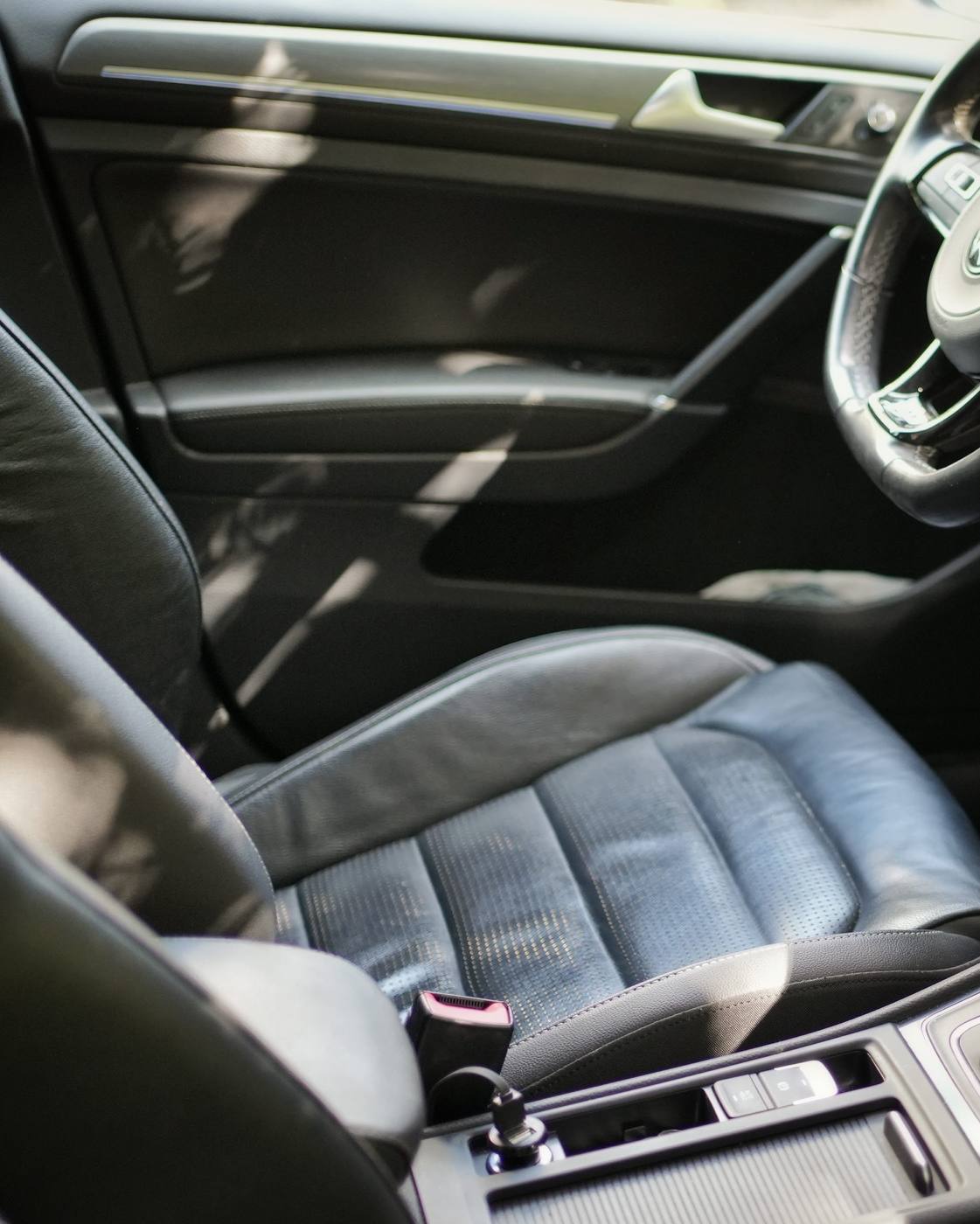
Then the armrest - with a clarification: the Polestar's does not bother me. It is just that the e-Golf's lifts on a hinge - adjustable in height, not just in length - and leaves room for whoever wants a different position. On the Polestar, forward and back only.
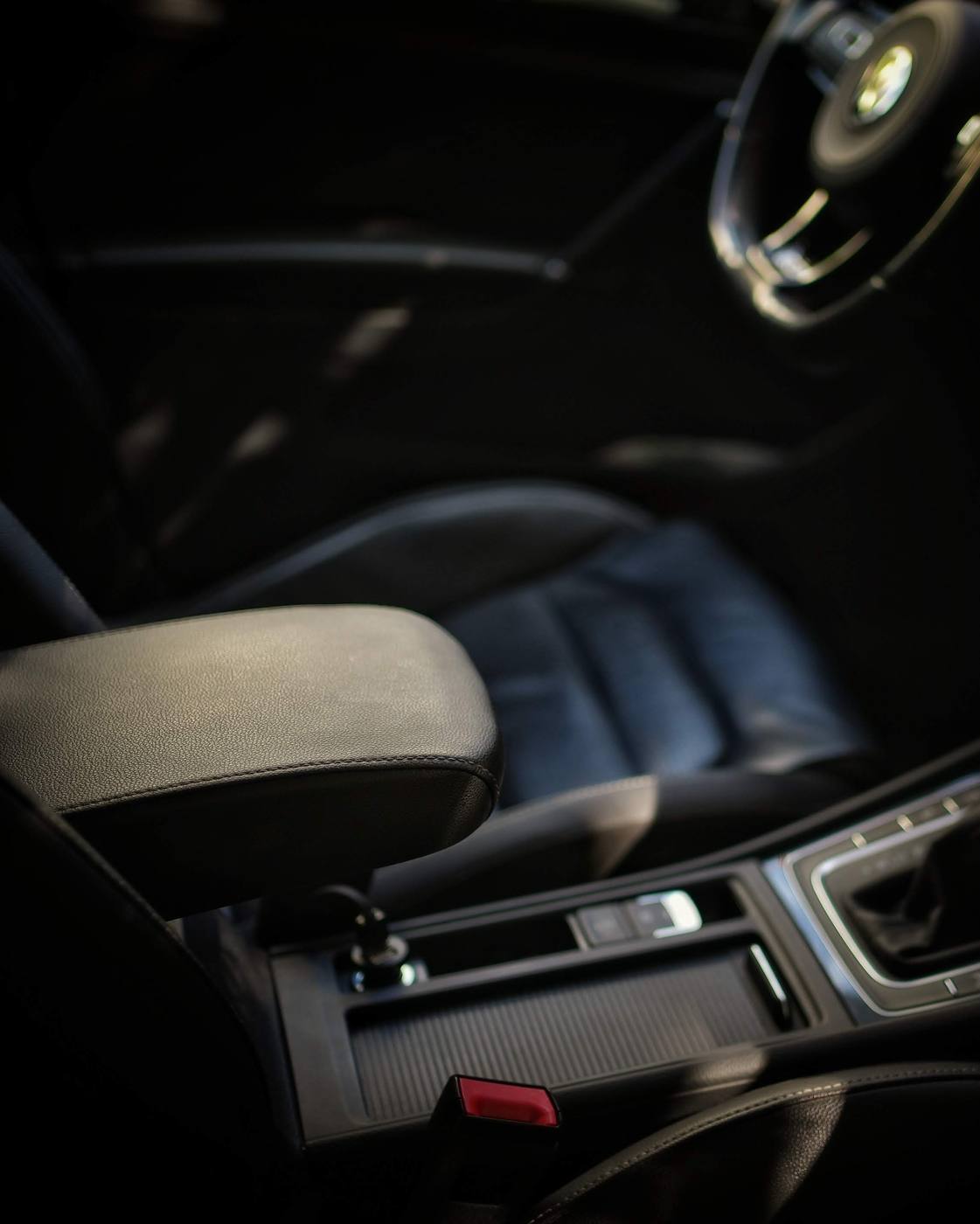
And one more aside, from the same seat: in the e-Golf the seat goes lower than in the Polestar, and the body sits differently at the wheel - legs more stretched, a more "sedan" posture. Plus the steering wheel, with a wider range of reach adjustment toward the driver: the 2-3 centimetres missing on 05.08 are exactly those. Not a tragedy - it is the difference between the seventh iteration of a Golf and the first of a Polestar.
See also: BMW X3 F25 · 09.08.24 · The sport interior - the seats that hold you in corners
03 · The American version's bonus
To be fair to the import from the States: the mirror was its minus, but it has pluses too. The most visible one, from behind: the turn signals are amber, not red. In America the law allows red rear turn signals and most cars there come that way - here, a red indicator gets confused with the brake light, and registration often demands a conversion. The Polestar 2 comes with European amber from the factory: nothing to convert, nothing to explain in traffic. The list of bonuses stays open - the dossier is alive.
THE DASHBOARD
One sharp corner bothered me. I ended up redrawing the whole dashboard.
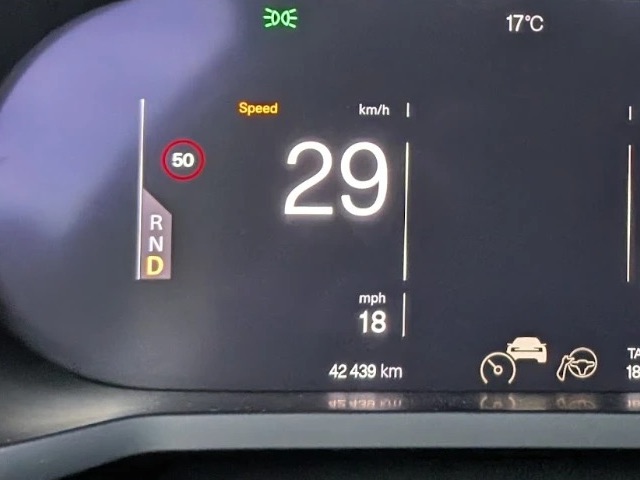
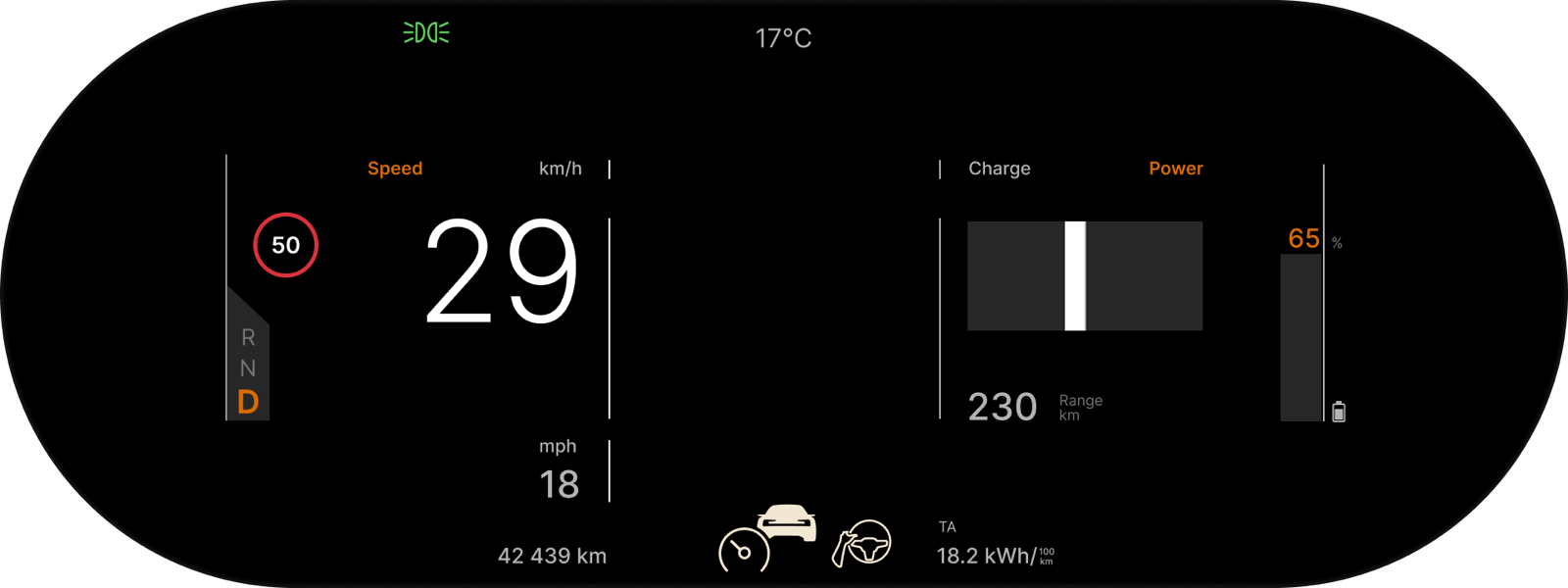
The photo is of the dashboard in Calm mode, the one without a map, at 29 km/h. Something on the left of the screen grated on me from day one: the sharp corner. This is the short version; the full study is on rt.md, in the Academia de Design.
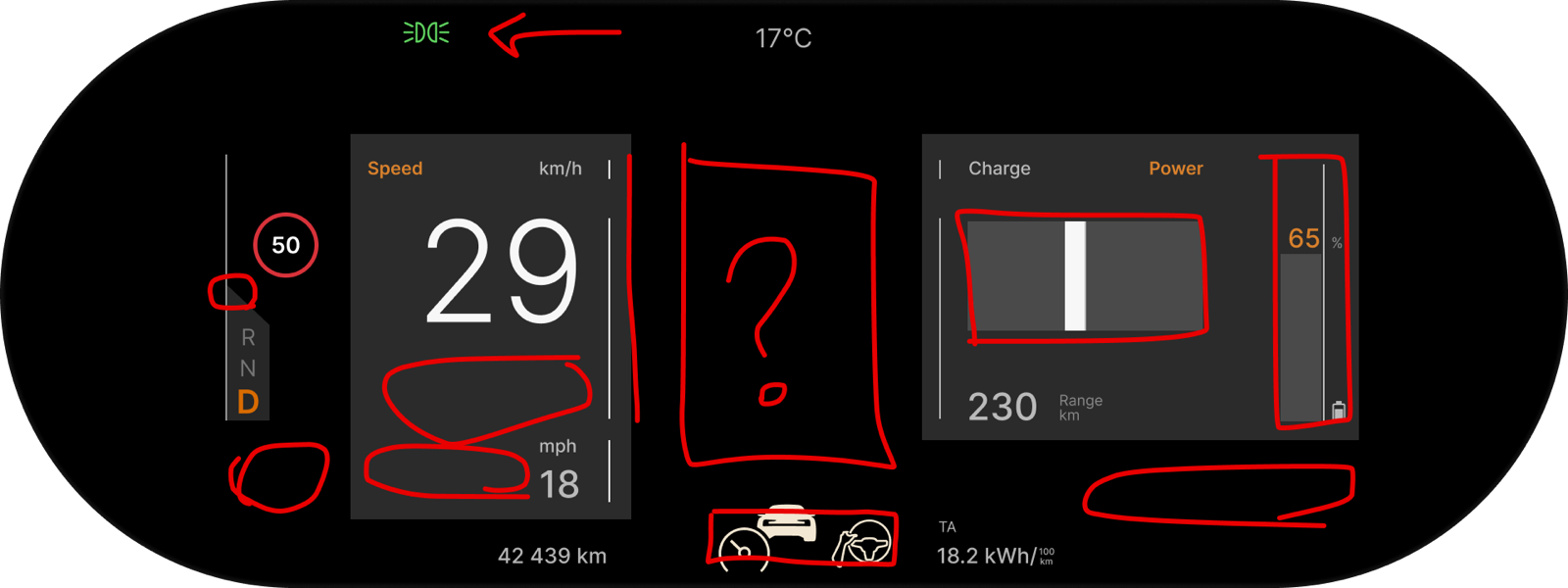
01 · The corner
The gear selector, R N D, has its top-left corner cut on a diagonal. It is the only diagonal in the structure of the screen. Everything else in the Polestar interface is made of straight lines, right angles and typography. The typeface is a custom version of Unica77, a Swiss grotesque from the '70s, remade by Lineto - and even they call it the main element of how the car communicates. In a language like that, a diagonal is a foreign word.
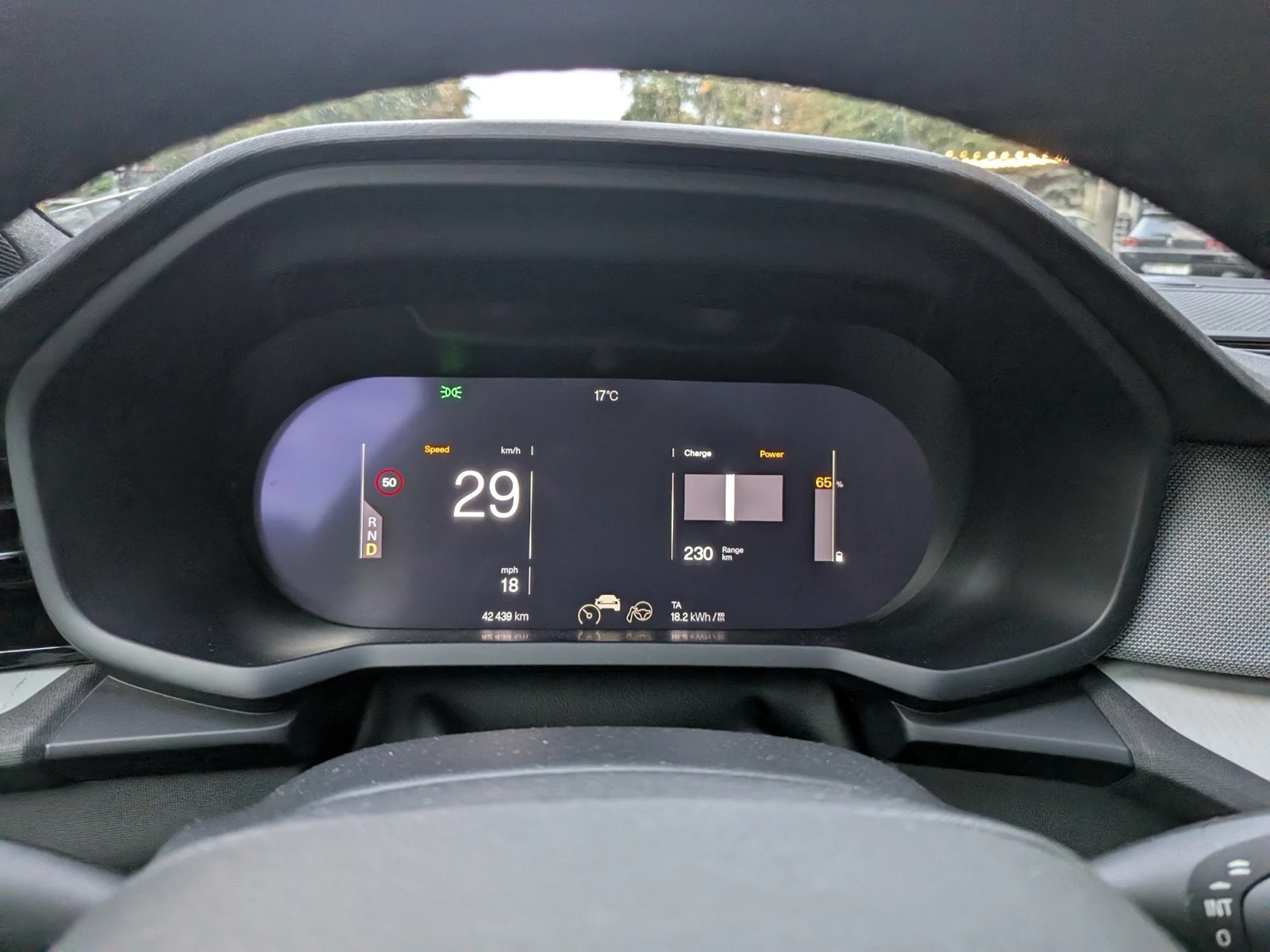
A sharp corner in a screen of right angles is like a typo: once you have seen it, you see it everywhere.
02 · The same first, then different
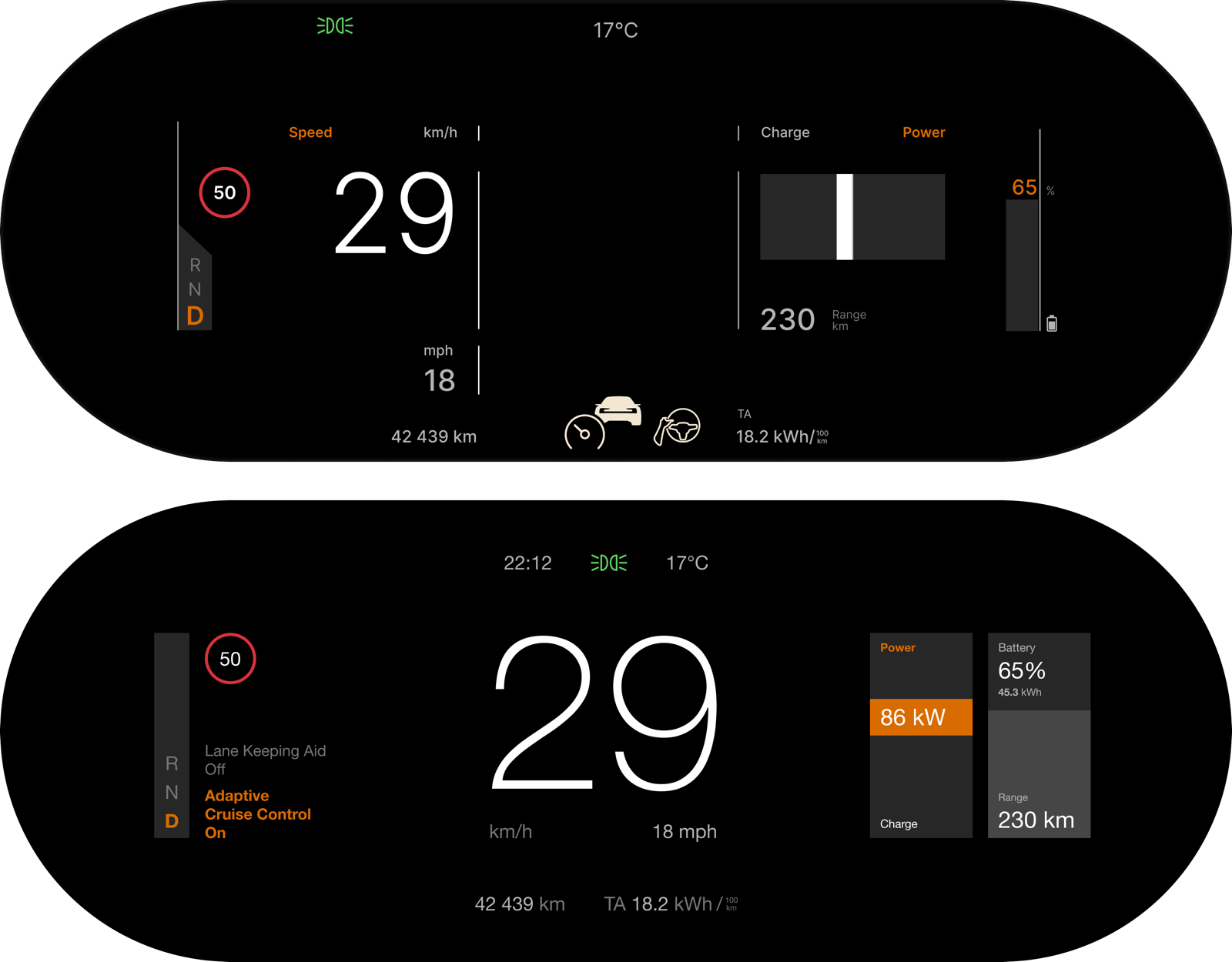
I tried to rebuild the screen as faithfully as I could from photos, to have it as a reference: 1920 × 720 pixels, the resolution of the 12.3-inch screen, with the colours measured and the symbols redrawn until they overlapped the photo. On this reconstruction I marked what bothers me, and next to it I drew my version. Only then does the criticism become measurable, not just an opinion.
03 · After the corner, the rest
The vertical lines seem to group the information next to them. At the speed, they group nothing: a short line for "Speed" and "km/h", a longer one for the number, another one below for mph. Three lines for a single piece of information. And if you draw a rectangle around everything to do with speed, it has big holes in the bottom left.
After the speed comes an empty space. Precisely the area you see most easily through the steering wheel: the rim covers the edges, not the centre. Polestar does not use it at all.
At the top, the lights telltale sits on the left for no reason. It could sit in the middle, between the clock and the temperature. And the clock is missing: it is on the centre display, but we are used to seeing it on the dashboard as well.
On the right, one bar is horizontal, the other vertical. Why?
04 · My version
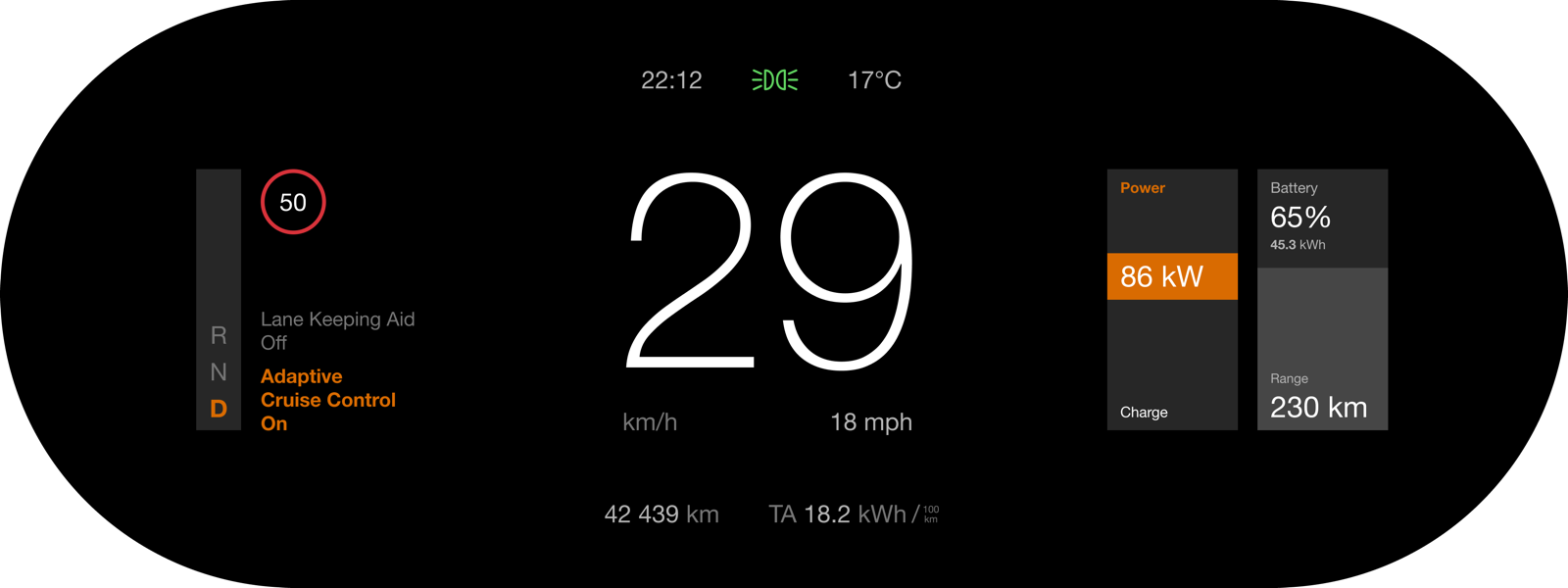
The proposal is only for Calm mode, the one without a map. I split the screen into three zones, by meaning. On the left, driving: the gear, the limit, the assists. In the middle, the speed. On the right, energy: power, battery, range. No lines - the blocks and the spacing between them do the grouping.
The speed digits grew from about 2 to almost 4 centimetres, and the speed moved to the middle, exactly where it is most visible through the steering wheel and where your eyes naturally go.
No acute angles. The R N D rail lost its corner and is as tall as the blocks on the right, even if it stays empty at the top: symmetry matters more than filling the space.
At the top, the clock, the lights telltale in the middle, and the temperature.
On the right, both bars are vertical. The orange going up is Power, which is why the "Power" label is orange too: it is the legend of the bar. The white going down is Charge. For the battery I also added the energy in kWh.
And one detail of balance: the right side weighs more visually than the left, so the middle axis is shifted by 20 pixels, about 3 millimetres. Optical, not geometric.
05 · Text, not icons
For cruise control and lane assist I used text instead of icons. I admit it: an icon is caught faster than a word. Only, seen up close, the two current icons look like they come from different sets, with different visual weights: the dial is a 3.3-pixel outline, the car a solid silhouette, the steering wheel with the hand a 2.6-pixel outline, and one is not the size of the other. Text is exactly their language.
And you read the text only once. After that, you know it by position: if the bottom left is orange, cruise control is on. "On" is bold and orange, "Off" is thin and grey, so the difference holds even for those who cannot tell colours apart well. The label has a single job: to show that it is on. When it switches off by itself, the car shows a larger notification and plays a sound anyway.
06 · The proposal
I realise it is not simple to implement, and that there are loads of cases to plan for. But as the default state, if this is what you saw on the dashboard every day, in Calm mode, I think it is better. Or a new mode could appear - why not?
Both screens are in an open Figma file, where they can be viewed and downloaded.
The whole process - the measured diagnosis, the principles, the seven variants and the glance test - is in the full study: Polestar 2. The driver display, rethought.
See also: Essay 03 · The decade lost to software - why what is on the screen matters
ELECTRIC, BUT ANALOG
An electric car with nothing to explain: not to your parents how to get in, not to your grandparents how to get out.
In a note under the 05.08 entry I wrote, in passing, that the exterior handles are exactly right. Two months in, I would stretch that sentence to the whole car: the Polestar 2 is an electric car as analog as it gets. I went through it with the camera on 29.09, in the order you use it - from door to door.
01 · Getting in
The door handles are in plain sight. They don't hide in the body, they don't pop out when you approach, and they have no buttons. You grab them like any car door handle you have ever held.
With the key in your pocket, you put your hand on the handle and the door is already unlocked. Nothing to press, nothing to wait for.
02 · The steering wheel
Adjustment is by a mechanical lever under the column: push it down, set the wheel, pull it back up. Two seconds and done. No hunting through menus to then move it with the buttons on the wheel - up, down, in, out. The reach toward the driver could have been a bit longer, as I wrote on 05.08, but the gesture is exactly right.
03 · Windows and mirrors
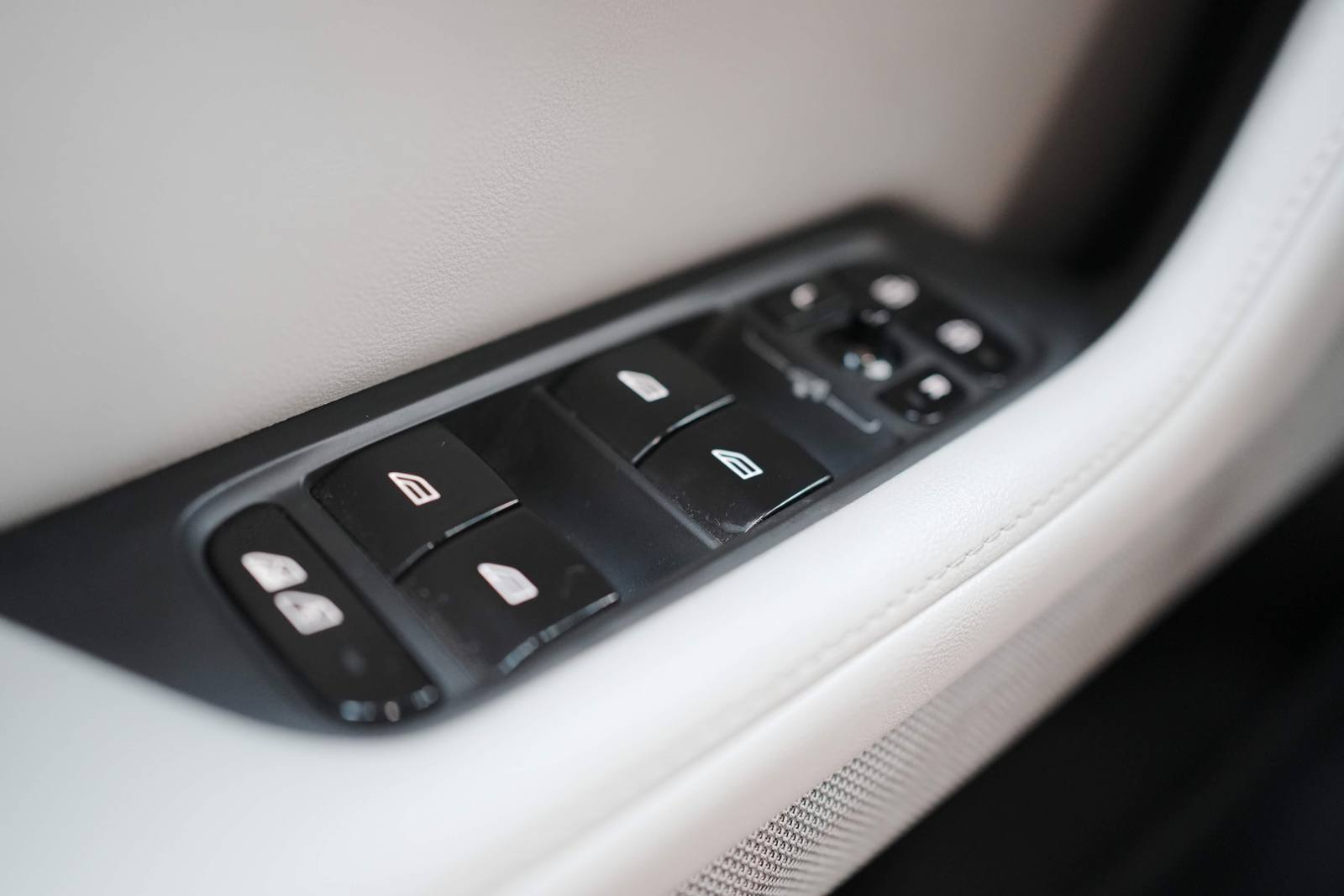
On the driver's door, four buttons for four windows. It sounds obvious, but it no longer is: the VW ID.4 has only two, and for the rear windows you first touch the "REAR" button. Here every window has its own button, and the mirrors have their joystick. You find them without looking.
04 · The selector
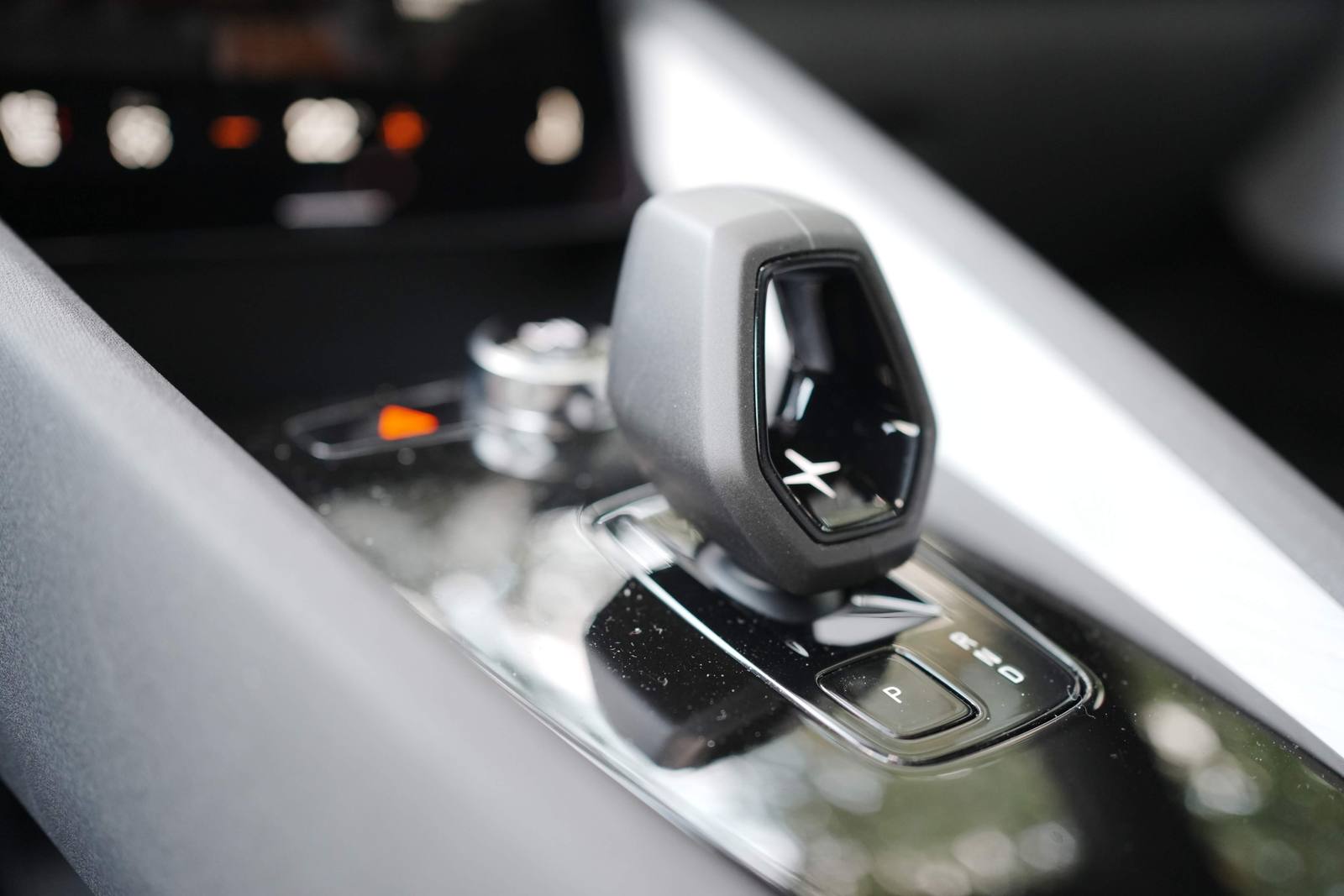
The right size, a nice shape, and just the right effort to push it into D or R. Put it in D and go - like in a BMW. And P, just like there, has its own separate button. It's the same R N D I wrote about on 25.09 - this time the one in your hand, not the one on the screen.
05 · On the move
The indicators are on the classic left stalk, not on buttons on the wheel. Tesla took it off the Model 3 in 2023, and since 2025 it has been putting it back - first in China, then in Europe too; in America it sells it as a retrofit, for 595 dollars. The wipers are on the right stalk, with their own thumbwheel for the rain sensor.
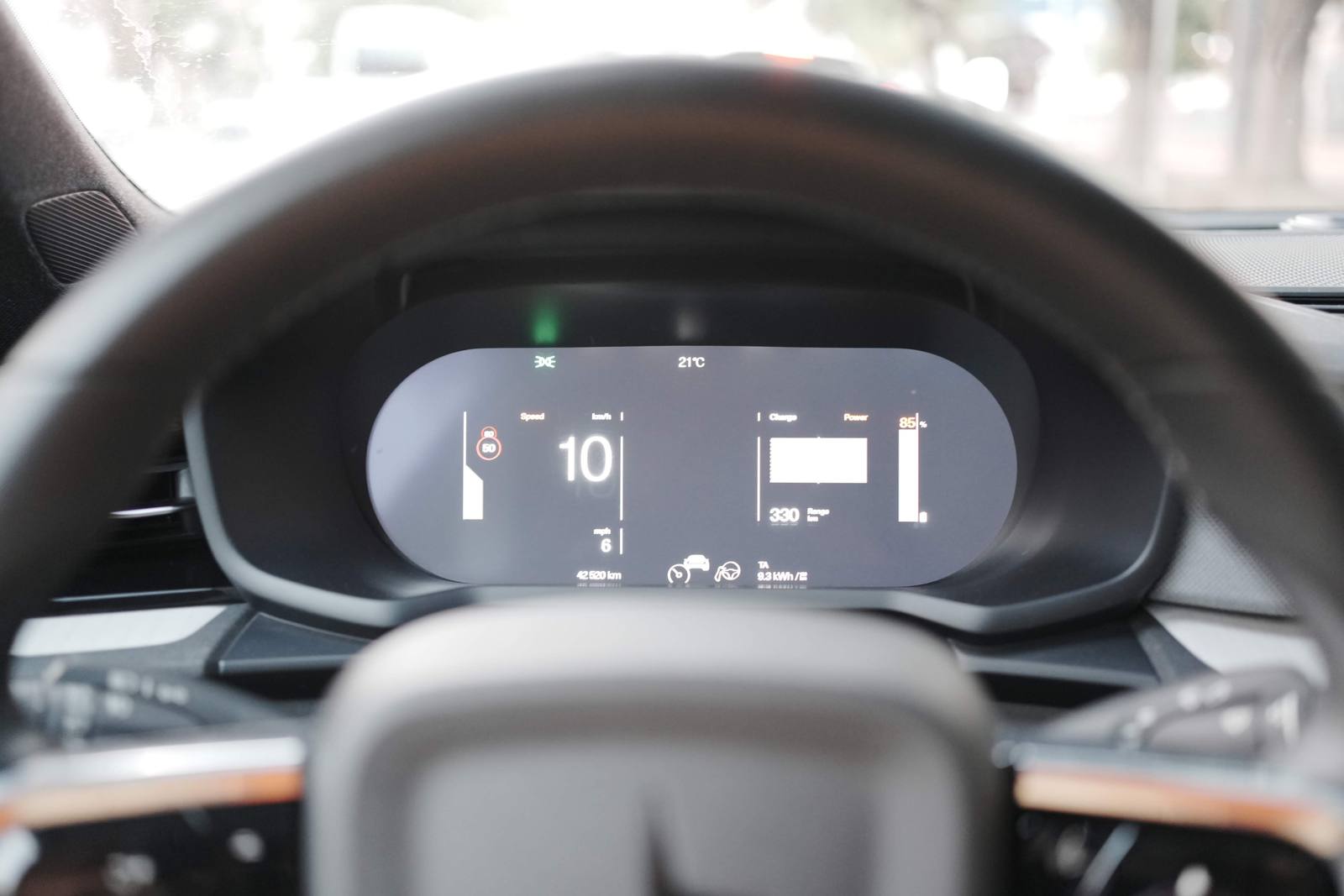
And the buttons on the wheel are all physical, with a short, sure click under the finger.
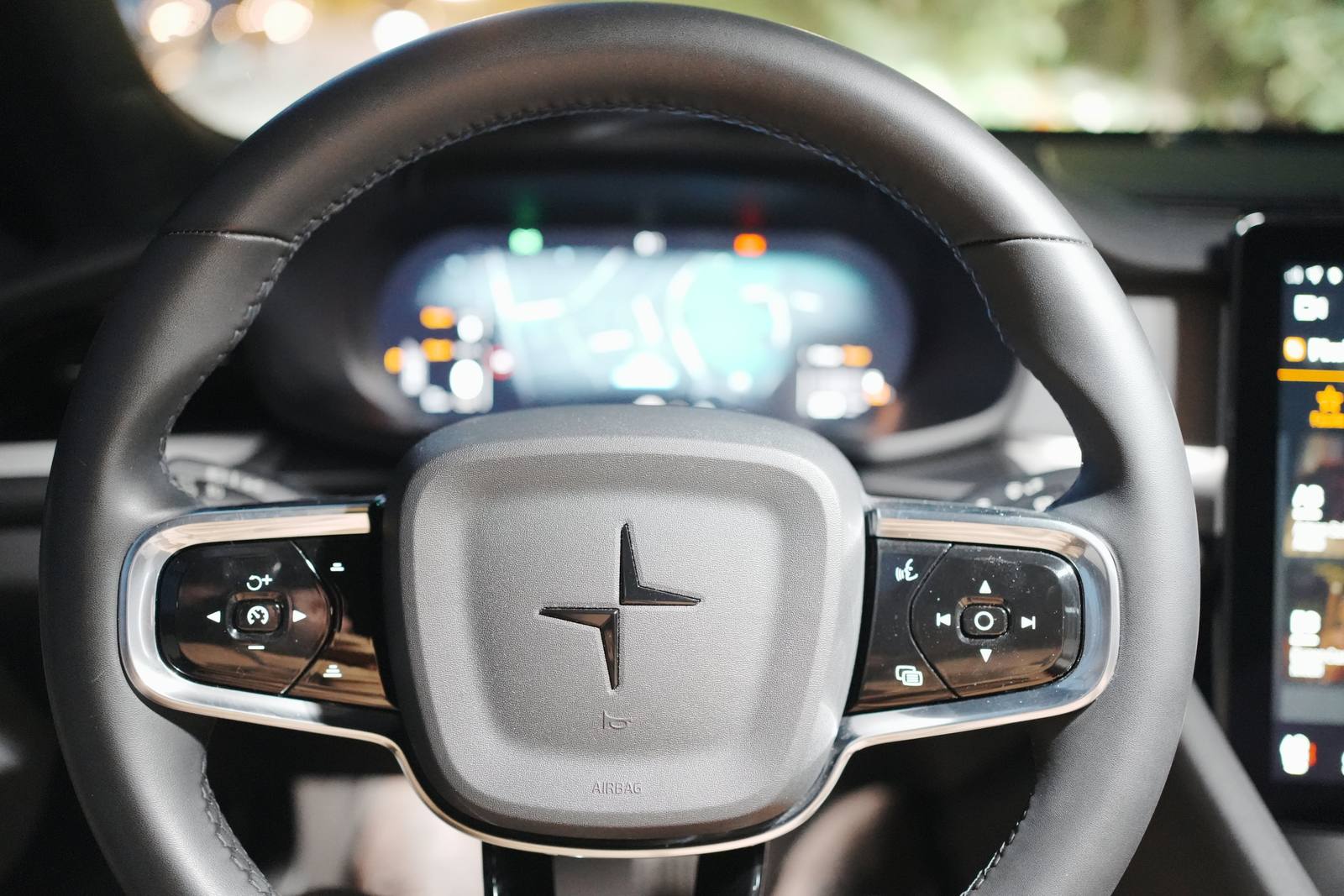
Volume isn't something you look for on the screen: it has its own knob on the console - turn it for volume, press it to pause. Next to it, the hazard lights: a physical, separate button you find without looking.
To be fair: the climate controls live on the screen. But in a bar that is always there, at the bottom - the temperature is one touch away, not in a menu.
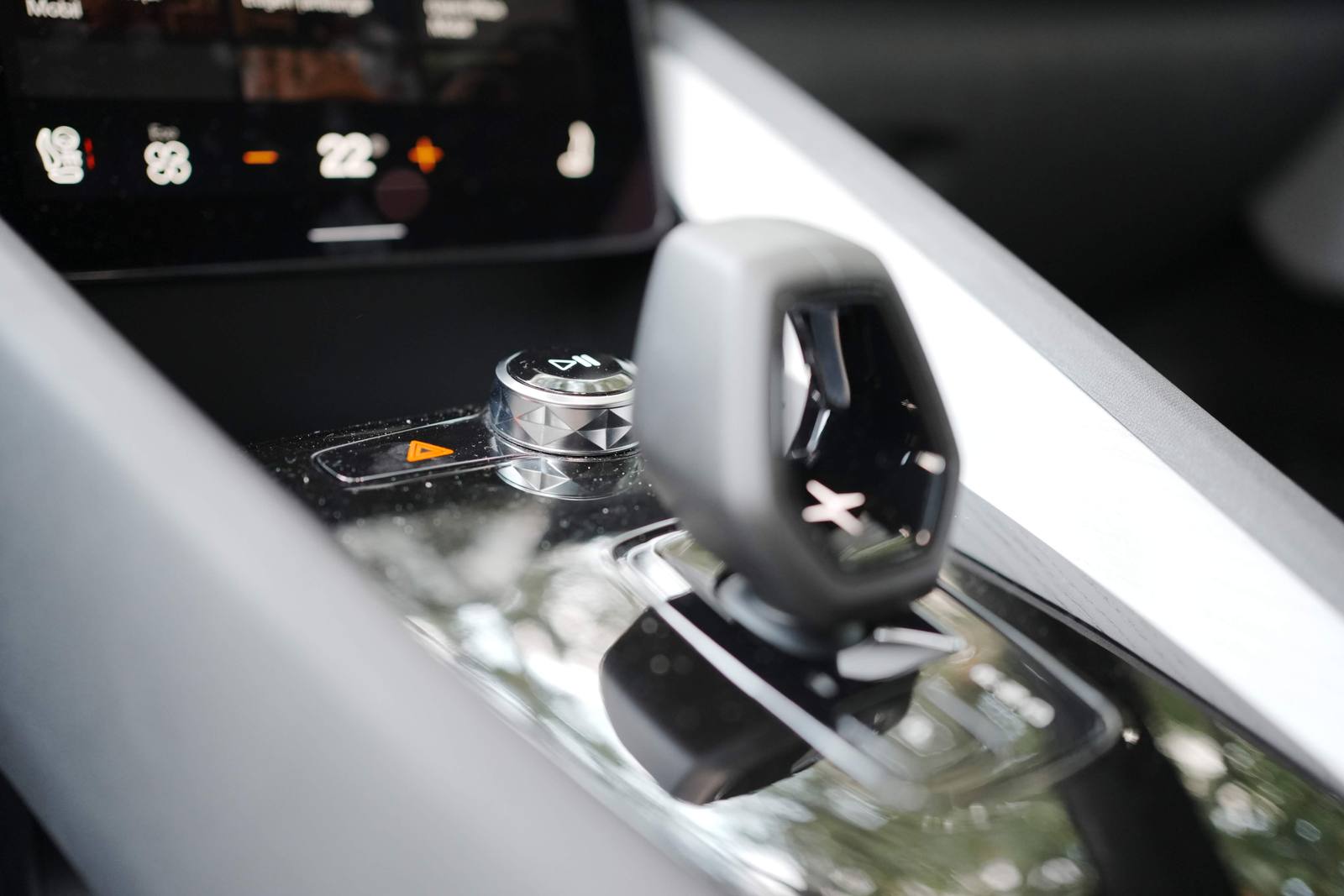
06 · Glovebox and vents
The glovebox opens mechanically, by hand, not through a menu - on the Tesla Model 3 and Model Y, for example, it opens from the screen.
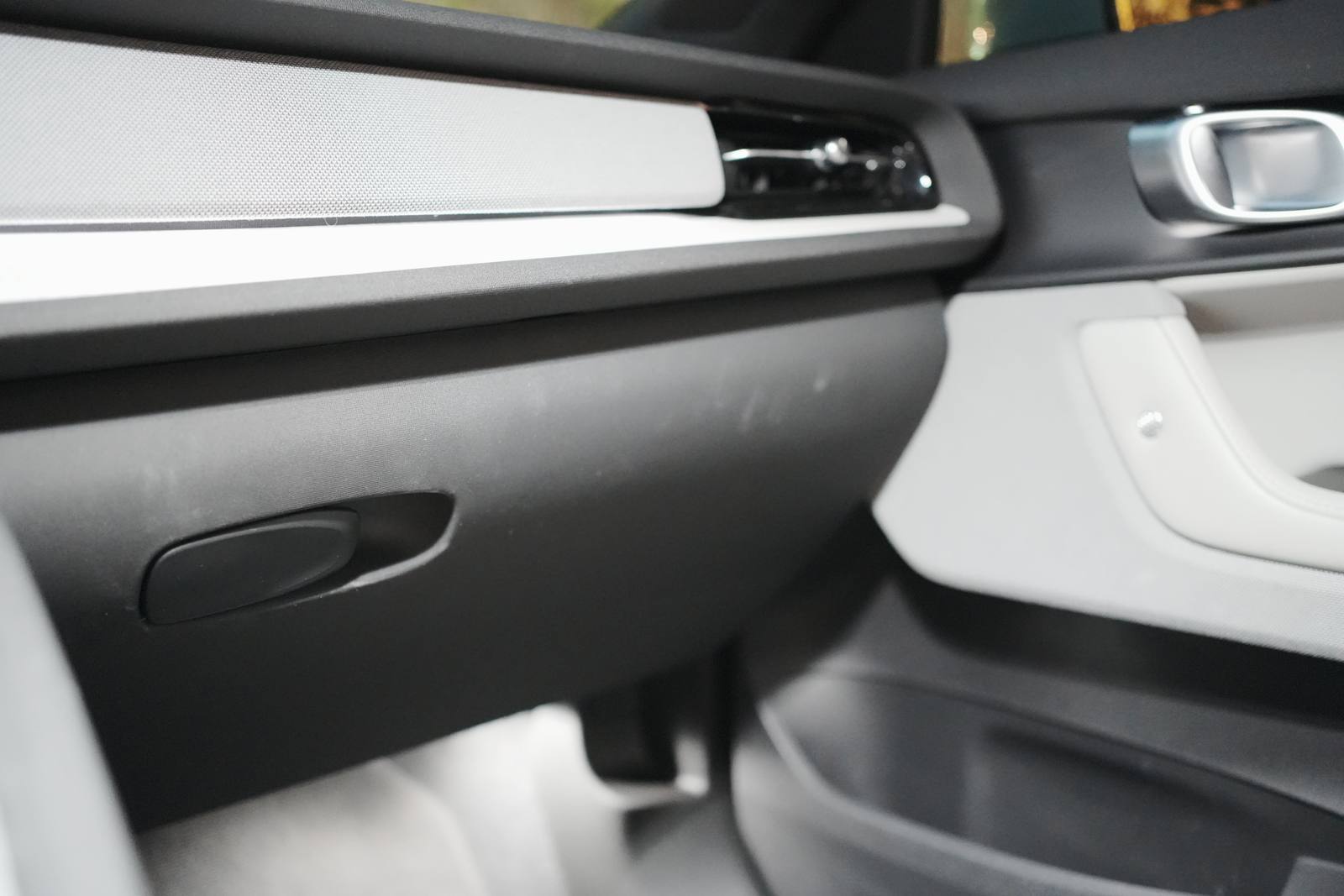
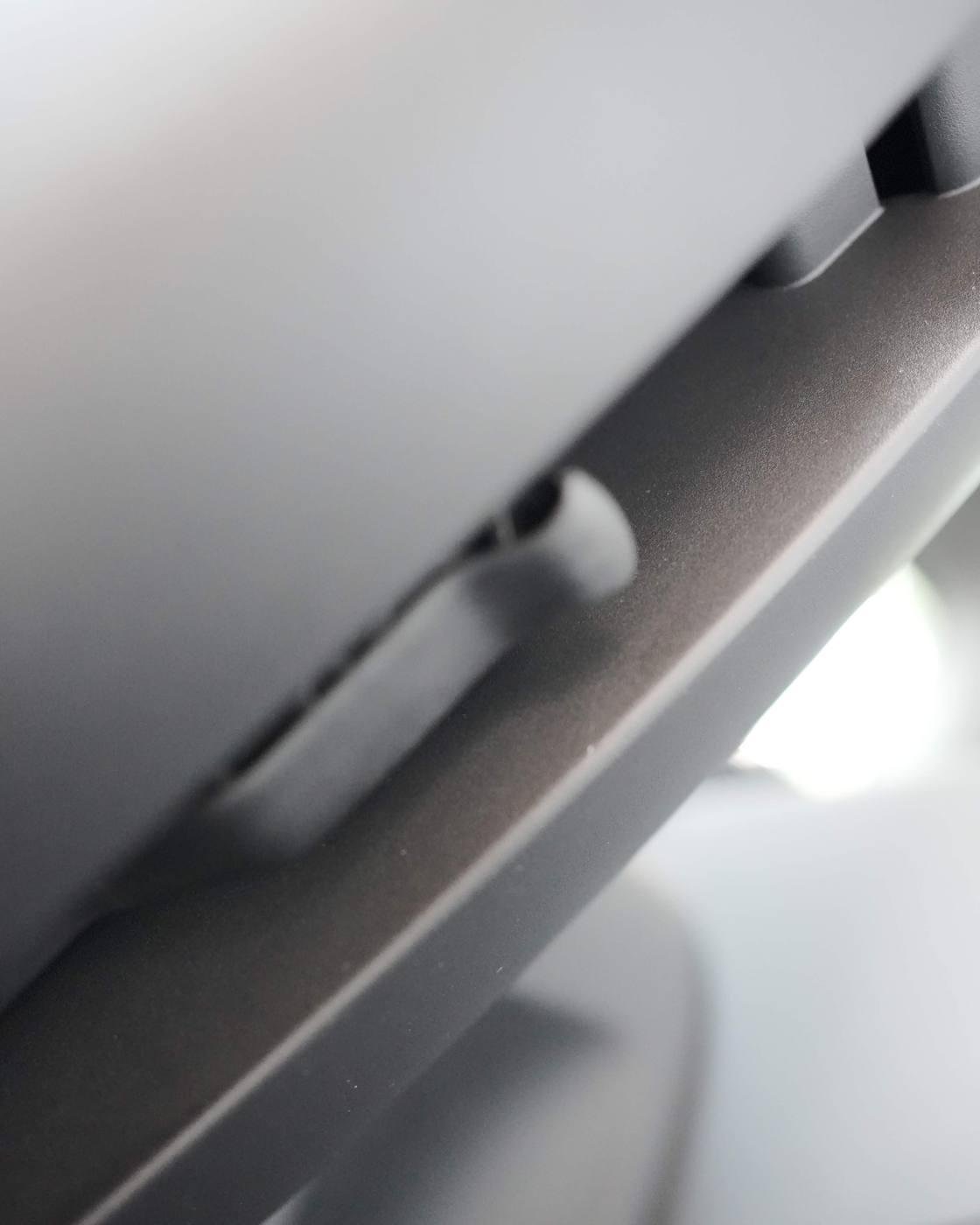
The vents are classic, with their metal knob: you push it with one finger and the air goes where you want.
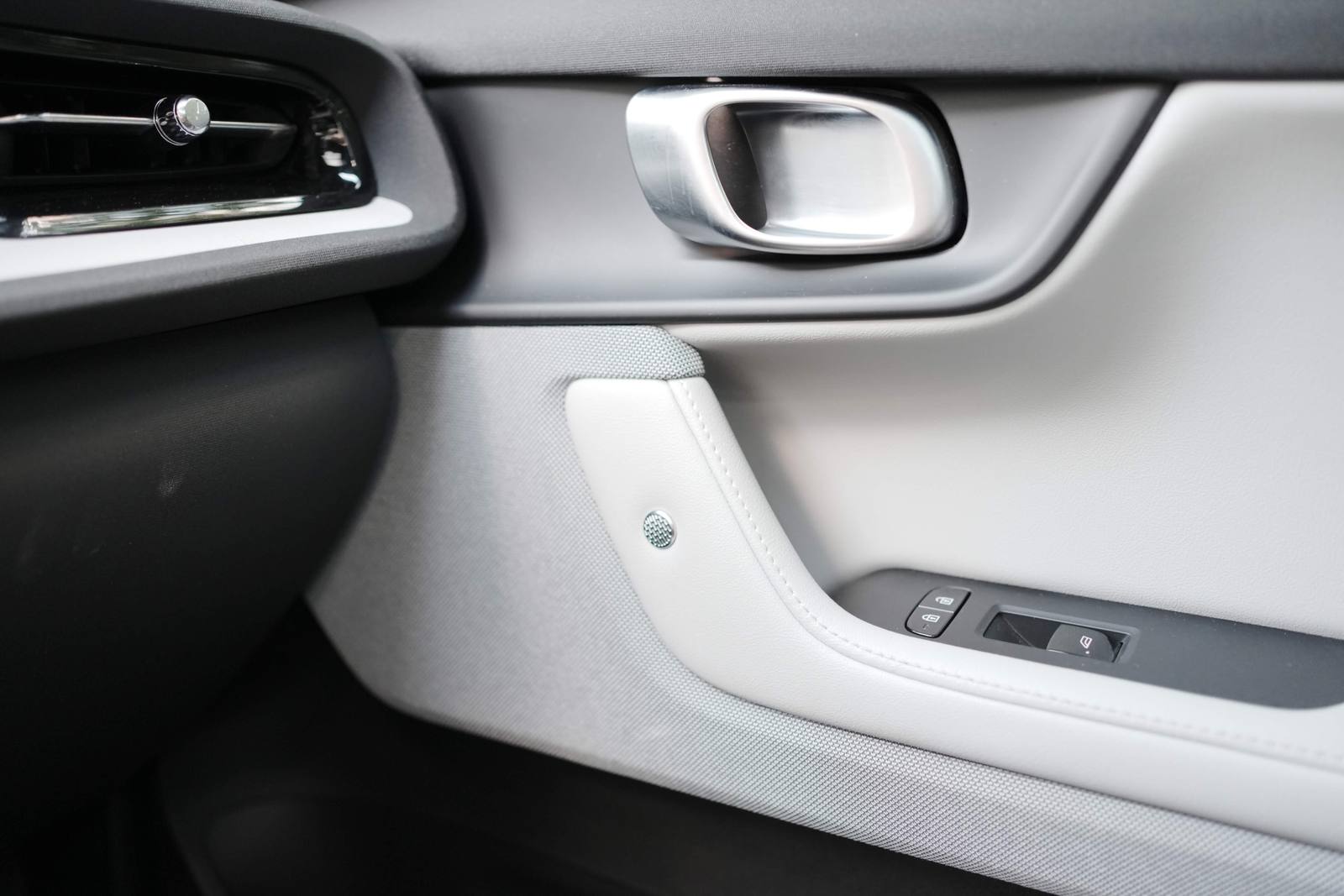
07 · The wipers
Nothing to do with analog, but still something well thought out: the washer nozzles are on the wiper arms, not at the base of the windscreen. The water lands right in front of the blade, so there is no longer that second when the whole windscreen is wet and you can't see a thing.
08 · Getting out
And from the inside, the same: a handle you pull. No electric button to look for and no emergency lever hidden away for the day the power is gone. You don't have to explain to anyone - parents or grandparents - how to get out of the car.
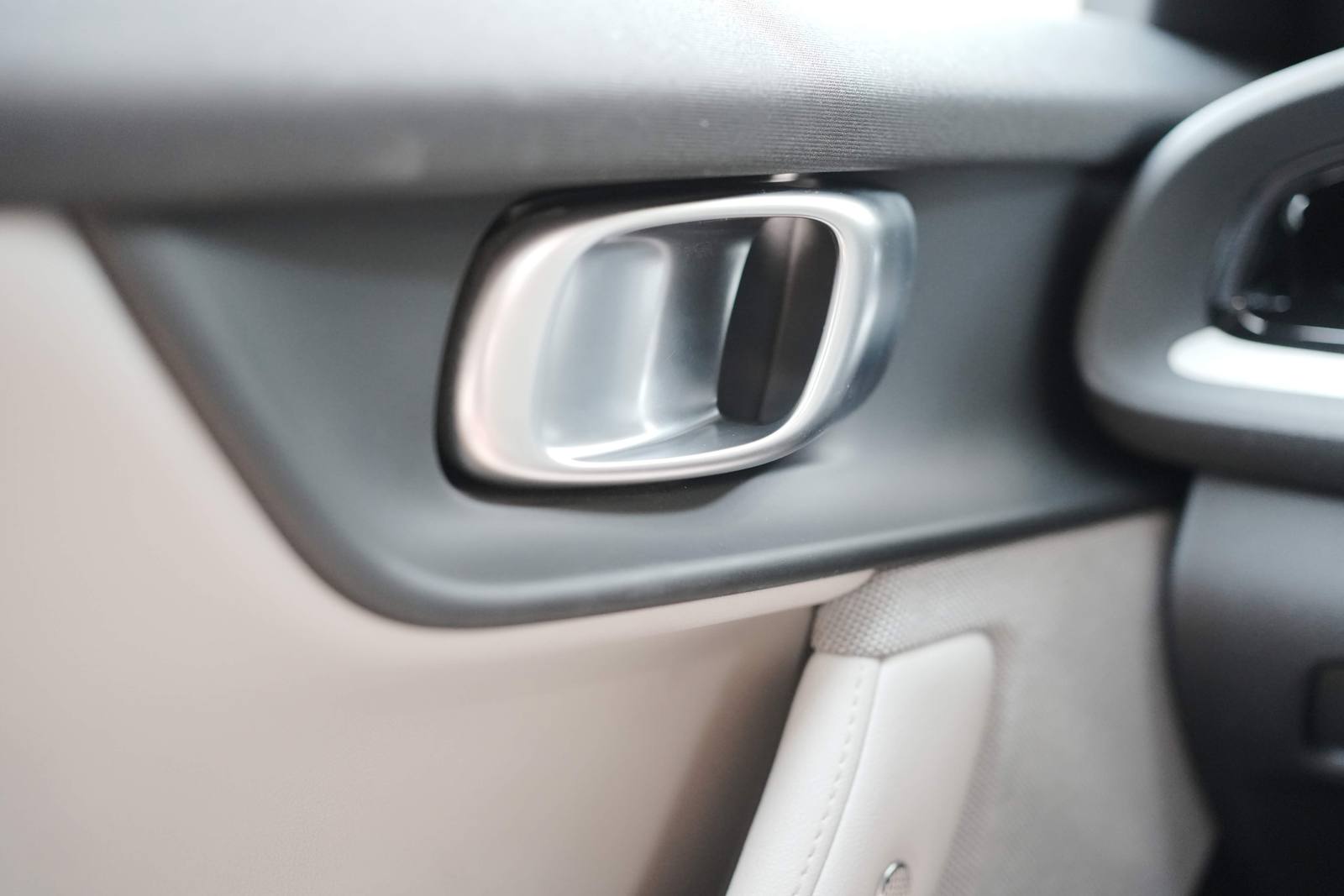
And when you leave, you touch the small recess at the end of the handle and the car locks. It works on all four doors, the rear ones included - no need to walk round to the driver's door.
09 · Not just my taste
I've had 22 cars, so I could put all this down to nostalgia. Except the rules are heading the same way. From 2026, Euro NCAP awards separate points for physical controls of frequently used functions - indicators, selector, hazard lights, horn, the SOS call, wipers - and withholds them if the function sits in a menu more than two steps deep. It's not a condition for the five stars; it's extra credit. On the Polestar 2, all of these are buttons or stalks; the SOS, for example, is a button in the roof.
On door handles, the rule goes all the way to law. In China, from 2027, a new car no longer gets type approval without exterior handles that open mechanically and without a mechanical release on the inside, visible and marked; already-approved models have until 2029. And in the US, in September 2025 NHTSA opened an investigation into the 2021 Tesla Model Y: the electronic exterior handles stopped opening the doors when the 12 V battery ran down, and in four of the first nine complaints people broke a window to get in.
Analog doesn't mean outdated. It means you know what something does before you touch it.
See also: BMW X3 F25 · 27.11.21 · Retrofit - the M shifter, with P on a separate button

A €3 GETAWAY
On National Wine Day, a few hours in nature: the Răut meander, dirt roads and 101 kilometres on less than €3 of electricity.
We set off without much of a plan: a few photos and a few hours in nature. The destination - Furceni, in the Orhei district, where the Răut makes a wide loop between hills with the rock showing through. A small getaway, in the quiet.

01 · The viewpoint
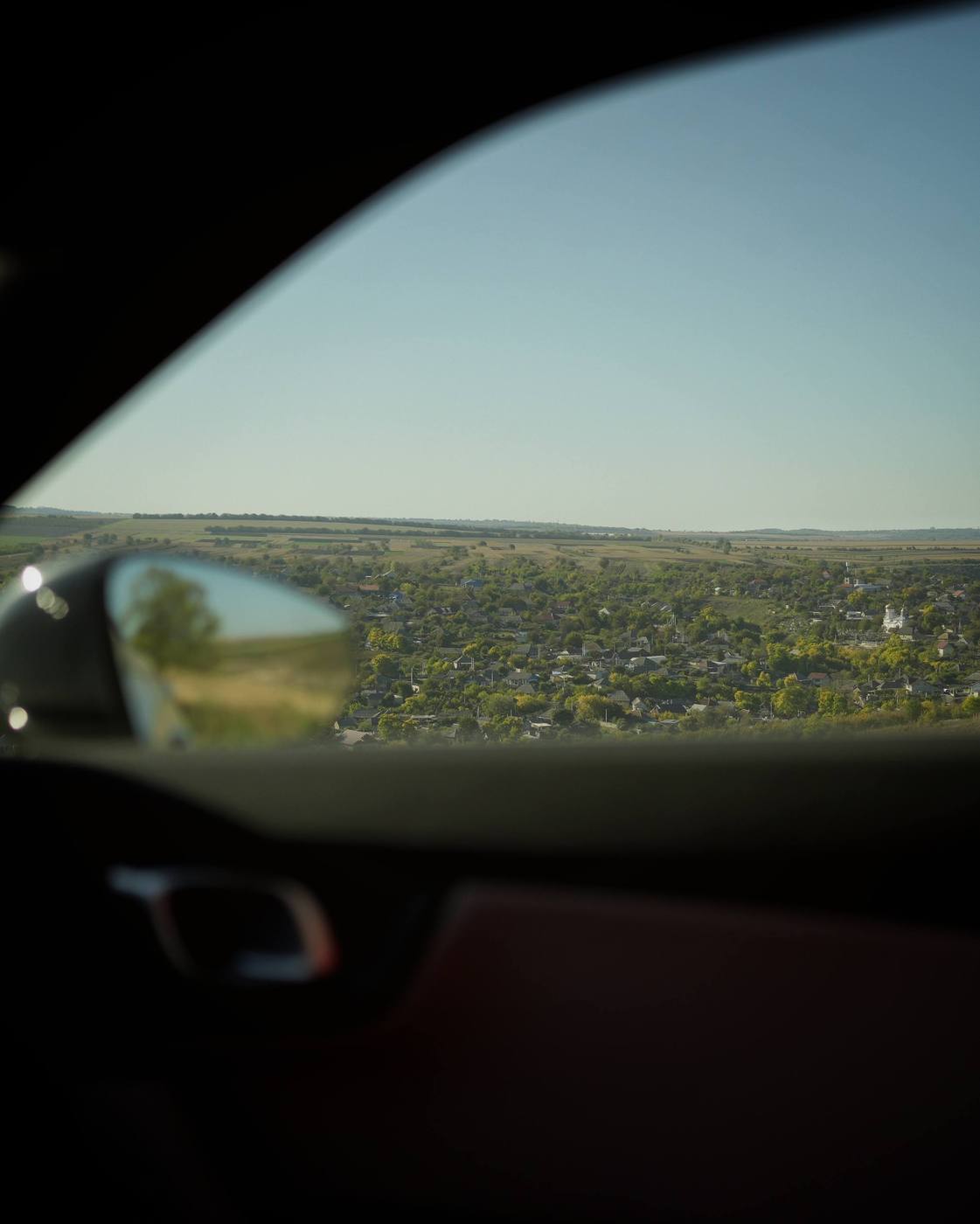
First stop - the viewpoint above the village. From here Furceni lies at your feet, with the Răut valley below and the fields stretching to the horizon.
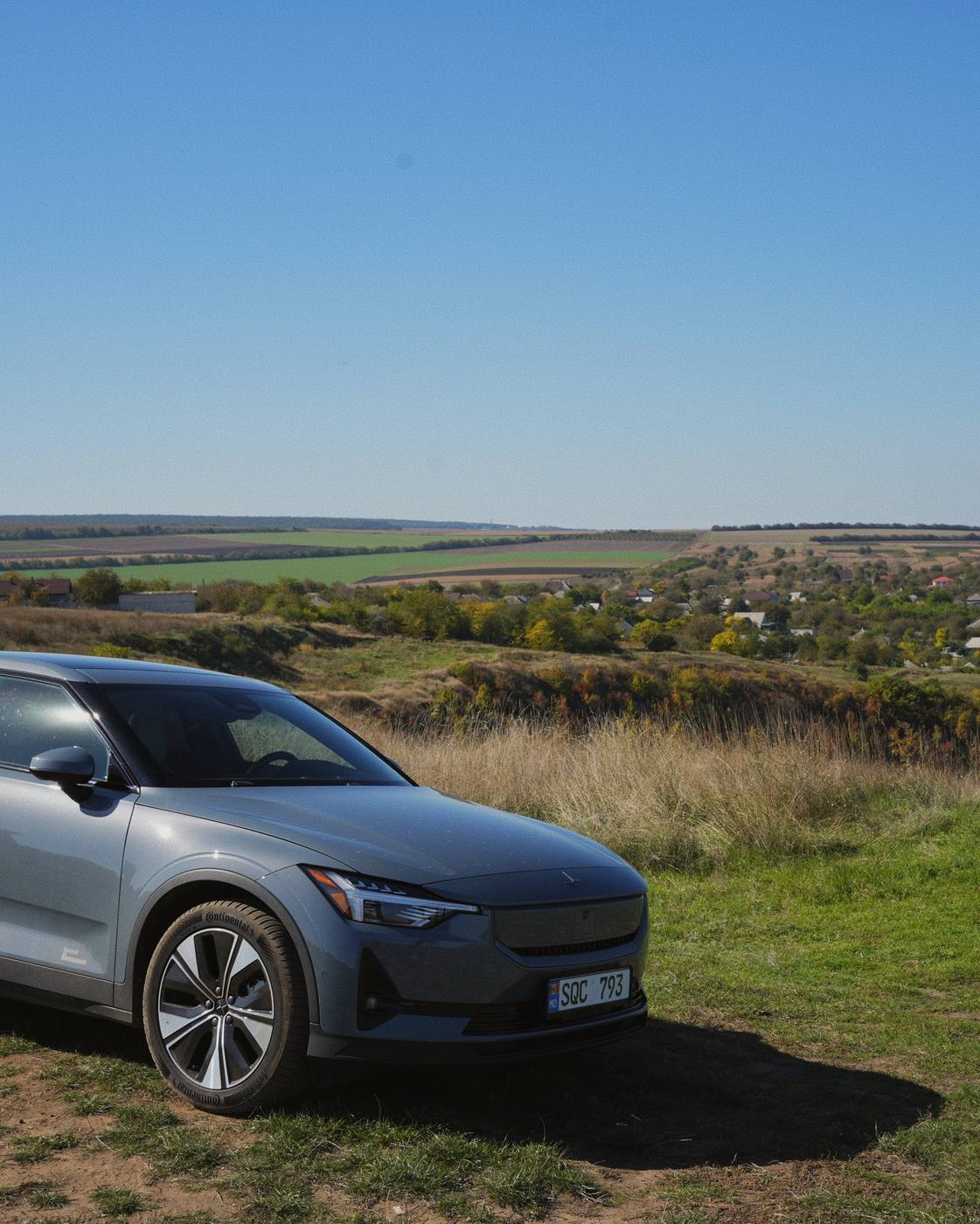

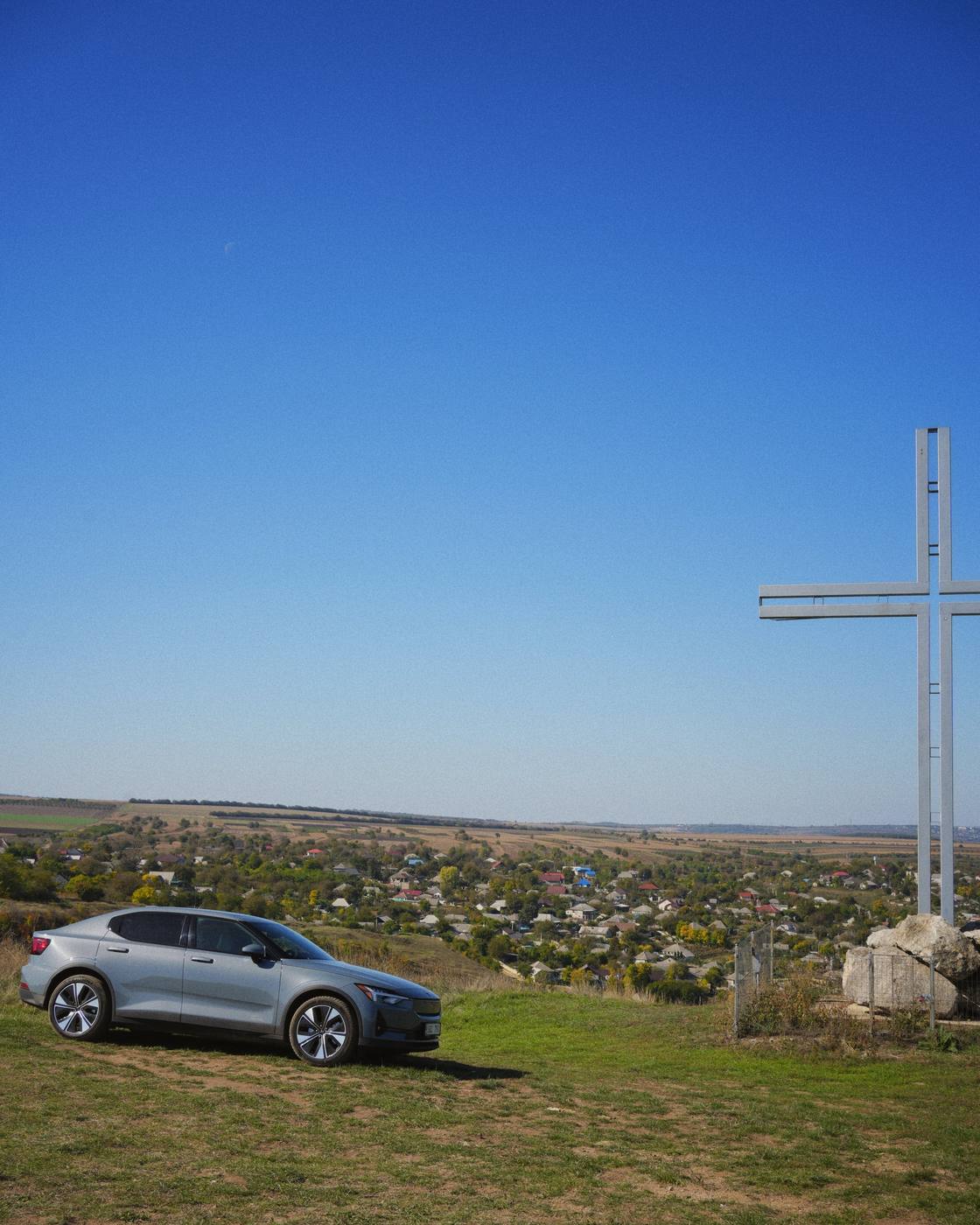

The viewpoint above Furceni
02 · Where the tarmac doesn't go
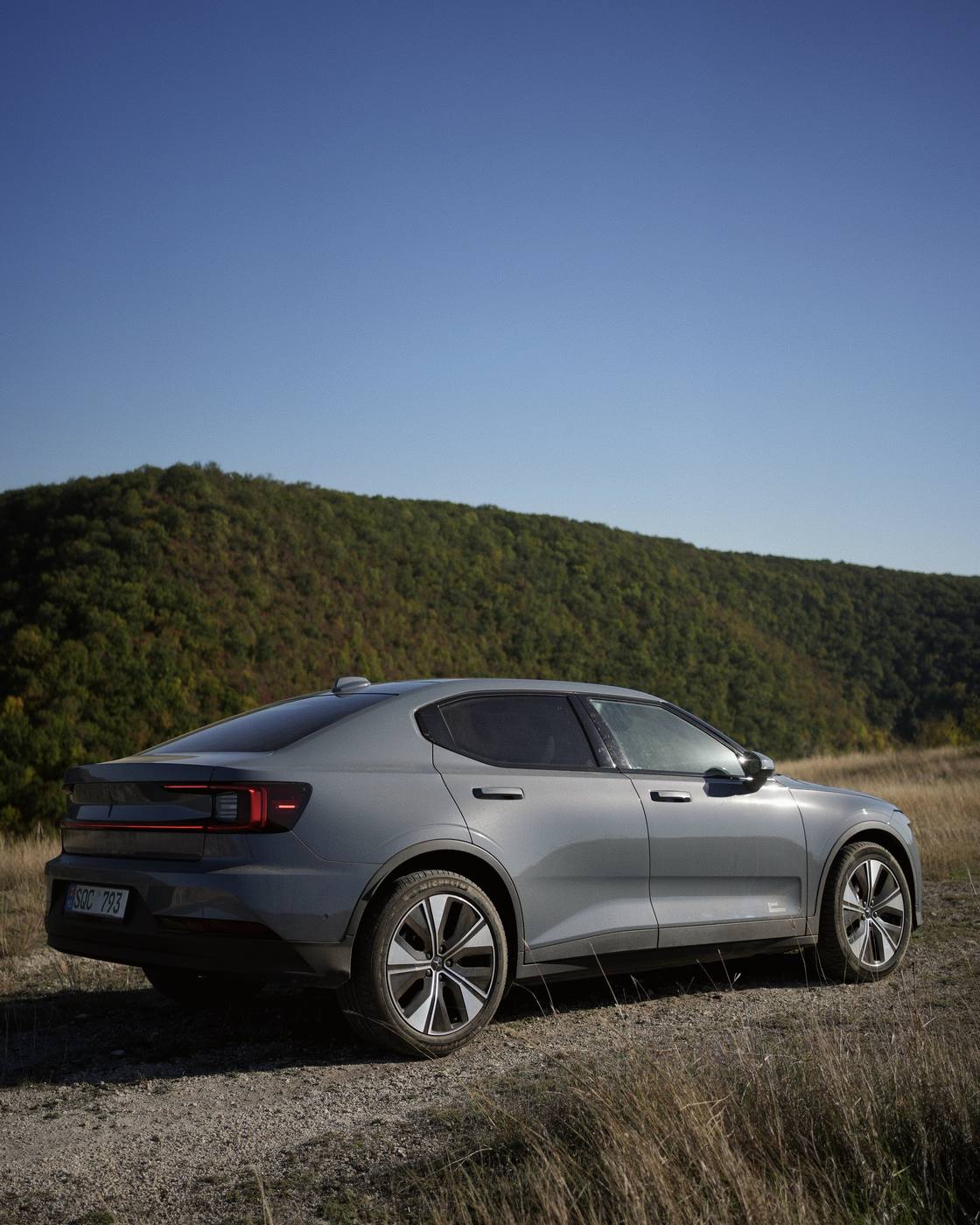
From the viewpoint we went down into the meander, on dirt roads. The ground clearance - higher than a Golf's, as I wrote in the prologue - is enough even for roads that have never seen tarmac. And the all-wheel drive copes well enough even with a wheel in the air: the electronics brake the wheel that spins freely, and the torque goes to the others.
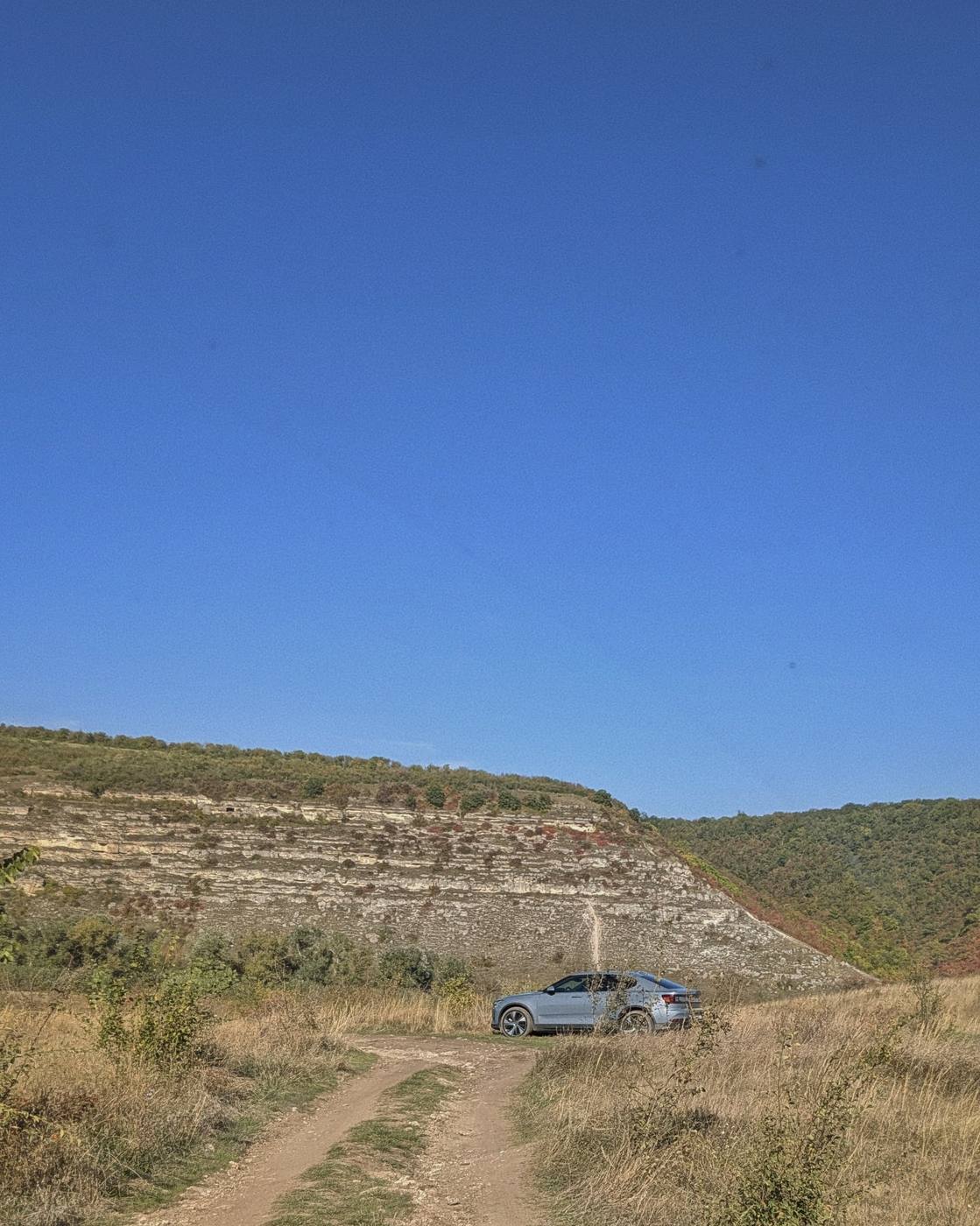
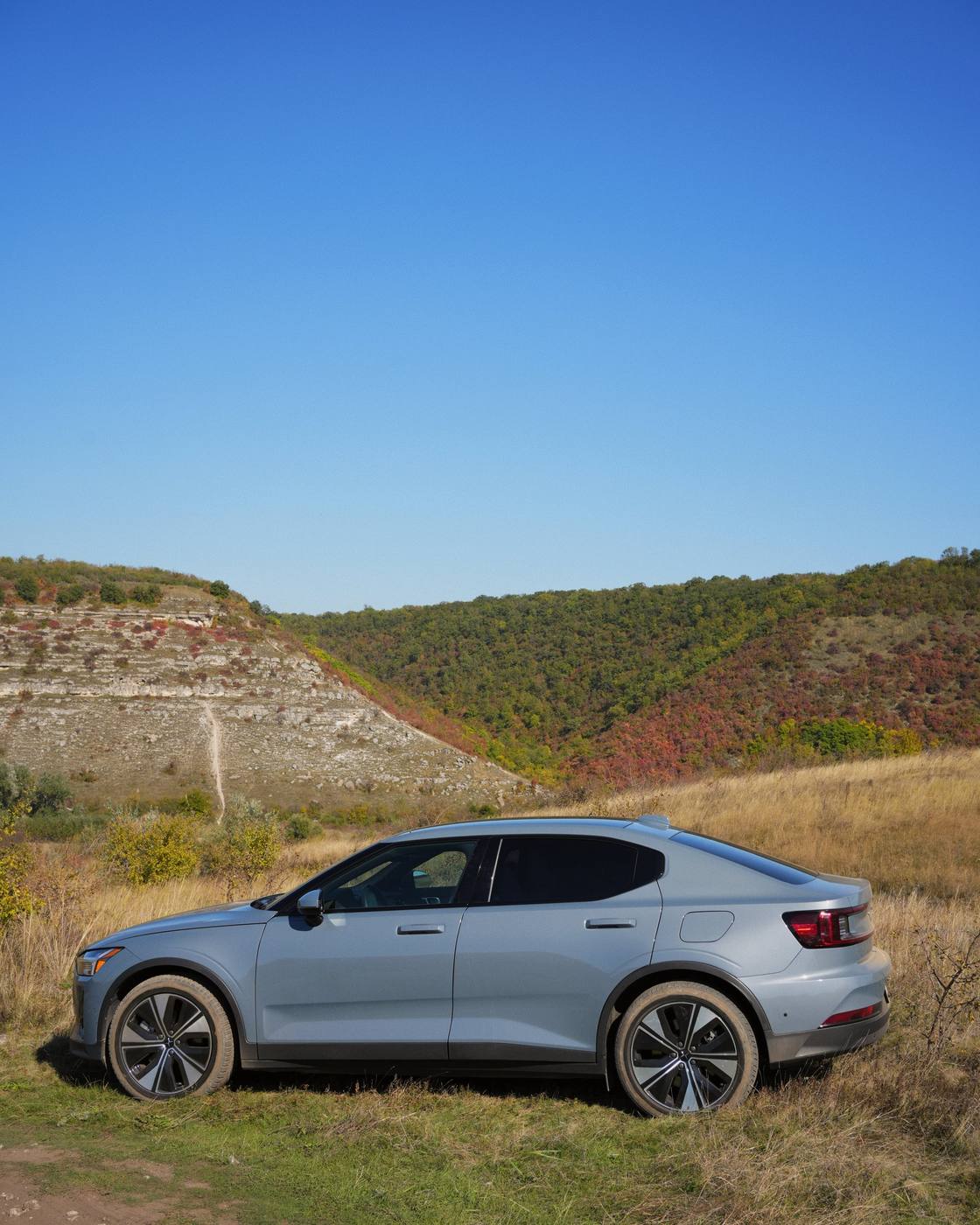
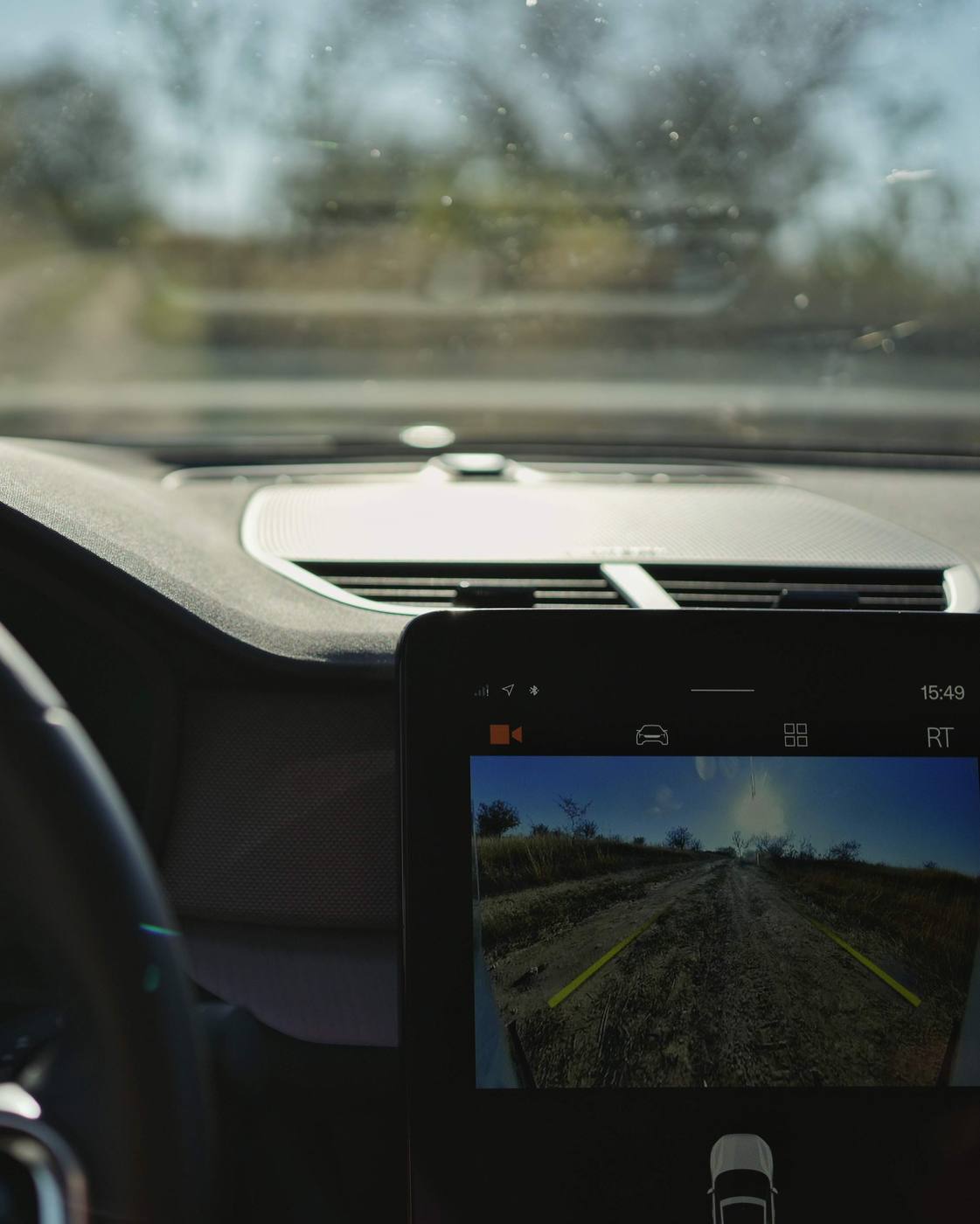
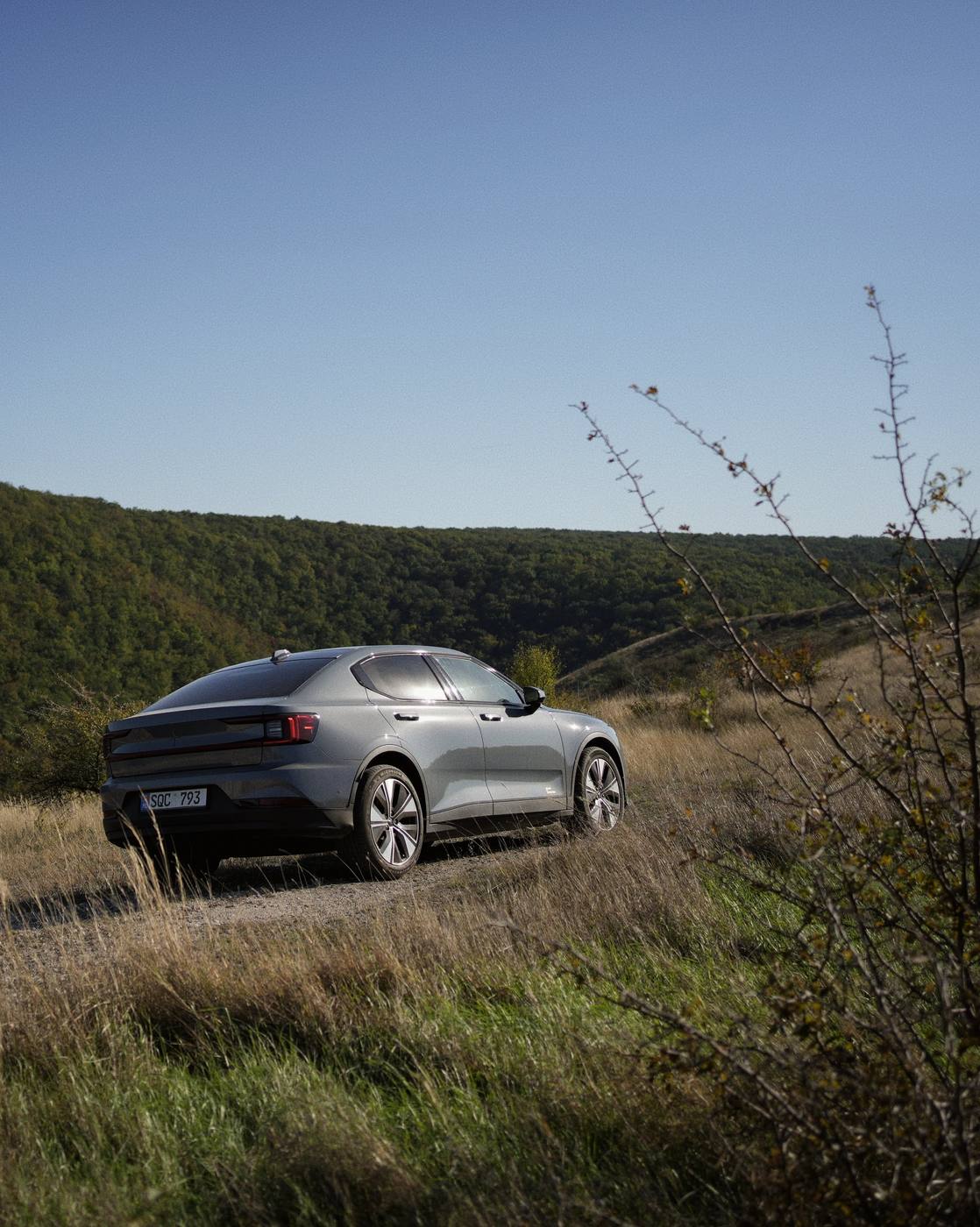
The Răut meander · the dirt roads
03 · National Wine Day
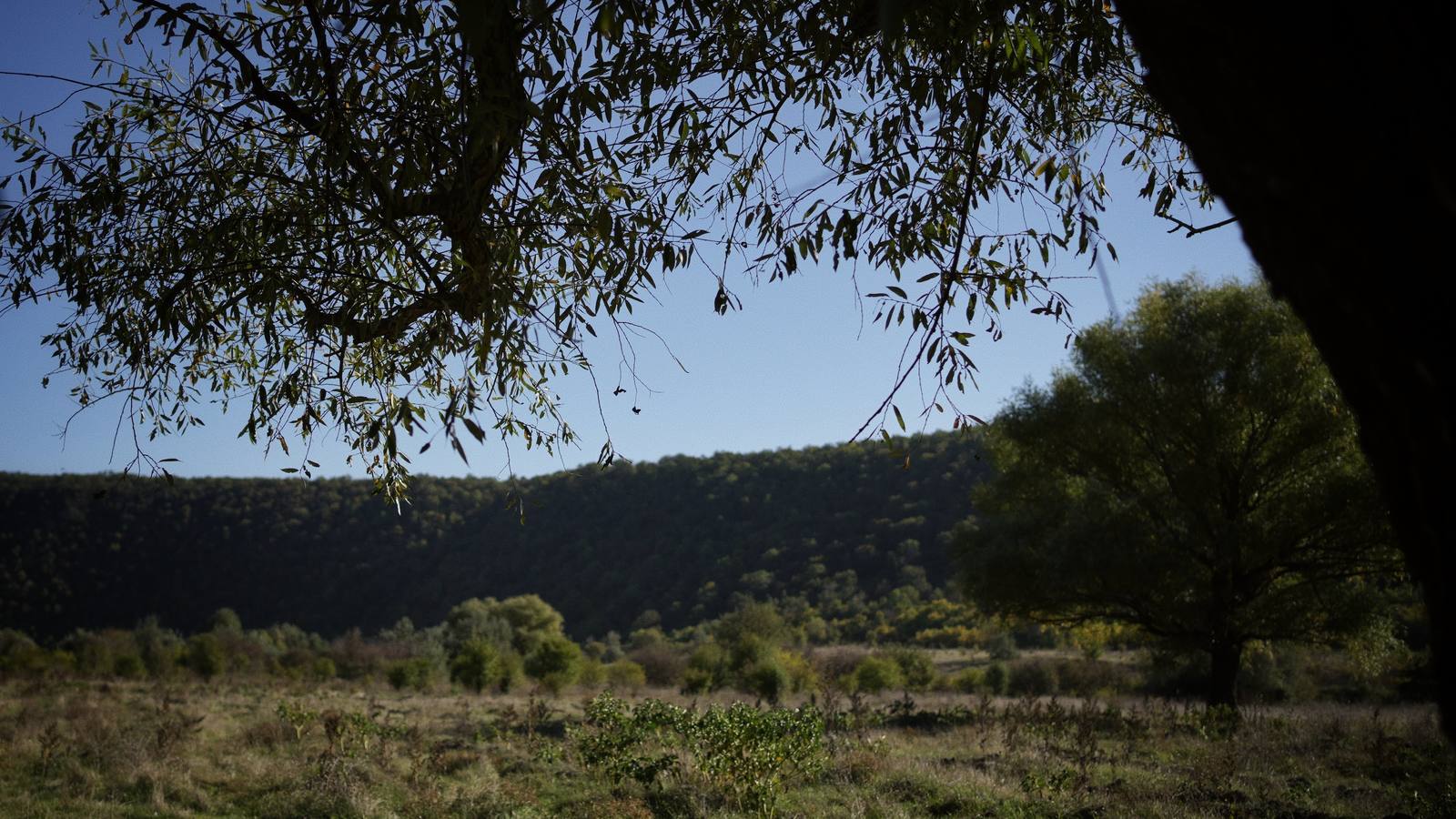
It was National Wine Day, so we took along a bottle of Freedom Blend by Purcari and a glass - just for the photos, in the fork of an old tree. Then only the valley: dry grass, hills starting to turn, and the quiet you go looking for precisely when you leave the city.



The valley · afternoon

04 · Back
Heading home, with one last look over the village and down the tree-lined road.

05 · The consumption
The figure of the day: 15.7 kWh/100 km over 101.2 km, in two and a half hours, averaging 41 km/h. 2 kWh less than at Orheiul Vechi on 08.08, in 29 degrees.
The 41 km/h average doesn't mean it was easy going: around Furceni we drove slowly and carefully. The electric car doesn't mind; a petrol car is the opposite - crawling along makes it drink more than on the open road.
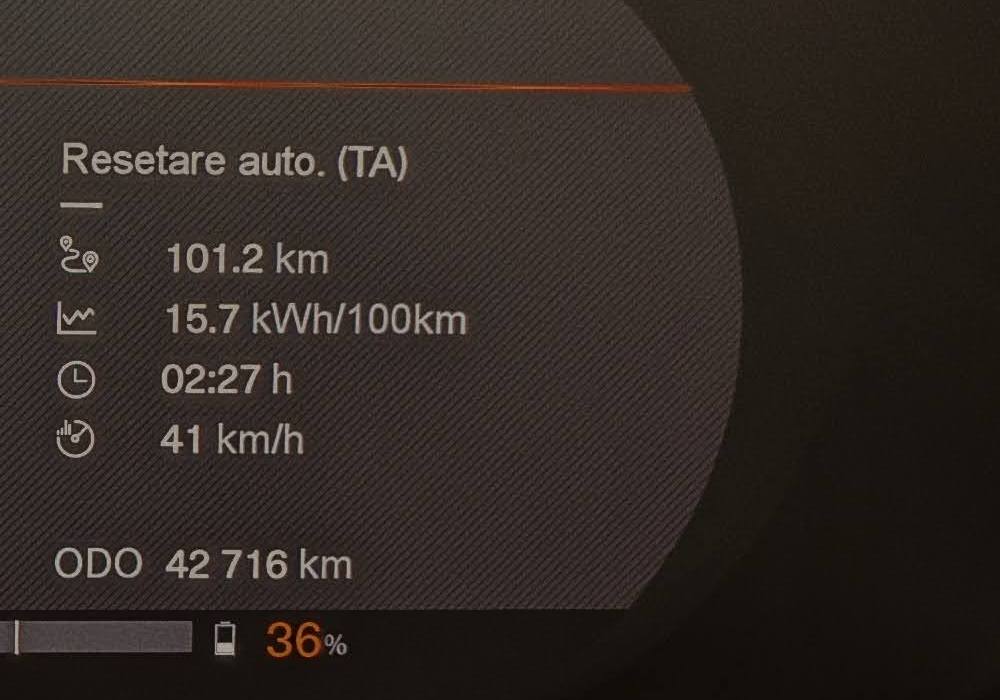
The maths, at the home rate: 15.9 kWh from the battery at 3.56 lei/kWh comes to 57 lei - under €3, in euro at a rate of 20. With the ~6% the wallbox loses, it reaches 60 lei: €3 exactly.
For comparison, the same day in the X3: at least 9.5 l/100 km, what it does on the open road - in reality, more. That's at least 9.6 litres: 329 lei on 95 petrol at 34.27 lei/l, or 371 lei on 98 at 38.60 lei/l, at October prices - €16-19. Five to six times more, and that's the optimistic version.
The cheapest part of the day was the drive.
The garage so far
All of one man's - RT. Not the whole table's. So you know exactly what this dossier compares against.
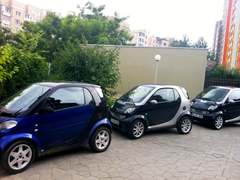 Smart ForTwo 4500.6 petrol
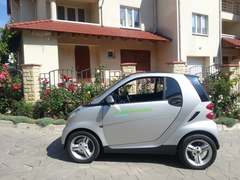 Smart ForTwo 4510.8 diesel
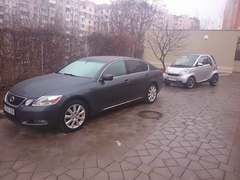 Lexus GS300 AWD3.0 petrol
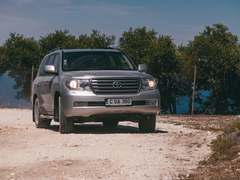 Toyota Land Cruiser 2005.7 petrol
 Honda CR-Z1.5 hybrid
 Mercedes-Benz CLS 350 CDI3.0 diesel
 Mercedes-Benz S 320 CDI3.0 diesel
 Acura RDX2.3 petrol
 Hyundai Ioniq1.6 hybrid
 Opel Insignia OPC2.8 petrol
 Porsche Boxster 987.22.9 petrol
 BMW 525d E392.5 diesel
 BMW 530i E393.0 petrol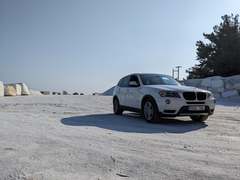
 BMW 318i Touring E301.8 petrol
 BMW 323i E362.5 petrol
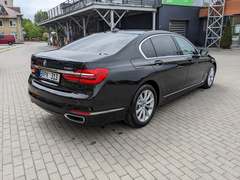 BMW 740Li xDrive G123.0 petrol
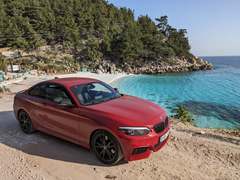 BMW M240i F223.0 petrol
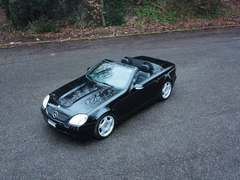 Mercedes-Benz SLK 3203.2 petrol
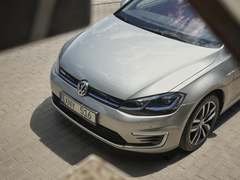 VW e-Golf MK7.5 (2018)electric
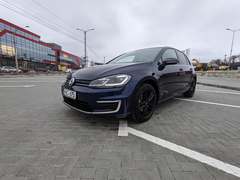 VW e-Golf MK7.5 (2020)electric
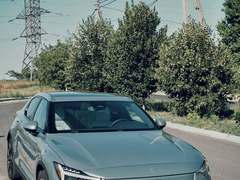 Polestar 2 (2024)310 kW · AWD · now
In time, some will get dossiers of their own - and we will link them from here.
THE MOTORS
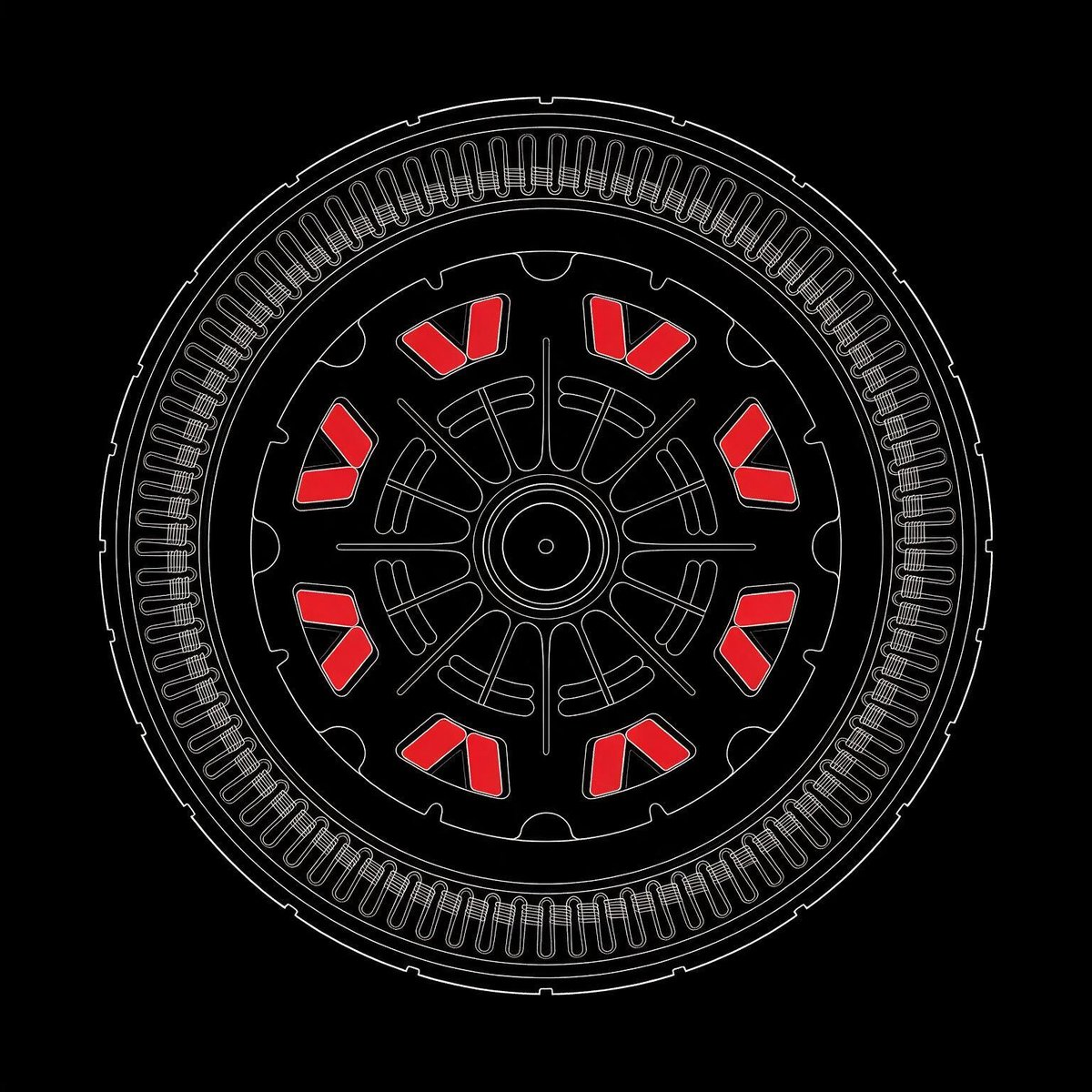
Petrol, diesel, LPG - everyone knows those. In EVs, the difference is not the fuel: it is how the magnetic field is born in the rotor.
With combustion engines, the fuel gives the type its name. In EVs the current is the same for all of them - what separates the families is the answer to a single question: where does the rotor's magnetic field come from? Different answers, different families. And the car in this dossier carries two of them, in the same floor. The profiles under each type: a 1-5 scale, estimated - so you can compare at a glance.
01 · Permanent magnet synchronous - PMSM
The field comes from neodymium magnets embedded in the rotor. It is "free" and permanent - hence the king of efficiency, 95-97%, plus maximum torque from the first second. Which is why it is the industry default: the Polestar 2's rear, the e-Golf, VW ID., Hyundai, Kia - nearly everything on the road today.
The minuses: rare earths are expensive and come almost exclusively from China; and magnets have no off switch - the motor always drags a little, even unpowered. The refined variant: the PMSRM in the Tesla Model 3/Y, at the rear - magnets plus reluctance, the same job with less magnetic material.
02 · Asynchronous, induction - ASM
Zero magnets: the rotor is a "squirrel cage" of conductive bars, and its field is induced by the stator on the fly. Cheap in materials, nearly indestructible, heat-tolerant. And with the great trick: unpowered, it spins freely, with no braking drag - which makes it the ideal secondary motor, sleeping until called.
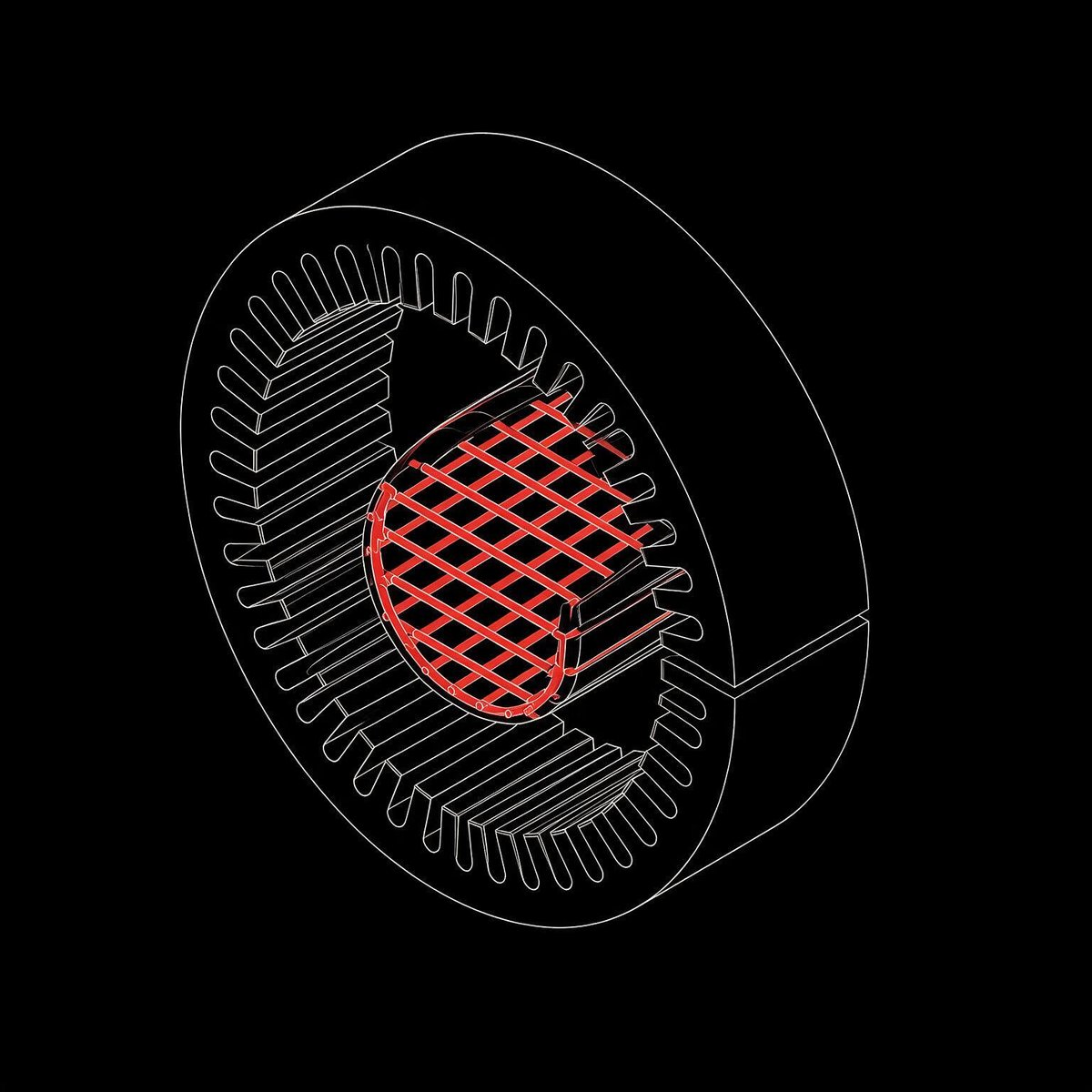
The minus: lower efficiency (~90-93%) and more bulk. The examples tell the strategy: the Polestar 2's front, the front of the Tesla 3/Y, the Audi e-tron - and, historically, the original Tesla Model S/X, entirely.
03 · Externally excited synchronous - EESM
The engineer's compromise: the rotor carries coils instead of magnets, and the field is made from current - adjustable in real time. Zero rare earths, excellent efficiency at higher speeds (BMW claims up to 4% over PMSM in certain conditions), controllable coasting drag.
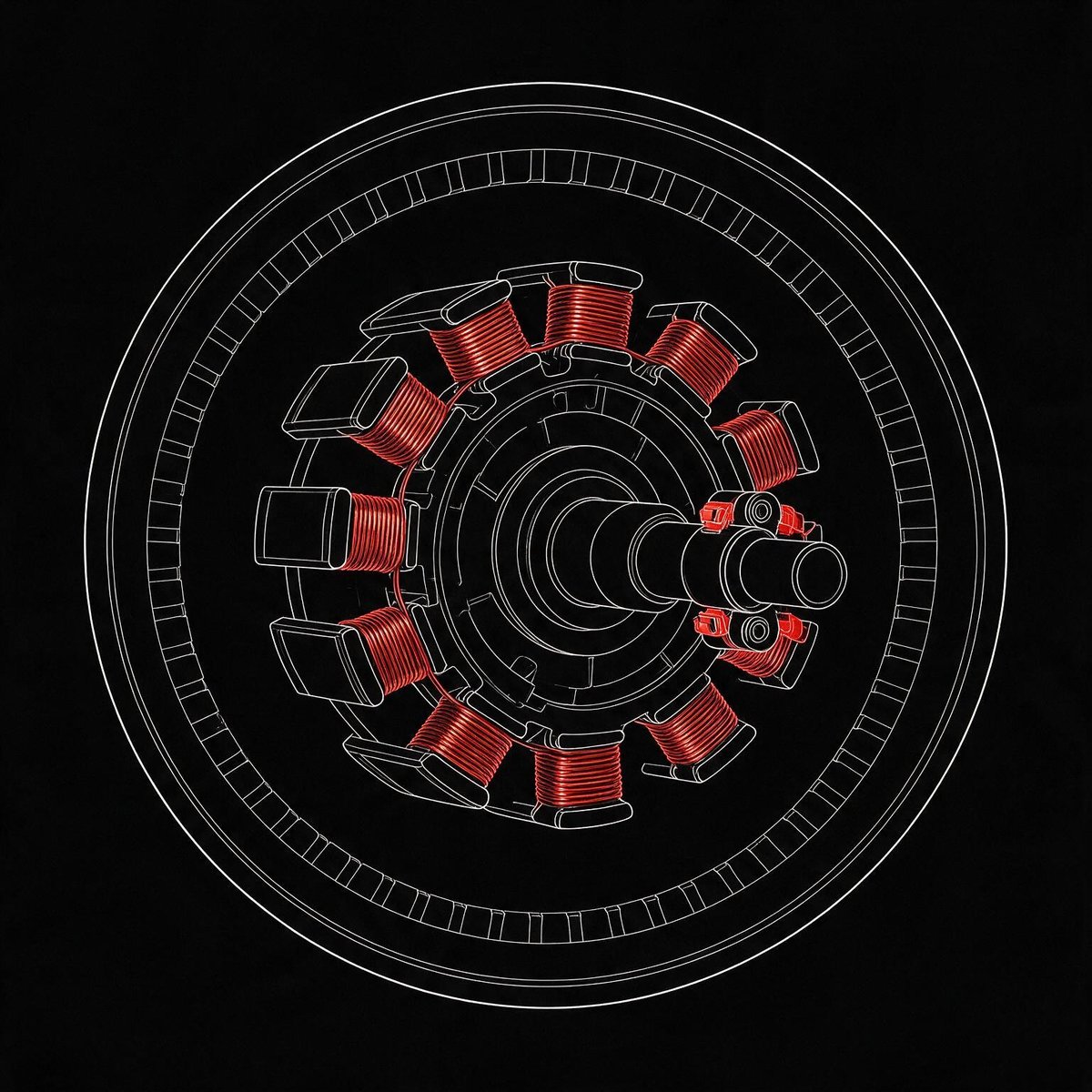
The price: complexity - the current has to be delivered into a spinning rotor, through brushes and rings - which wear. The only type here with real periodic maintenance. Who uses it: BMW i4/i5/i7/iX - the entire fifth-generation eDrive, the Renault Zoe and Megane.
04 · Axial flux - the exotics
Everything above is a cylinder. These are discs: the field works along the axle, and the motor becomes a thin "pancake" with enormous power density. Expensive and rare for now - YASA (bought by Mercedes for AMG), Ferrari's hybrids. Worth watching: it is where the next decade's power comes from.
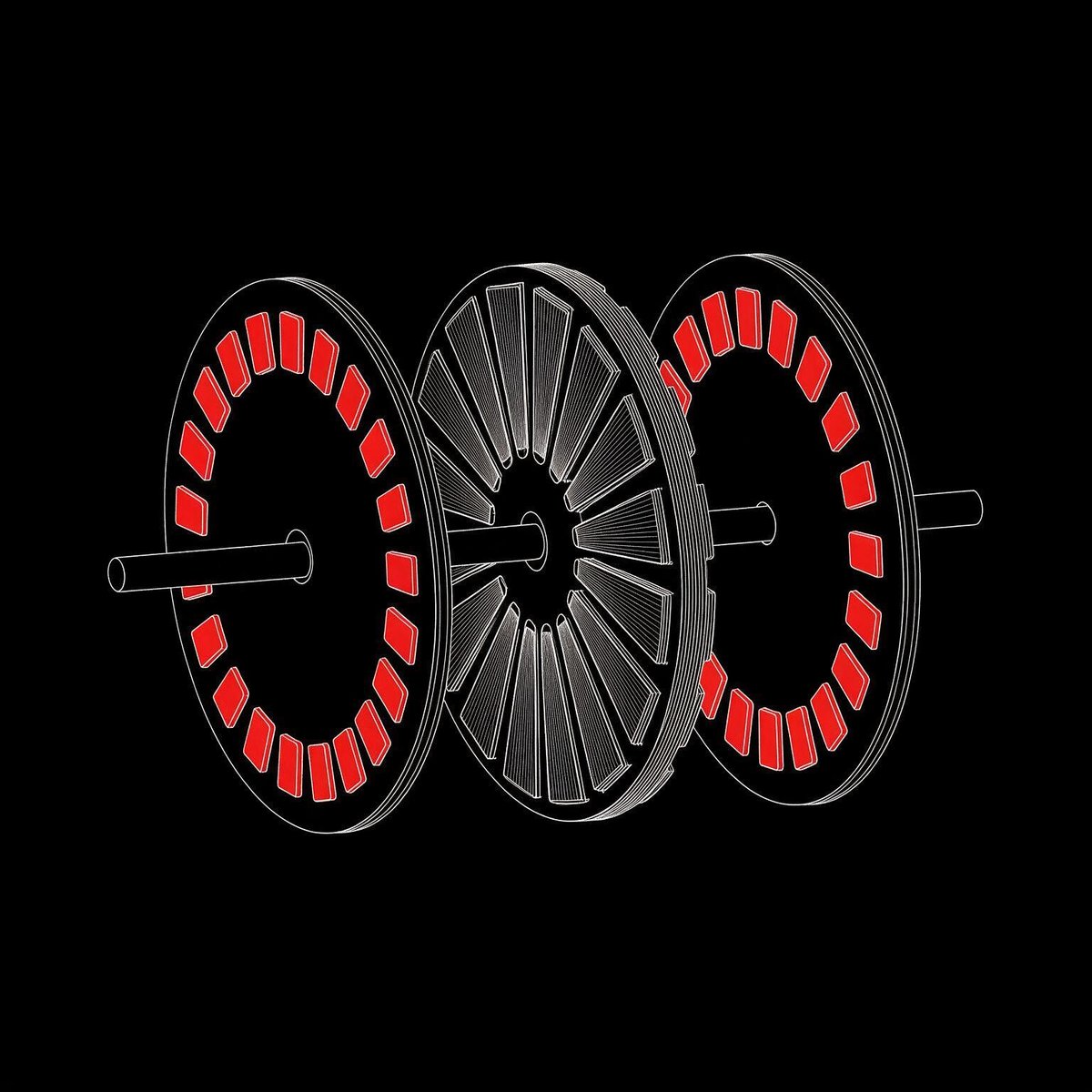
And the map by car - who chose what:
| Car | Front | Rear | Worth knowing |
|---|---|---|---|
| Polestar 2 (2024) | ASM · decouples | PMSM · SiC | front sleeps, rear pulls - the efficiency recipe |
| Tesla Model 3 / Y | ASM | PMSRM | same recipe; took SiC to series production in 2017 |
| VW e-Golf | PMSM | - | one motor, simplicity embodied |
| BMW i4 · i5 · iX | EESM (xDrive) | EESM | zero rare earths; the brushes want maintenance |
| Renault Megane E-Tech | EESM | - | wound rotor, no magnets |
| Hyundai Ioniq 5 · Kia EV6 | PMSM · decouples | PMSM | magnets up front too, but with a mechanical disconnect |
| Audi e-tron (2019-23) | ASM | ASM | zero magnets, robust and thirsty; the seal that lets coolant into the motor |
| Jaguar I-Pace | PMSM | PMSM | always engaged - drag on both axles |
| Porsche Taycan | PMSM | PMSM · 2 gears | 800V, hairpin winding - the performance extreme |
Dual Motor / AWD configurations · for single-motor cars the second column stays empty
See also: BMW X3 F25 · Annex · xDrive against the rest - how a single-engine car splits its torque
05 · The parts that do not exist
And the curiosity this annex should have opened with: the electric motor is practically eternal. It has around twenty moving parts - a combustion drivetrain has hundreds, many rubbing against each other, in oil that ages. A rotor, bearings, a single-speed reduction gear - that is about everything that moves.
Engine oil. Oil filter. Spark plugs. Ignition coils. Timing belt or chain. Water pump. Fuel pump. Injectors. Turbocharger. Clutch. Flywheel. Gearbox. EGR. DPF. Catalytic converter. Exhaust.
Every line above is a bill that will never arrive.
What that looks like in money - the total cost of the powertrain: the motor's maintenance plus what you feed it. The garage assumptions, in the open. Maintenance: an oil-and-filters service every 8,000 km on petrol (~€120) and 12,000 km on diesel (~€140), plus each engine's scheduled items. Fuel, at Chișinău prices, August 2026: petrol 95 at 30.12 lei/l, diesel at 31.98 lei/l, home electricity at 3.56 lei/kWh - in euro at a rate of 20. Consumption: 10 l petrol, 8 l diesel, 20 kWh electric per 100 km (realistic - my own counter sits under 19). Per hundred, that is ~301 lei · ~256 lei · ~71 lei. Cumulative:
Solid segment: fuel · faded segment: motor maintenance · the value: the total
Motor + fuel, cumulative · Aug 2026 prices · garage estimates, not quotes
At 300,000 kilometres, the gap between electric and petrol is the price of a good car: ~€42,000. And there is one more difference - of kind, not of price - for those who will rightly say electricity can get more expensive too: electricity is the only fuel you can produce yourself. Panels on the roof, a storage battery, a solar carport - and your price at the "pump" becomes your own. When prices rise, the filling station answers with its display; you can answer with your roof.
Where the curves come from: on petrol, oil alone means 38 trips to the workshop by 300,000; on top come spark plugs every 60,000 and the timing belt with water pump every 100,000 (€600-800). On diesel the services are rarer but pricier, and old age brings the trio that hurts: the EGR, the DPF (~€1,200) and the injectors (~€1,600). And the electric row is empty because there is no maintenance schedule for the motor - on some models, a single reduction-gear oil change, once in the car's life, and that is all.
Honest to the end: the whole car is not free - brakes, tyres and suspension exist on all three, the battery coolant has its own change around 200,000+, and the battery itself is another subject - big enough to deserve its own annex. But the motor itself? The motor never shows up in the maintenance budget. At all. The measurements confirm it at scale: Consumer Reports found lifetime maintenance costs cut in half for EVs, and the US Department of Energy puts them at ~60% of a combustion car's per-kilometre cost.
See also: BMW X3 F25 · Annex · N52 - the list: what really got replaced by 271,000 km
06 · Winter and short trips
One more underrated consequence of simplicity: winter. The electric motor has no operating temperature - you get in and go, with full power available from the first hundred metres. On a combustion car the constraint is real even if it is no longer visible: nobody idles to warm up any more, but until the oil reaches temperature, any serious push means wear - and anyone who respects their engine drives gently for the first kilometres.
Then the comfort half: preconditioning. Scheduled or started from the app - the cabin waits for you warm, the windows defrosted, with no engine running. A combustion car "warming up" outside the house burns fuel standing still; the EV does it from the socket. And, since there is no exhaust, it can do it inside a closed garage - no carbon monoxide.
And short trips, 10-20 kilometres around town, are the test where combustion loses ugliest. A modern, efficient diesel often never even reaches operating temperature on such a winter run - and the DPF from the previous section clogs precisely in this regime, then demands long regeneration drives. A petrol engine gets to temperature, but spends half the route below it, where most of the wear happens. The EV shines exactly on the trips we make most often - home to work, to the shops, to family.
What the EV pays in winter is something else: range - the cold hits the battery, not the motor. But that is a battery discussion, and it gets its own annex.
Which leaves the ten-second test: what combustion car lets you get in at -10°C, close the door, buckle up, put it in Drive and calmly go - in under ten seconds?
07 · Depreciation - the argument, reversed
And the objection heard most often: "EVs depreciate faster." True - especially the premium ones, which lose more in their first years than comparable combustion cars. Except this argument contains its own opposite: depreciation is the problem of whoever buys new - and the discount of whoever buys next. At 2-4 years old, a good EV often sells at half price; the car in this dossier - at under a third, with the battery at 93%.
And that is where the buy-back begins: you buy at the point where someone else has already paid the fall, then you collect the savings from the chart above. Versus petrol, the gap is ~230 lei per hundred kilometres on fuel alone - at 20,000 km a year, ~€2,300 a year left in your pocket, before counting the maintenance that does not exist. Within a few years of normal use, an EV bought at half price has paid a good part of itself back. You do not buy it - you redeem it by driving it.
Honest here too: depreciation hurts only if you play the wrong side of it - buying new and selling at 2-3 years. Whoever buys the fall and keeps the car collects both ends: the low entry price and the low cost per kilometre. This dossier is, at bottom, that exact experiment, documented in real time.
08 · Glossary: the silicon-carbide inverter
The term appears in the prologue, under The drivetrain - here it is in short. The inverter is the power electronics between the battery and the motor: the battery gives direct current, the motor wants finely dosed three-phase alternating current, in real time - engine speed and torque depend on it. The conversion happens by "chopping" the current tens of thousands of times per second through power transistors. In practice, the pedal talks to the inverter, and the inverter talks to the motor.
Classic transistors are silicon. The ones made of silicon carbide (SiC) - a crystal of silicon and carbon - switch much faster, lose less energy as heat with every switch, and tolerate higher temperatures, so they need less cooling. The net gain: a few percent of efficiency, especially at low loads - which is exactly city driving. A switch that does not heat up when you flip it: the energy that used to be lost as heat becomes kilometres. Tesla took it to series production with the Model 3 in 2017; today it is the badge of the efficient generation - and one of the reasons the facelift gained range without a dramatically bigger battery.
And the lesson applied, on the car in this dossier: the Polestar 2 Dual Motor carries two motor families at once - PMSM at the rear for efficiency and the base drive, ASM at the front, decouplable, for the snowy days. The same recipe as the Tesla 3/Y. In one sentence: the synchronous pulls, the asynchronous sleeps until called.
The dossier stays open. The rest is written with each day.
← All dossiers